
The primary goal of no-code and low-code platforms is to make the building process of software simpler and faster. These tools have been designed to minimize the necessity of extensive coding knowledge by making it quite easy for users to build applications with limited technical knowledge.
Right now, I am going to take you through the difference between No-code and Low-code platforms.
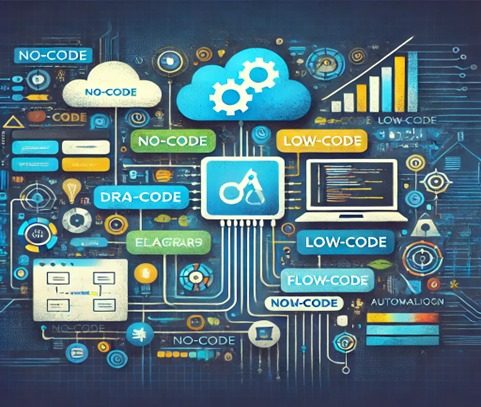
No-code Platforms
No-code platforms are tailored to users who have no programming knowledge. They leverage visual interfaces where users can design and build applications through drag-and-drop functionality. Essentially, no-code platforms abstract away the complexity of programming languages by providing pre-built components that can be assembled into fully functional applications.
No-code platforms allow users to create simple websites and mobile apps to complex business process automation tools and even Customer Relationship Management (CRM) systems. Popular examples include Wix, Bubble, and Airtable.
Low-code Platforms
Low-code platforms target the user who perhaps can understand coding or at least feel comfortable writing a small amount of code. These tools offer more flexibility than no-code options but still greatly reduce how much code needs to be written in application development.
Low-code platforms do support faster development compared to traditional coding; at the same time, they provide an drag-and-drop interface for easy design, while also allowing developers to create custom code for more advanced functionality. Examples of low-code platforms include OutSystems, Mendix, and Microsoft Power Apps.
While no-code platforms are targeted at non-technical users exclusively, in the case of low-code platforms, both technical and non-technical users have a wider scope for complexity and customization with the possibility of rapid development.
Why Are No-code and Low-code Platforms Gaining Popularity?
1. Shortage of Developers: One of the main reasons for the increasing interest in no-code and low-code platforms is the continuous shortage of professional developers. While the demand for tailor-made software and digital solutions grows, it is increasingly hard for businesses to fill in developer positions. According to LinkedIn, there is a huge gap in technological skills, and companies cannot find candidates for software developer positions.
No-code and low-code platforms alleviate this problem by making non-technical resources, popularly known as “citizen developers,” perform the tasks of app development. In other words, no-code and low-code platforms free business teams from the bondage of depending on IT departments or outsourcing agencies to develop applications for their specific needs. This is a big plus for SMBs that cannot afford to have full-time developers on their payrolls.
2. Faster Time-to-Market: In today’s fast-paced business environment, the ability to get products and solutions to market quickly is more important than ever. Traditional development cycles can take months or even years, especially for large-scale projects. No-code and low-code platforms dramatically shorten the development timeline, enabling businesses to create and deploy apps in a fraction of the time.
This speed is particularly valuable for startups and businesses in competitive industries looking to move as fast as possible to stay ahead of the curve. By embracing no-code and low-code platforms, these businesses can iterate and adapt more quickly-testing and refining ideas with minimal risk.
3. Cost Efficiency: Building custom software traditionally involves hiring a team of developers, designers, and project managers. These development projects tend to be expensive, and the costs can easily add up. No-code and low-code development platforms reduce the requirement for large teams, thus cutting down some of the costs related to app development.
No-code and low-code platforms are cost-effective methods for businesses to implement simple applications or develop internal tools. Beyond reduced development costs, the benefits also include lower maintenance expenses, since apps built on such platforms are typically easier to manage and update.
4. Agility and Flexibility: The fast-changing landscape of modern business demands solutions that can be quickly adapted and updated. No-code and low-code platforms offer businesses the agility to make changes in real-time, whether it’s adding new features, fixing bugs, or updating content.
Because these platforms allow users to change and develop applications without having to wait for extensive development cycles, businesses can quickly adapt to market conditions, customer needs, or internal demands. This level of flexibility means that companies can stay competitive, no matter how fast things change.
5. Empowering Non-Technical Users: No-code and low-code development platforms makes it possible for business professionals, marketers, and other employees to be directly involved in contributing to the development process of an application, hence reducing bottlenecks and allowing the business to scale up their operations with no sole dependency on IT.
No-code and low-code platforms provide the tools to the business users to build their own apps. Therefore, it fosters the collaboration of technical and non-technical teams. In turn, all of this builds up a more agile and responsive development process driven by real-world business needs.
Challenges and Considerations
Despite their many advantages, no-code and low-code platforms do not come without challenges and limitations.
- Scalability: While no-code and low-code platforms are great for small to medium-sized projects, they’re not always the right solution for enterprise-scale applications. Apps built on these platforms can start to encounter performance issues or struggle to scale with growing demand.
- Security and Compliance: All software applications are concerned with security, and no-code and low-code platforms are no exception. While some platforms offer robust security features, they may not meet the same rigorous standards as custom-built applications. For industries with strict compliance requirements (e.g., healthcare, finance), it’s important to thoroughly vet the platform to ensure it adheres to industry regulations.
- Limited Customization: Low-code platforms are more customisable than no-code platforms, but low-code platforms can be limited in one way or another. For instance, users may have very specific or complex features that require implementation beyond the capacity of the platform. In such cases, the development process may demand more specialised knowledge or may not be possible at all.
- Vendor lock-in: Many of the no-code and low-code platforms are proprietary, meaning the application built on such a platform is often tied to the vendor’s ecosystem. If you ever want to switch to another tool or migrate your app to traditional ways of development, it will be a cumbersome and painful process. To mitigate this risk, businesses should carefully evaluate platform options and consider long-term scalability before fully committing to a particular tool.
The Future of No-code and Low-code Development
The future of no-code and low-code development looks very bright. As these platforms continue to evolve, they will get much more powerful, flexible, and user-friendly. With the improvements in artificial intelligence (AI) and machine learning (ML), we are bound to see no-code and low-code platforms embed much more intelligent automation for much faster and more efficient development.
Moreover, as demand for software applications widens among various industries, no-code and low-code development platforms are positioned to further become highly instrumental in supporting business growth and innovation without requiring large teams of developers.
In the next few years, the future for no-code and low-code tools is probably in addition to usage by citizen developers, integration in enterprise software systems that will allow for hybrid development approaches whereby business teams will develop alongside IT professionals to create such powerful applications.
Conclusively, no-code and low-code platforms provide something for everyone-from entrepreneurs trying to develop their first app, corporate professionals who want to automate some process, all the way to a developer trying to get faster development lifecycles. Understanding the advantages, challenges, and future potential of these platforms gives companies the capability to leverage them to the fullest and shapes the path towards more agile and innovative software development.
