Categories
How-Tos Tech Uncategorized

Prompt Engineering Explained: How to Talk to AI and Actually Get Results

While scrolling through my feed sometime last year, I stumbled on a job listing that stopped my thumb mid-air. The role was called Prompt Engineer and the salary attached to it had enough zeros to make a man reconsider his entire career path. I remember showing it to a friend and him squinting at the screen, “So they are paying somebody to just… talk to a computer?”
Well, he wasn’t entirely wrong. But he wasn’t entirely right either.

First, What Even Is a Prompt?


Before we get into engineering anything, let’s settle the foundation.
A prompt is simply what you type into an AI model. That’s it. When you open ChatGPT or Claude and type “write me a caption for my business page,” that sentence is your prompt. It is your instruction, your request, your way of telling the AI what you want.
Now here is where most people stop. They type something vague, get a vague answer back, shrug, and conclude that AI is overrated. However, they fail to realize that the quality of what comes out is almost always a direct reflection of the quality of what went in, and that relationship between input and output is exactly what prompt engineering is about.

Where Did the Phrase Come From?


To understand that, you need to know what is sitting on the other side of your screen when you type.
It is called a Large Language Model, or LLM. Think of it this way; imagine someone sat down and read virtually everything ever written on the internet. Every article, every textbook, every conversation, every Wikipedia page, every forum argument. After reading all of that, they developed a deep, almost supernatural ability to predict what word should come after the last word, and the one after that, and the one after that. String enough of those predictions together and you get something that sounds remarkably like intelligence.
That is essentially what an LLM is. It is not thinking the way you think. It is pattern-matching at a scale so enormous that the output feels like thought. Models like GPT, Claude, and Gemini are all LLMs trained on billions of pieces of text until they become very, very good at continuing whatever you start.
Now because these models are so sensitive to the way you phrase things, researchers and developers started noticing that small changes in wording produced dramatically different results. Ask the same question two different ways and you could get a brilliant answer or a completely useless one. This observation gave birth to the discipline of prompt engineering; the deliberate, strategic craft of designing inputs that consistently produce high-quality outputs from an LLM.
The phrase itself started appearing seriously in AI research circles around 2021 and by 2023 it had gone fully mainstream, job listings and all.

The Five Types of Prompt Engineering


Prompt engineering is not one thing, it comprises of several techniques to improve the model’s understanding and output quality, each suited to different situations. Let us break them down one by one.

1. Zero-Shot Prompting


This is what most people do without knowing it has a name. You give the AI a task with no example, no context, no explanation; just the instruction.
“Summarise this article.” “Translate this to Igbo.” “Write a birthday message for my aunty.”
You are shooting your shot without any warm-up. Hence, zero-shot.

2. Few-Shot Prompting


Here, instead of just giving the instruction, you give the AI a few examples of what you want before asking it to do the actual task. You are essentially showing it the pattern and then saying, “now continue in this same style.”
For instance, if you want the AI to categorise customer complaints in a specific way, you might show it three examples of how you want it done before feeding it the real data.

3. Chain-of-Thought Prompting


This one is particularly clever. Instead of just asking the AI for an answer, you ask it to show its work,\to reason through the problem step by step before arriving at a conclusion.
It sounds like this: “Think through this step by step before giving me your final answer.”
That one small addition can dramatically improve the quality of responses on complex problems; maths, logic, analysis, strategy. It is the difference between a student who guesses an answer and one who works through the calculation.

4. Role Prompting


This is where you assign the AI a character or identity before asking your question.
“You are an experienced financial advisor in Nigeria. A young professional earning ₦200,000 a month asks you how to start investing…”
By giving the AI a role, you are narrowing the lens through which it responds. It stops drawing from everything it knows and focuses on what that specific type of person would know, say, and prioritise.

5. System Prompting


This is less visible to everyday users but it is arguably the most powerful technique on this list. A system prompt is an instruction given to the AI before the conversation begins; it sets the rules, the personality, the boundaries, and the purpose of the entire interaction.
When you use a customer service chatbot on a company’s website and it only answers questions about that company, refuses to go off-topic, and always responds in a particular tone; that behaviour was defined by a system prompt written by a developer.

How to Write Better Prompts: 6 Practical Tips


Knowing the types of prompt engineering is one thing. Sitting in front of an AI and knowing what to type is another.

Start with a clear goal.

Before you type anything, ask yourself; what exactly do I want to walk away with? Vague goals produce vague prompts. Instead of “write something about my business,” try “write a 200-word Instagram caption for my catering business targeting working-class Lagos women between 25 and 40.” You have told the AI what to write, how long, where it will live, and who should feel spoken to. That is a prompt with a destination.

Give it context.

The AI does not know your life. It does not know your industry, your audience, or the specific situation you are dealing with, unless you tell it. Feed it the relevant background before asking your question. Include data if you have it. Reference a document if it matters. Define terms that might be interpreted differently depending on who is reading. The more context you provide, the less the AI has to guess, and guessing is where things go wrong.

Show it what you want.

When words are failing you, examples do the work. If you want a particular tone or style, show it two or three examples before making your actual request. This is few-shot prompting in practice, you are not just describing the target, you are pointing at it. The AI is extraordinarily good at recognizing and continuing patterns. Use that.

Be specific and precise.

There is a version of every prompt that is lazy and a version that is precise. “Write a long poem” is lazy. “Write a fourteen-line sonnet exploring the feeling of leaving your hometown for the first time” is precise. Quantify where you can. Break big requests into smaller steps when the task is complex. Treat it like giving instructions to a very capable new employee who knows nothing about your specific situation yet.

Ask it to think out loud.

Whenever you are dealing with anything that involves reasoning, a business decision, a problem you are trying to solve, an analysis of something , add this to your prompt: “think through this step by step before giving your final answer.” That small addition alone will improve the quality of complex responses more than almost anything else. You are not just asking for an answer, you are asking for the working behind the answer. The difference shows.

Keep adjusting.

Your first prompt is rarely your best one. If the output is not quite right, do not scrap everything. Change the phrasing. Add a detail you left out. Shorten the instruction or lengthen it. Good prompt engineering is iterative by nature, the same way a good writer does not publish their first draft.

Does Prompt Engineering Still Matter With Today’s Advanced Models?


Modern models like GPT-4o, Claude 3.5, and Gemini Ultra are dramatically better than their predecessors at understanding vague, poorly worded instructions. What would have required careful prompting two years ago now works reasonably well with a casual ask. In that sense, the barrier to entry has dropped significantly. You no longer need to study prompt engineering just to get useful things out of an AI.
But here is what hasn’t changed.


The ceiling of what you can extract from these models is still largely determined by how well you communicate with them. The difference between a mediocre prompt and a well-crafted one on a cutting-edge model is not as dramatic as it used to be at the bottom, but at the top, it is still enormous. Professionals who understand how to structure context, assign roles, chain reasoning, and design system prompts are consistently pulling results out of these models that casual users simply cannot reach.

So What Does This Mean For You?


It means two things.
First, you do not need to wait until you are a developer or a tech professional to benefit from the understanding prompt engineering. Whether you are a student, a content creator, a small business owner, or a job seeker, knowing how to talk to AI tools well is already giving some people an unfair advantage over others. That advantage is available to anyone willing to learn it.


Second, prompt engineering as a standalone career is likely to evolve rather than disappear. The people who will remain valuable are those who combine domain expertise with the ability to deploy AI effectively within that domain. A lawyer who understands how to use AI for legal research. A marketer who knows how to build AI-powered content systems. A teacher who designs AI tools for learning. The skill does not live in isolation, it multiplies whatever else you already know.

The friend who squinted at that job listing and said “so they are paying somebody to just talk to a computer” was not entirely wrong. But what he missed is that talking well; clearly, strategically, and with intention, has always been one of the most valuable skills a person can have.

And if you are considering becoming a prompt Engineer you can check out this OpenAI Doc

Categories
Tech

The Compound Effect in Tech: How Consistency Beats Urgency When Upskilling

Every young Nigerian on a tech journey is familiar with the term, ‘Upskilling.’ At the workplace, in the media, at every tech conference or conversation the topic of upskilling is one that is always echoed.

Attached to this phrase is the urgency to upskill so that you aren’t left behind in the tech race, at the end you are left with a long list of courses you want to take which you eventually don’t take at all and even if you do, you never get to complete them.

The Real Problem With How Upskilling Is Sold

Instead of being guided through a realistic, step-by-step process, you are handed urgency and a destination. For instance, master Python in 30 days, become a data analyst in 8 weeks; with very little acknowledgment of what the journey actually looks like.

Social media makes it all worse because you get to only see the end product of a process that took tons of hours to accomplish. So, you are anxious, and the delusions that you are doing nothing increases. Once again, you try to hasten your learning pace, but again you fall flat to your face.

What Is the Compound Effect?

The concept of the compound effect was succinctly and efficiently explained by Darren Hardy in his book the compound Effect. In his own words, “The Compound Effect is the principle of reaping huge rewards from a series of small, smart choices. What’s most interesting about this process to me is that, even though the results are massive, the steps, in the moment, don’t feel significant. ”
What this means is that your small choices, including consistency and time produces significant results.

What does that mean for a techie on a journey to upskilling?


In simpler terms, it means you don’t have to start by looking for ways to short circuit your learning duration which is something that is frequently advertised. For instance instead of looking for YouTube tutorials that promise mastery of Data analysis within one month, you could start by making your learning a daily practice and In the initial period your process may seem invisible, but you are building momentum.

How Learning Momentum Works in Tech


If you’ve ever tried to learn a tech skill; Python, frontend development, data analysis; you’ve already felt it: that frustrating, slow, almost discouraging start where nothing seems to click.


At the beginning, it feels like trying to start a stubborn generator. You pull once, nothing. Pull again, still nothing. You check YouTube, adjust something small, try again. It sputters, but doesn’t quite come alive.That’s what the early stage of learning tech feels like.


You spend hours installing tools, fixing errors you don’t understand, and following tutorials line by line. You write code, run it, and it breaks. You tweak one thing, and something else breaks. At the end of the day, it feels like you’ve made no real progress. But if you stay with it, something subtle begins to happen. A concept clicks. Your code runs, just once, but it runs. You begin to recognize patterns. The same errors that confused you yesterday start to look familiar today.


You’re still putting in effort, but now the system is beginning to respond.Soon, you’re no longer just copying code. You debug with a bit more confidence. You open documentation without immediately feeling overwhelmed. You start connecting ideas: how one concept leads to another, how tools fit together.


Then, almost without noticing exactly when it happened, you cross a threshold. You can build small things on your own. You understand your errors more than you fear them, you start questioning tutorials.


Learning becomes less of a chore and more of a rhythm. From the outside, it looks like you’ve suddenly become “good at tech.” But what’s really happened is simpler: momentum has taken over.Now, every new skill builds on the last. You learn faster. You recover quicker when you’re stuck. Even when you take a break, it doesn’t take much to get back into flow.


That’s the power of momentum in tech.
The truth is, learning a tech skill isn’t difficult because it’s beyond you. It’s difficult because most people quit before things start to move. They mistake the slow beginning for a lack of ability, not realizing it’s just the natural resistance that comes before progress.
The ones who succeed aren’t necessarily smarter, they just stayed long enough for things to start working in their favor.

A Simple Daily Learning Framework for Tech Upskilling

Applying the compound effect does not require long, exhausting study sessions. It requires showing up consistently.

Most advice you will find online suggests a clean, structured routine: wake up early, study for an hour, build something, repeat. That sounds great in theory. In reality, you have a job, family obligations, NEPA taking light, data running out, or simply a day where motivation is nowhere to be found.

So here is a framework built around your actual life, not an ideal version of it.

On a good day, aim for 45–60 minutes or even 2 hours

  1. 10 minutes: Review. Before learning anything new, spend a few minutes revisiting what you covered last time. Re-read your notes, re-run your code, or just try to recall the key concept from memory.
  2. 25–30 minutes: Learn one thing. Not one course. Not one module. One concept. Watch a short tutorial, read a documentation page, or work through a single exercise. The goal is depth over speed
  3. 10–20 minutes: Apply it immediately. Write the code, sketch the wireframe, run the query, build the small thing. Even if it breaks. The moment you try to use what you just learned is the moment you find out whether you actually understood it.

On a hard day, aim for just 15–30 minutes:

Do not skip entirely. Open your laptop, re-read yesterday’s notes, watch one short video, run one line of code. It does not have to be productive in the traditional sense. The goal on a hard day is simply to maintain the habit signal, to remind your brain that this is something you do, not something you used to do.

On a completely lost day

Missing one day does not break momentum. Missing a week starts to. Missing two weeks and you are essentially starting over emotionally, even if the knowledge is still there. The recovery cost of a long break is majorly about rebuilding the psychological habit of showing up.

Track your consistency somewhere visible. Not to be rigid about streaks, but because seeing a pattern of effort is its own quiet motivation to keep going.

Is the compound effect still relevant in the age of AI


Yes, and here is why. With the current irresponsible use of AI producing garbage-in, garbage-out content, it is easy to doubt the necessity of a slow, disciplined approach to learning when you can retrieve any piece of information in seconds. AI promises to increase productivity and accelerate the learning pace. So why endure the slow grind of building skills from scratch when AI can hand you the output in seconds?
The answer is simple; what you need to compound has shifted, not the principle itself.


AI doesn’t replace thinking. It doesn’t replace judgment, discernment, or the ability to evaluate what is true, useful, or well-reasoned. If you haven’t built momentum in understanding fundamentals and critically assessing outputs, you will hand a powerful tool to an incompetent operator, and the results will show. The people winning with AI are not those who use it the most. They are those who have compounded the right foundations, curiosity, critical thinking, domain knowledge, and the discipline to go deep.


The Compound Effect is not less relevant in the age of AI. It is more important than ever because the gap between those who have built real understanding and those who haven’t is now wider and more visible than at any point in history. Compound wisely. The returns will speak for themselves.


And here is the exciting part, now that you understand the power of compounding the right things, our next article is going to show you exactly how to put AI to work for your growth. We are talking Prompt Engineering; the skill that turns AI from a fancy search engine into your most valuable learning companion. See you there.

Categories
General Kickstart Mentorship News Social Tech Uncategorized

Empowering a Continent: Five Years of Techrity Championing “Tech for Good” in Africa.

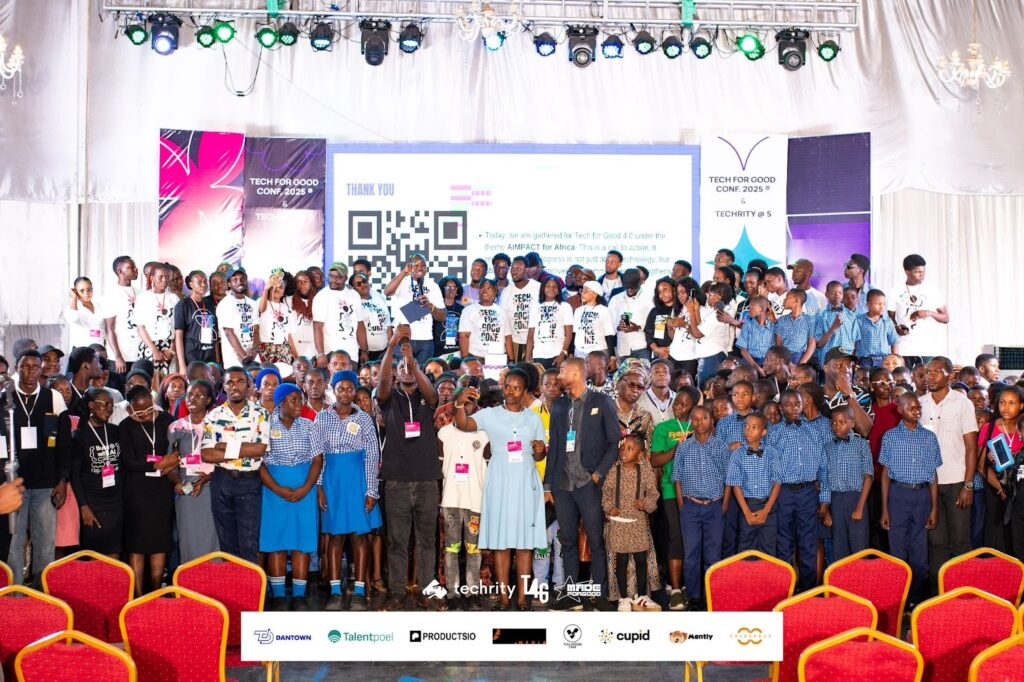
For half a decade, the Techrity Innovation Foundation has been on a steadfast mission to transform Africa’s digital landscape. What began in December 2020 has evolved into a continental movement dedicated to bridging the digital divide. On October 25, 2025, Techrity marked its 5th Anniversary by celebrating this journey of empowerment at the fourth edition of its flagship conference, themed AIMPACT Africa, held in Port Harcourt.

The milestone event brought together over 500 innovators, entrepreneurs, and educators to explore how Artificial Intelligence (AI) and emerging technologies can drive inclusion, digital literacy, and sustainable development across the continent.

Grassroots Impact: The Road to Tech for Good

Techrity’s commitment to “Empowering a Continent” begins in the classroom. Leading up to the anniversary conference, the team embarked on the “Road to Tech for Good” outreach, visiting Rumuokuta Girls Secondary School and Community Secondary School. The mission was to inspire young students to view technology not just as a subject, but as a critical tool for shaping their futures and solving real-world problems.

To solidify this commitment to early access, Techrity sponsored 120 students from public and private secondary schools across Rivers State to attend the conference. A powerful highlight of their participation was the emergence of Emmanuel Amaechi, an SS1 student from Christ Army Educational School, as the winner of the interschool Q&A session. He received a ₦50,000 cash prize and a full Tech Scholarship from Mr. Chinoso Chijoke, Founder of Cupid Technologies.

Key Takeaways: The Moments and Highlights That Shaped the Conference

Opening the conference, Islamiat Arinola Oseni, Senior Project Officer at Techrity, described Tech for Good as “more than an event, it is a movement to leverage technology for empowerment, community growth, and social impact.” She highlighted Techrity’s commitment to bridging the digital divide through mentorship, capacity building, and inclusion-focused initiatives.

Delivering the 5th anniversary speech and  Impact story, Techrity’s Founder and Team Lead, Mrs Owanate Amachree, reflected on the foundation’s growth since its establishment in 2020. She said Techrity has evolved into “a pan-African force for social innovation and digital empowerment,” citing initiatives such as Hack for Good, the Techrity Mentorship Program, the Kickstart Initiative, and the Laptop Support Scholarship. “Technology has the power to redefine Africa’s growth narrative. At Techrity, we are building an ecosystem that enables learning, innovation, and impact,” she said.

The Keynote Sessions offered thought-provoking insights into the transformative power of technology in shaping Africa’s digital future. Mr Kenneth Nwokoro opened with “Building an Inclusive Digital Economy: Empowering Communities and Closing the Digital Divide,” emphasising the need for equitable access to technology and digital opportunities across all communities. Chimene Chinah followed with “AI for Inclusive Growth: Harnessing Artificial Intelligence to Drive Africa’s Transformation,” exploring how artificial intelligence can catalyse sustainable development and inclusive progress across the continent.

The Guest Speakers further enriched the discussions with practical perspectives on innovation and empowerment. Mrs Amarachi Stanley-Duru delivered a compelling session on “Shaping Africa’s Workforce for the Future: Embracing Digital Transformation and Skills Development,” highlighting the importance of upskilling and adaptability in a rapidly evolving world. Mrs Karla Obakpolor rounded off the segment with “Building for Social Good: Scaling Innovation and Creating Impact,” emphasising the role of purpose-driven innovation in driving meaningful change across Africa.

The Speaker Session featured Harmony Elendu, who delivered an insightful presentation titled “People Behind Models: How AI is Elevating Careers and Skills Expansion.” Her talk shed light on the human side of artificial intelligence, exploring how AI is transforming industries and empowering individuals to build new skills, enhance their careers, and thrive in the digital age.

The conference also featured engaging panel sessions, lightning talks and a fireside chat that explored innovation, inclusion, and Africa’s digital future. The first Panel Session focused on the topic, From Learner to Leader: Forging a Resilient Tech Talent Pipeline through Ecosystem Collaboration hosted by Bliss Isioma Ajie (HR/Operations Manager, Mently) and the Panelists were Richard Pepple (Founder, Technoville) and Shammah Nei (Director, Engineering Philanthrolab), The second Panel session focused on Navigating The New Financial Frontier: Regulation, Innovation and The Future of Crypto in Nigeria hosted Mr Godwin Jimmy (CTO, Dantown HQ) and the panelists were Godfrey Kelechukwu (Founder, Boardroom), Favourite Henry (Product Marketing Manager), Chininso Chijioke (Founder, Cupid Technologies), The Third Panel session focused on the topic, The Global Talent Playbook: Unlocking Remote Opportunities and Building a Competitive African Workforce, was moderated by Fano Oyin Jessica, Techrity’s Chief Administrative Officer. Panellists included Lloyd Otu, Co-Founder of TalentPoel, and Newton Adiari Newton, Product Manager at Cre8Space Africa, shared insights on remote work, digital tools, and how African youths can compete in a borderless economy.

The fireside chat with Julian Duru (ex Moniepoint engineer and now an independent researcher) hosted by Daniel Obiyo (Founder, Quint Impact Initiative), offered an inspiring story of resilience and leadership, as he discussed personal experiences and lessons from Africa’s evolving innovation space.

The Lightning Talk Breakout Sessions featured a series of simultaneous, high-energy presentations where speakers shared unique insights on technology, creativity, and artificial intelligence. Chibuzo Madumere explored “From Curiosity to Code: How AI and Creativity Empower Tech Beginners,” emphasising how innovation often begins with curiosity. Opuine Kayode Fowora presented “AI for Differentiated Instruction & Inclusivity: A Teacher’s Perspective on Empowering Every Learner with AI,” shedding light on AI’s role in inclusive education. Yves Kwameh V. delivered “Beginner Skills You’ll Need Before the Boots Take Your Briefs,” a dynamic talk on essential skills for those starting their tech journey. Numbere Tehila Tamunobakam discussed “Agentic AI and Liability: Who Bears the Burden When Mishaps Occur?” examining accountability in the age of intelligent systems. Meanwhile, Precious Sunday inspired attendees with “Unlocking the Future: Navigating Tech’s Uncharted Territory,” encouraging bold exploration of technology’s evolving landscape.

A key highlight of the event was the official launch of Made for Good, presented by Peculiar Akinloye, Techrity’s Operations Manager. Made for Good is a purpose-driven brand that embodies the spirit of paying it forward using proceeds from its merchandise and initiatives to support causes such as providing laptops, internet data, and digital tools for young Africans. The initiative also connects startups, organisations, and innovators working on technology-driven impact projects across the continent. According to Akinloye, the platform aims to “promote partnerships, shared learning, and scalable innovation for development.

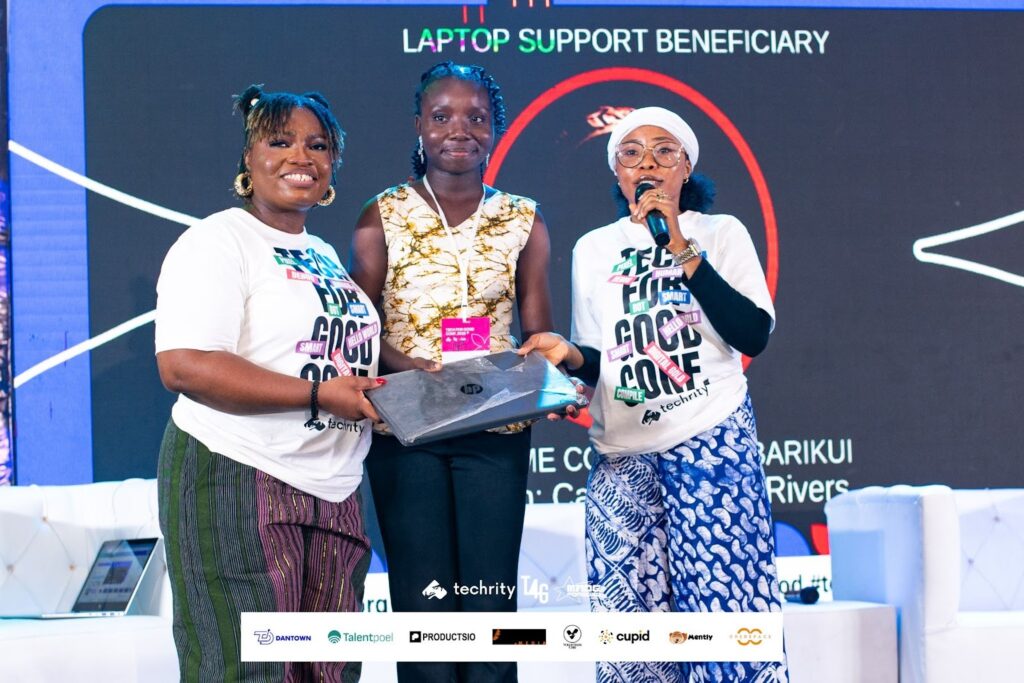
In addition, there was the Techrity Laptop Support Scholarship presentation. This initiative equips young Nigerians with laptops, internet access, and mentorship to enhance their digital skills and create career growth opportunities. Following a transparent selection process guided by passion, need, and commitment to social good, 11 (eleven) young Nigerians were awarded laptops, data support, and mentorship to boost their digital careers at the conference. Among these beneficiaries were Ikordeme Confidence Barikui, Onaeko Emmanuel Oladipupo, Ozuru Irenma Pearl, Ozuru Olanma Jewel, Philomena Nkereuwem Nyah, Iyke Victor Chidera, Winner Osinachi Offor, Elekwachi Zion Chibuchi, Emeka Victor Chigozie, Okonkwo Ckaima Peniel, and Ebubechukwu Osy-Uzoekwe. “We believe in using technology to transform lives, one person and one community at a time,” Oseni said.

Another major highlight of the day was the Techrity Social Impact Awards, which honours individuals and organisations using technology to drive mentorship, digital inclusion and social good. The award recipients included Renaissance Innovation Labs (Tech Community Partner of the Year), Kenneth Nwokoro ( Social Impact Award (Mentorship), Stakeholders Democracy Network (Social Impact Award – Tech for Gender Equality), Bright Chinenyeze (Social Impact Award (Digital Inclusion Advocate), Richard Sodienye Pepple (Social Impact Award – Mentorship), and Richard Tamunotonye (Social Impact Award – Mentorship).

A Five-Year Legacy and a Call to the Future

In just five years, Techrity has grown into a global community of 886 innovators with over 12,000 digital followers across Nigeria, Kenya, India, Botswana, Ghana, Rwanda, and Uganda. Through initiatives like the Kickstart Initiative, which has provided 35 laptops and ₦5 million in data support, and a mentorship program engaging over 100 participants, Techrity is actively nurturing Africa’s next wave of tech talents.

The success of the 5th anniversary celebration was bolstered by several partners, including Dantown (Key donor and partner for the Laptop Support Scholarship), Productsio, TalentPoel, Cre8Space, Artful Media, Cupid Technologies, Volunteers Crib, Mently, and Made for Good.

In her closing remarks, Owanate Amachree thanked all partners, speakers, and volunteers for their contributions, noting that “the true impact of Techrity lies not only in its social impact programs but in the lives we transform.” She reaffirmed the foundation’s goal to continue empowering Africans through technology, mentorship, and innovation — inspiring, coaching, and building for social good.

As part of its five-year milestone, Techrity is extending an open call to corporate partners, development organisations, startups, and philanthropists to collaborate in building the future of young Africans through mentorship, digital education, and social impact programs designed to bridge gaps in unemployment, inclusion, and opportunity across Africa. 

Let us drive this mission together by equipping young people with laptops, internet access, and digital skills, fostering innovation through SDG-focused hackathons and mentorship programs, and promoting inclusion and gender equality through technology-driven education.

Watch the full documentary of how we have championed tech for good in Africa on our YouTube Channel.

Organisations and individuals interested in partnering can reach out via hello@techrity.org or visit www.techrity.org to learn more.

Categories
Mentorship Tech Techrity Programmes Uncategorized

From Cobbler Dreams to Tech Innovation: Stella’s Journey of Impact with Techrity Mentorship Program 

Introduction

When you think about a cobbler, what comes to mind?

Maybe an old workshop, the scent of leather, and someone hammering away on a sole.

For Stella, becoming a cobbler wasn’t just a fleeting childhood dream. It never sounded demeaning because it was an unusual and deeply personal ambition.

While her peers imagined hanging stethoscopes around their necks or being seen in courtrooms and called “the law”, Stella was sketching shoe designs and pulling apart worn-out sandals to see how they were made. It was raw curiosity and creativity in its purest form.

But life, as it often does, had other plans for her.

The Tech Path That She Never Had in Sight

Francis Odeyemi via Unsplash

Years later, Stella found herself studying computer science at university. It was a prestigious degree by most standards, future-proof, globally relevant, and full of possibilities. But for Stella, it didn’t feel like a calling. While she passed her courses and learned to write code, there was a lingering question that never left her: what exactly do I want to build?

She knew she was creative. She knew she liked working with her hands. She even liked tech a bit. But she hadn’t yet figured out how all these passions could intersect.

That’s when the Techrity’s Mentorship Programme came into the picture.

Finding Clarity and Her Calling Through Community

Stella joined the programme, unsure of what to expect. What she found was a structured yet warm environment, mentors who listened, peers who were on similar paths of discovery, and sessions that focused not just on skills but also on purpose.

Stella took her time immersing herself in the mud of the program, but it wasn’t long before Stella began connecting the dots to her lightbulb moment.

What if she could combine her childhood love for shoemaking with her knowledge of technology? What if she could create something truly African, handcrafted but scalable, an innovative brand that bridges tradition and tech?

These bubbling questions became the seeds of a powerful idea:

A home-made leather shoe brand with a tech-driven twist.

Today, Stella is not just building shoes; she’s building a tech brand. A sustainable business that uses tech to improve production, reach more customers, and tell a unique story of African tech talents.

And it all began with clarity, the kind of clarity that can only come from having the proper support, structure, and mentorship.

The Bigger Picture: Techrity’s Mission

Stella’s story is inspiring, but it’s not rare.

At Techrity, we’ve seen countless young Africans grappling with purpose, creativity, and a desire to build something meaningful. Often, all they need is a spark, a guiding hand, a community, a structured programme that helps them align their skills with their dreams.

We created our Mentorship Programme for exactly this reason. And the results? They speak for themselves.

From fashion tech to fintech, from storytelling to software, our mentees are launching startups, building solutions, and rewriting the narrative of what’s possible for the African youth.

Be a Witness: Join the Techrity Impact Series

If Stella’s story moved you, you’re not alone. That’s why we created the Techrity Impact Series, an Instagram live storytelling experience that showcases the journeys of real people whose lives have been transformed by mentorship, tech, and community.

Hear their voices. Learn from their journeys. Be part of the impact.

Whether you’re a student, a builder, a dreamer, or someone searching for direction, these stories might just spark something in you, too.

Hear Stella’s full story here 

We are featuring others just like her to share their inspiring stories because every impact begins with a moment of clarity. And that moment could start here for you, too.

Don’t miss the next session of our Impact Series on 1st August 2025

I am in right away.

Categories
Career advice General Tech

The Rise of New Jobs and Careers You’ve Never Heard of By 2030

The Jopwell Collection

In 2025, the job market is evolving in ways we never imagined. Gone are the days when doctors, lawyers, and engineers were the ultimate career choices. 

Thanks to advancements in technology, environmental shifts, and evolving consumer behaviors, new job roles are emerging that sound like they belong in a sci-fi movie (seriously, who’s a Space Tourism Guide?). Moreover, 85% of jobs that will be mainstream by 2030 have not even been created.

From earthquake forecasters to digital currency advisors, the workforce of 2030 will look very different from what we know today. 

If, like us, you’re curious about what kind of crazy, exciting, and futuristic careers might pop up over the next few years, you’re in the right place. Join me on a wild adventure to uncover the future job roles that will redefine the way we work.

1. Earthquake Forecaster

Çağlar Oskay via Unsplash

We have weather forecasters predicting storms and hurricanes, but what about earthquakes? Scientists are making progress in using AI, satellite data, and geological shifts to predict earthquakes with higher accuracy. So in he coming half a decade, what can we expect? For a start, by 2030, we could see dedicated earthquake forecasters working alongside governments, real estate developers, and disaster preparedness teams. The culmination of such professional effort will be to provide early warnings and reduce damage.

2. Crypto and Other Digital Currency Advisor

General Bytes via Unsplash

while crypto exchanges are filing for bankruptcy, Bitcoin still manages to smash its all-time high figures from months ago. With the continued rise of Bitcoin, Ethereum, and central bank digital currencies, traditional financial advisors might not cut it anymore. Enter the digital currency advisor, a financial expert specializing in crypto investments, blockchain technology, and regulatory compliance. As decentralized finance (DeFi) continues to grow, these advisors will help individuals and businesses navigate the world of digital money.

3. AI Ethics Consultant

Mariia Shalabaieva via Unsplash

AI has virtually become a mainstream part of our work and personal life. It is taking over everything from customer service to medical diagnoses, but who’s making sure it’s being used responsibly? Enter the AI ethics consultant. This will be a specialist who ensures AI systems are fair, unbiased, and don’t lead to unintended discrimination. As artificial intelligence becomes more integrated into daily life, companies will need these experts to keep things ethical and legal.

4. Space Tourism Guide

Ju Guan via Unsplash

With companies like SpaceX and Blue Origin making space travel a reality, the future might hold an entirely new tourism sector—space tourism. The role of a space tourism guide will be similar to that of a flight attendant, but in zero gravity! These guides will be responsible for educating travelers about space, ensuring safety during trips, and making intergalactic journeys unforgettable.

5. Virtual Reality Therapist

Andrej Lišakov via Unsplash

Mental health treatment is evolving, and VR is playing a big role in that transformation. A virtual reality therapist will use immersive VR environments to help patients manage anxiety, PTSD, and even chronic pain. Instead of traditional face-to-face therapy, these specialists will guide patients through simulated scenarios designed to ease their struggles.

6. Cybersecurity Threat Analyst

KeepCoding via Unsplash

Cybercrime isn’t going away anytime soon. The need to checkmate the excesses of hackers and nefarious elements on the world wide web keeps intensifying. by 2030, companies will need more than just IT support; they need cybersecurity threat analysts who can anticipate, analyze, and neutralize digital threats before they cause havoc. a cybersecurity threat analyst role will combine AI-driven security measures with hands-on detective work to protect sensitive data and infrastructure.

7. Chief Climate Officer (CCO)

Markus Spiske via Unsplash

Climate change is no longer just a discussion. It has grown into a major global corporate concern. By 2030, large companies will likely have Chief Climate Officers (CCOs), responsible for ensuring businesses operate sustainably. Their job? Reduce carbon footprints, implement green policies, and make sustainability a core part of corporate strategy.

8. Personal Data Broker

ZBRA Marketing via Unsplash

In a world where data is more valuable than oil, individuals will need professionals who can help them manage, sell, or protect their digital information. A personal data broker will act as a middleman, ensuring people are fairly compensated for the data they share with corporations while maintaining privacy. Data analysts and data scientists are already very useful to several industries, you might be needing a personal data broker for your next contract.

9. AI-Powered Personal Shopper

Mariia Shalabeiva via Unsplash

Forget traditional retail assistants because AI-powered personal shoppers will use machine learning to analyze your fashion taste, budget, and lifestyle to provide customized shopping recommendations. Whether you’re buying clothes, gadgets, or even groceries, these AI-driven assistants will ensure you get exactly what you need.

10. Drone Traffic Controller

Ben Iwara via Unsplash

With drone deliveries also becoming mainstream, cities will need professionals to manage the air traffic of thousands of drones flying overhead. A drone traffic controller will ensure that delivery drones don’t collide, stay within their flight paths, and operate safely in busy urban areas.

11. Genetic Modification Specialist

Getty Images via Unsplash

Gene editing technologies like CRISPR are advancing fast, opening up new possibilities in healthcare, agriculture, and even beauty. A genetic modification specialist will work on everything from designing allergy-free foods to curing genetic diseases.

12. Augmented Reality (AR) Architect

Maxim Tolchinskiy via Unsplash

As AR becomes more widely adopted by society for education and recreation, we’ll need experts to design digital overlays for real-world environments. An AR architect will create virtual shopping experiences, interactive museums, and even holographic city maps that blend seamlessly with reality. Imagine building the next reality that connects billions of users over endless use cases and platforms.

13. Smart Home Designer

Anwar Hakim via Unsplash

Smart homes are the new normal. Your home has gone beyond just providing you shelter, it needs to offer comfort, security, and ease. People will need professionals who can integrate real time digital solutions, machine learning, IoT, and automation seamlessly into their living spaces. A smart home designer will specialize in creating homes that adjust lighting, temperature, and security settings based on personal preferences.

14. Emotional AI Trainer

Katja Anokhina via Unsplash

AI is getting better at detecting human emotions, but it still needs help. An emotional AI trainer will work with AI developers to teach machines how to recognize and respond to human emotions appropriately.  This is no small feat as their task will help chatbots, virtual assistants, and even robots become more empathetic and human-like. There are already a few jobs open to Africans and Nigerians, where people help train artificial intelligence to respond to emotions.

15. Quantum Computing Analyst

Ubaid E. Alyafizi via Unsplash

Quantum computers are the future of data and solution provision. This field is one promising to revolutionize problem-solving in industries like medicine, finance, logistics, and more. A quantum computing analyst will be responsible for translating quantum data into practical applications for businesses and governments. In no time we may be to answer some of the deepest questions about humanity!

The Future Workforce: Adapt and Evolve

Ian Mikraz via Unsplash

The world as we know it is changing at a rapid pace,  the likes of which human civilization has never experienced. The pandemic was a turning point, opening the eyes of the world to a completely remote society, birthing new roles, and rendering some redundant.

As we approach 2030, the job market will continue to shift. Some traditional jobs will disappear, while new and exciting roles will emerge. The key to staying relevant? Adaptability. 

The rest of the world is moving with the flow. As a young African, what are you doing to avoid getting left out? Whether you’re a student deciding on a career path or a professional considering a shift, keeping an eye on emerging careers can help you stay ahead of the curve.

Conclusion

So, which of these futuristic jobs excites you the most? Will you be a digital currency advisor, an earthquake forecaster, or perhaps a space tourism guide? Whatever the case, the future workforce is going to be one wild ride, and I hope you will be strapped in! 

If you need to see what some of these opportunities are about, visit the Techrity Opportunity Board. You can click here to join our community for more insight. 

Categories
Career advice Getting started How-Tos Tech

How to Get Your Next Job With The Opportunity Board

2025 is a year to make more money, buy a dream gadget, and finally go on that one trip you’ve been planning since 2020. A high income skill and great talent can position you for some of the best opportunities in the world, no matter your location. 

So how do you get that next job? Techrity’s latest rollout feature, the Opportunity Board is designed to connect talent to opportunities. Endless opportunities are waiting to be explored and converted to desired high income jobs. But first, how do you leverage this opportunity? This article has all you need to get started so keep reading. 

What is the Techrity Opportunity Board?

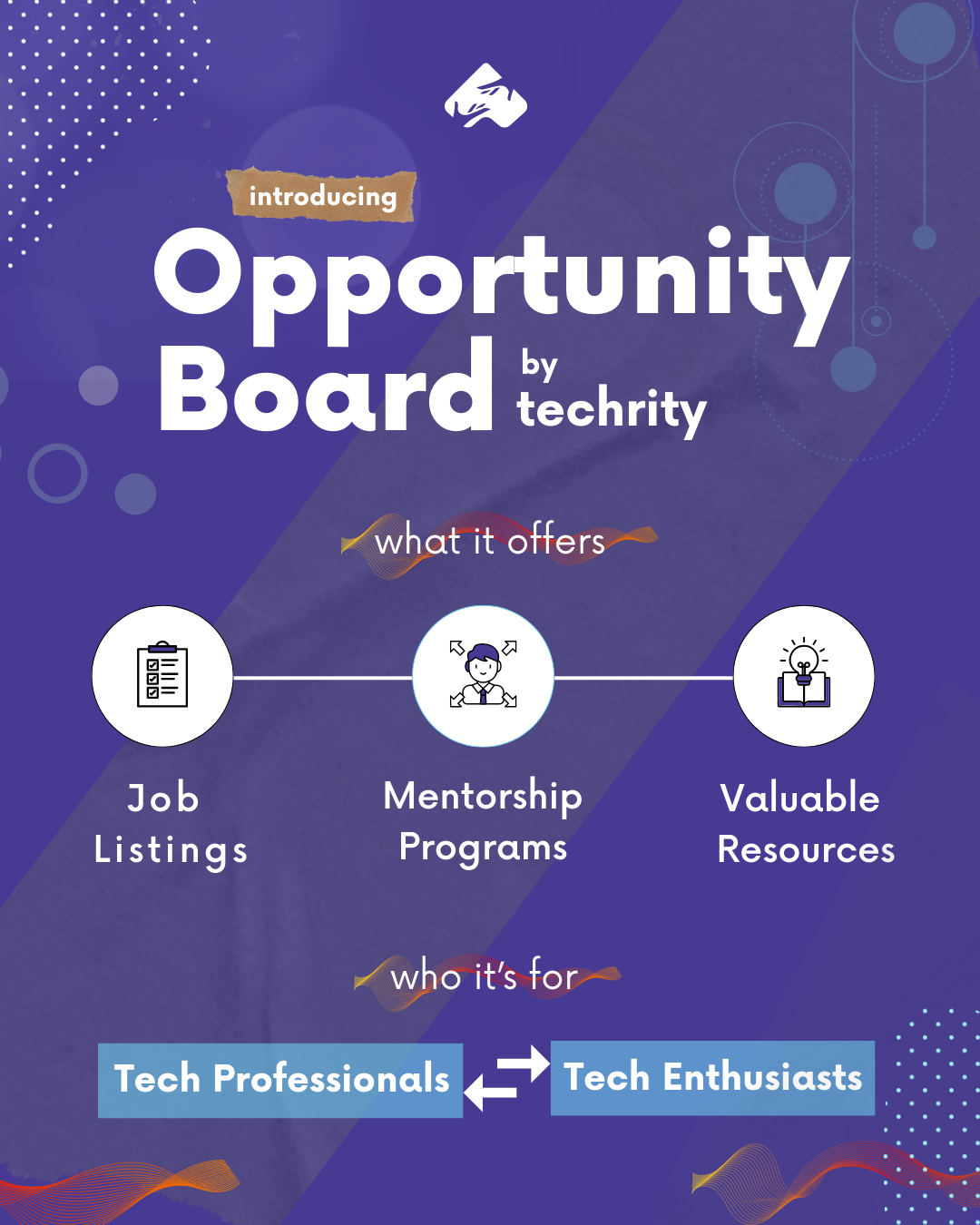
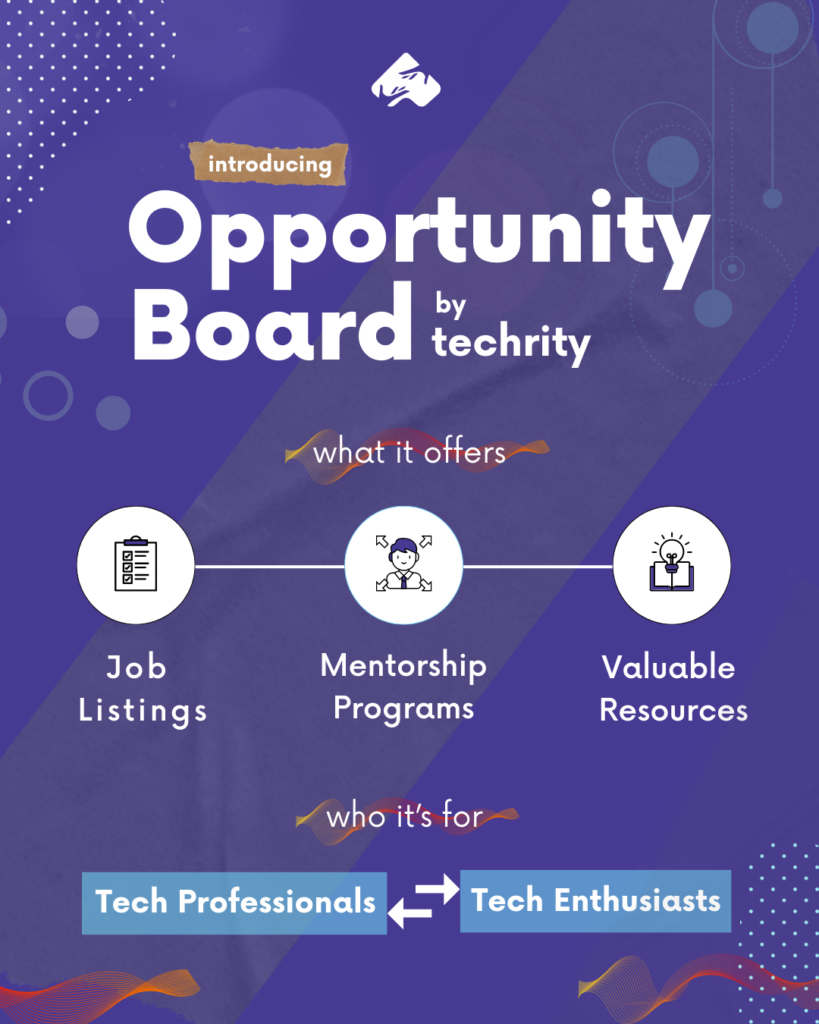
For techies, the dynamic job market in 2025 is not without its struggles and challenges. The Techrity Opportunity Board (TOB) is an avenue for tech professionals and employers sourcing talents to meet, get job listings, mentorship programs, and resources. 

Are you after the next best opportunity in your career or are a newbie looking for data support, productivity tools, and laptop support? The TOB is designed to empower you and thousands more young talented African remote and hybrid talents.

You will get access to these productivity tools, and the TOB will also offer consistent and helpful tips that will allow you to make informed career choices. Here is a breakdown of the resources the Techrity Opportunity Board offers:

Job Openings

The Opportunity Board displays job listings from companies of all sizes and industries looking to hire African talents and workers. The job listing displays the following information:

  • Name of role
  • Level of experience 
  • Name of the company hiring
  • Remote, on-site, or hybrid
  • Full-time or part-time

Aside from opportunities for full-time roles, there are also listings for internship positions offering compensation and even senior management roles.

Internship and Graduate Trainee Opportunities

Newbies don’t always get access to opportunities because of the bias towards experienced candidates. Internships and trainee programmes are one way to secure much needed experience on the job and learn from some of the best minds. This tab features paid and unpaid calls for interns from companies seeking African tech talents that can go onto permanent roles.

Laptop and Data Support

Economic challenges can affect the connectivity and consistency of tech enthusiasts at any level of their career pursuit. Initiatives like our One Techie One Laptop campaign and data support are geared towards eliminating constraints that hinder consistent training and learning. In addition to that, the Opportunity Board displays information about applying for unlimited access to laptops, grants, and data support from several organizations specifically targeted at African professionals.

Mentorship and Training Programs

Uk Black Tech via Unsplash

With the existence of skill gaps, certain programs are designed to offer solid mentorship programmes and training to eliminate such gaps. Through the Opportunity Board, Techrity partners with leading technical professionals, educational institutions, and tech companies. This partnership is built to offer guided mentorship training programs, workshops, and certifications that equip individuals with high-income skills that the market needs.

Who Can Use the Opportunity Board?

The primary goal of the Opportunity Board is to connect tech job seekers with openings in various levels of experience and industry. There is also the chance for beginners and newbies from disadvantaged backgrounds to get a laptop or data support.

The first criterion to access TOB is to be a tech-inclined company or professional. The opportunity seeker has to be of African descent or nationality. As a rule of thumb, here are a few individuals we are hoping can take advantage of the TOB: 

  • African tech companies looking to hire the best tech talents in Africa
  • African tech talents looking to practice their skills in a reputable startup through an internship
  • African tech professionals looking for a digital work tool support to enable them to compete equally.
  • Techies looking to compete globally from Africa
  • Motivated and enthusiastic tech talents that do not have access to data to continue learning and mastering a tech skill

Benefits of the Opportunity Board

Career Guides

With the career guides section, the Opportunity Board provides free, reliable insight and knowledge about the different available tech roles. For example, a newbie might confuse the roles of product designer and product manager. But with the career guides, a clear distinction will be made, highlighting the must-have skills each role requires and the possible career paths.

Company Reviews

Gone are the days when recruitment was a one-sided affair. Nowadays, companies are subjected to as much scrutiny as job seekers and potential employees. Talents want to know how the company’s alignment with their values and its financial health. 

More than ever, they need to know the opportunities for professional and personal growth, and the opportunity for work-life balance. This company review section will provide necessary insights into company culture and worker experiences. 

Salary Benchmarks

Knowing what a job offer pays is great, but how does it match up to your expectations and your true market value? A lot of job seekers do not understand how to negotiate for a fair remuneration and get exploited in the recruitment process. But with the salary benchmarks, we can help talents understand their market value and negotiate fair compensation. There are also written resources on how to crack job interviews to get the best deal. 

How to Get Desired Jobs & Support from Techrity’s Opportunity Board

If you find yourself on the Techrity Opportunity Board as a talent seeking work, know that there are several opportunities you can explore. But first things first, how do you get the desired jobs and support you require?

On the Opportunities Board, you can filter your search by role, mode, work type, or opportunity type. Next you can click the [apply filter] button to search for opportunities that offer one or more of these keywords. 

You can also search for some of the most recently posted jobs to see if you are fit. This option displays the jobs and their location. When you click on individual opportunities, you get to see more job details about the listing like the salary range, responsibilities, requirements, application instructions, and application deadline.

Clicking on the [Apply for this position] button will take you to the Propel page where you can access the application form and further instructions from the hiring managers. If you don’t already have an account to log in, you will be prompted to sign up for Propel.

Conclusion

Techrity is focused on inclusion and charity in the tech space. The Techrity Opportunity Board is on its way to make sure it stays true to its vision. Thanks to this new addition, talents from all over Nigeria and Africa can get connected to unseen opportunities from all over the world.

And employers looking for these talents have the rare chance to pick from a pool of highly talented and motivated individuals ready to be changemakers!

Categories
How-Tos Tech

How Techrity is Building Africa’s Tech Workforce with The Opportunity Board

Introduction

The African tech space is leading in the global digital revolution, with the largest youth population brimming with potential. This agile, young, and creative population is poised with problem-solving skills, motivation, and the ability to compete on a global scale

What This Means for Africa and The Tech Space

According to Statista, over 28 million jobs in Nigeria and 17 million in Kenya will require digital skills by 2030. The number of jobs requiring digital skills in Africa is expected to grow exponentially annually, with a high demand for skilled, vibrant, and motivated tech talent.

Africa is rightly positioned to take advantage of the current shortfall in the global tech workforce. This is due to a report from the World Economic Forum (WEF) in 2017, which stated that Sub-Saharan Africa is the world’s youngest region. By 2030, the continent’s working-age population is set to increase by two-thirds, from 370 million adults in 2010 to over 600 million in 2030.

Yet a significant gap persists between the skills available, access to work tools, opportunities, and demands of the rapidly evolving digital economy.

The Growing Problem

Sub-Saharan Africa has the world’s second-largest youth population after Asia. With more than 60% of its population under the age of 25, Sub-Saharan Africa is already the world’s youngest region today – and, by 2030 more than one-quarter of the world’s total under-25 population.

However, skilled professionals in the tech industry struggle to connect their skills to available opportunities. Many struggle with unreliable job postings and limited access to opportunities, such as a lack of data and a laptop, to help them on their career journey.

This is a far cry for a continent that currently has 13% of the world’s working-age population, which is set to increase rapidly to more than 17% by 2030.

A New Dawn for African Tech Professionals

Techrity is stepping up to provide a bold and innovative solution; the Opportunity Board is a platform designed to connect aspiring African professionals with the resources and openings they need to amplify their hard work and talent.

The Opportunity Board will be more than just a job board; it is a home for techies like you and the next generation of professionals to gain access to everything they need to get a job, learn a new tech skill, get data support to enter the tech space, master a tech skill, and digital tools to aid their work.

Connecting Talents with Opportunities

At its core, the Opportunity Board is a vital link between African talent and the global marketplace. It curates a diverse range of opportunities, including:

Job Openings

The board features listings from companies across various tech sectors actively seeking African talent, from entry-level positions to senior management roles.

Internships

Recognizing the importance of practical experience, the platform highlights internship programs that allow students and recent graduates to gain valuable on-the-job training.

Mentorship and Training Programs

To address skills gaps, Techrity partners with leading technical professionals, educational institutions and tech companies to offer guided mentorship training programs, workshops, and certifications that equip individuals with in-demand skills.

Laptop and Data Support

Financial and connectivity constraints can often hinder further learning and training for tech enthusiasts in Africa. The Opportunities Board provides information on how to apply for unlimited access to laptops, grants, and data support from several organizations specifically targeted at African professionals.

Volunteer Opportunities

Get real-world experiences to master your skills with many listings and volunteer opportunities from credible tech companies. These opportunities allow individuals to give back to their communities and make a meaningful impact in the tech space.

Who is This Platform For?

  • Techies looking to compete globally from Africa
  • Motivated and enthusiastic tech talents that do not have access to data to continue learning and mastering a tech skill
  • African tech companies looking to hire the best tech talents in Africa
  • African tech talents looking to practice their skills in a reputable startup through an internship
  • African tech professionals looking for digital work tool support to enable them compete equally.

Empowering You for The Future You Deserve

Beyond simply listing opportunities, Techrity aims to empower individuals with all they need to make informed career decisions. The opportunity board also offers resources such as:

Career Guides

Providing insights into different tech roles, required skills, and career paths.

Salary Benchmarks

Helping individuals understand their market value and negotiate fair compensation.

Company Reviews

Offering insights into company culture and employee experiences

Conclusion

Techrity’s Opportunity Board is transforming tech hiring in Africa by addressing the core challenges faced by job seekers, tech enthusiasts and employers. The platform creates a more efficient and inclusive job market by connecting talents to unseen opportunities and facilitating global job access.

Whether you’re a tech professional seeking your next opportunity, need data support, workplace tools for productivity, or an employer looking for top-tier talent, Techrity’s Opportunity Board is the ideal solution.

It’s a platform to watch and that holds immense promise for unlocking the continent’s vast potential.

Categories
Career advice General Software Tech

10 Must-Have Skills for Job Ready Developers in 2025

Introduction

The labour market is consistently flooded with several tech talents quarterly and recruitment agencies failing to keep up with the rapidly evolving nature. Recruiters have gone beyond the common desirable skills in developers such as writing good codes, completing projects, and shipping products. 

Developers are no longer just coders; they are becoming pivotal players in shaping digital futures this means recruiters are looking for candidates who possess a blend of cutting-edge technical abilities and essential soft skills. But what are these in-demand skills, and how can developers stand out in a competitive job market?

Must-Have Skills for Developers in 2025

If you are out there, searching for your first job, planning to change jobs, or transitioning from a non-tech role to a more technical role. These skills will help you stand out as a candidate to beat the system and stay on top of the talent pool for recruiters to find you and your experience attractive.

  1. Ability to Communicate

A developer\’s ability to share or pass information simply and effectively is key, especially in remote work environments. The need for developers to be able to articulate ideas, provide updates, outline processes, and collaborate seamlessly across teams and different time zones is on the rise and you have to adapt to meet this need.

  1. Knowledge of Artificial Intelligence

The ability to use Artificial Intelligence and Machine Learning tools to build and deploy models and solutions within a fraction of the time is an essential skill. We are rapidly moving past the era of searching for ways to do things with Google and using Stackoverflow to find solutions. Developers who can build and deploy AI models, and work with frameworks, will be highly sought after in 2025.

  1. Management of Limited Resources

Being able to effectively manage time, projects, and limited resources efficiently is a key skill that recruiters seek when hiring developers. Most times in remote settings, developers would have to work on several projects with tight deadlines, your ability to prioritize tasks, meet deadlines, and ship products on time with little or no direct supervision will make recruiters want to hire you.

  1. Cloud Computing Experience

Having experience using cloud platforms like AWS, Azure, and Google Cloud will remain critical. According to a report from grandviewresearch.com, the cloud computing market is projected to grow from USD 602.31 billion in 2023 to USD 2,390,184 with a CAGR of 21.2%. This means more organizations are migrating to the cloud to streamline operations, improve agility, and unlock new levels of efficiency. As a developer, you need to focus more on understanding how to deploy products on the cloud and manage cloud services efficiently.

  1.  Version Control Tools

In a world where new versions of software and products are shipped out every second, gaining mastery of version control tools like Jenkins, GitLab, and GitHub is paramount to your success. Understanding continuous integration and continuous deployment (CI/CD) processes work is an added advantage in the hiring process.

  1. Debugging

Do you know how to use tools to identify and resolve code issues swiftly? It is not enough to know how to write clean code, what can you do when something goes wrong with the working code – this is a key area that recruiters aiming to know about you. Your ability to use debugging tools and techniques to maintain high code quality and quickly address any problems that arise will be tested during interviews and assessment tests. Knowing how to debug efficiently takes you from “it doesn’t work” to here is how I can make it work mentality.

  1. Ability to Extract Relevant Information

Your ability to quickly read, understand, and extract relevant information from large volumes of text and documentation is an essential commodity. This skill will help you as a developer to stay updated with trends and respond to changes in projects or technologies.

  1. Ability to Predict the Future

Having the foresight to know what will happen in the next 5 or 10 years in a particular industry or space is a great skill. It can be as simple as predicting what language or tool will become more useful in your skill – will allow you to anticipate future challenges and plan accordingly. This proactive approach helps prevent potential issues, so you can stay ahead of digital trends.

  1. Accountability

It is a common occurrence in remote and autonomous work environments, for employees to be unaccountable when it comes to completing tasks, meeting deadlines, and attending meetings to get the needed information on what to do. Recruiters want to hire developers who are not only good at what they do but also take responsibility for their tasks, outcomes, and continuous improvement.

  1. Keyboard Mastery

Your ability to be able to use keyboard shortcuts, and touch typing without having to look down and up while typing should be developed upon if it is currently low. Fast and accurate typing is an underrated but valuable skill for developers in this digital century. Mastering your keyboard shortcuts and efficient coding techniques can significantly boost productivity and save you tons of time.

You can measure your typing skills and improve your typing speed here

Current Job Openings for Developers

For more resources visit these links:

Why is this new direction important? 

Recruiters in the digital space are liaison agents between tech talents and companies. They find and assess job candidates through interviews and propose hiring suggestions based on the outcomes of those processes. Over the years they have become strategic talent scouts, exploring advanced tools like Applicant tracking systems (ATS), AI, and data analytics to find the perfect candidates. While they do so, the focus is not only on technical expertise; they want developers who can excel in and adapt quickly to changing environments.

Conclusion

Your success as a developer in 2025 is based on your ability to anticipate future work trends, understand the required technical and soft skills, and develop in those areas.

Now is the best time to refine these skills in communicating, making presentations, managing time and projects, and being accountable to stay competitive with the demands of the digital-first world.

Categories
Career advice How-Tos Team Management

How Remote Workers Are Staying Motivated During the Holidays

Christmas, Easter, Salah, National Days, no matter the one, the holiday season can be challenging for freelancers who need to stay productive while the world takes a break. If you are a newbie freelancer experiencing the holiday season for the first time, it can all be overwhelming.

While some established freelancers might have the luxury or freedom to take days off during the holidays, others might not. Imagine having to deal with tasks on Christmas Eve while your family is two rooms away laughing over Home Alone 2 (that is a Christmas classic; no one should be missing that!). 

So how do you, as a remote worker, stay motivated during these festive periods, complete tasks, and still manage to celebrate? This article bares all the tricks to escape “vacation mode.”

First Things First, Should I Be Working During Holidays?

The holiday period allows remote workers to spend more time with family, travel, or focus on that hobby they’ve been ignoring all year. Most freelancers make enough to turn down jobs during this busy time of the year. 

However, people new to their respective niches or industries might not have that luxury. The holiday period presents an opportunity for some to earn extra cash heading into the new year.  

Remember that flexibility is one of the reasons people work remotely. People who work from home can go grocery shopping in between checking off tasks from their holiday jobs. But this has big implications. 

It sometimes encroaches on the work-life balance, and if your client is in a different time zone or simply impatient, you might have a harder time than most. But it is perfectly normal to work during the holidays if you can manage to do so and still keep up with the festivities.

Six Ways To Self-Motivate During the Holidays

Image from Unsplash

For the most part, the holiday spirit and desire to lay in bed all day sets in. You stare at blank screens where codes should be. In the worst-case scenario, instead of feeling the Christmas spirit, you get Christmas blues. How can you stay on top of your goals and complete your tasks? 

1. Redecorate Your Workspace

Holiday decorations add to the feel of the season and the celebration. Most of the time, they kindle joy and happiness for the spirited. Imagine the dopamine rush you could get just by staring at that winter wonderland snow globe. If candles, lights, and paper ornaments are more your style, please use them around your office or directly on your desk. The goal is to add elements of the holiday season that trigger happy thoughts and feelings, keeping you enthusiastic in your home office.

2. Set Up Holiday Schedule

Tis the season of good cheer, but ’tis also the season of busy schedules and, sometimes, marketing budget cuts. If you seek career or business growth during the holidays or are new to remote work, you desperately need a holiday schedule. While this might seem out of character for the traditional nature of what freelance workers are used to, it will do you a world of good. For one, it will help you find that work-life balance and avoid “desk-rotting.” Here are a few tips to set up that EOTY holiday schedule:

  • Prioritize tasks
  • Organize according to deadlines and difficulty
  • Take meal breaks, chore breaks, and family time 
  • Use panner tools

3. Reward Your Milestones and Progress

The concept of self-reward might seem a little difficult for most people but it is a great way to stay highly motivated during the holidays. You are never going to run short of distractions during festive seasons. Even if you live alone, you still need to make visits, jump on personal calls, receive visitors, or make a snack. 

You could factor in walks, snacky treats, half an hour of leisure, or a warm bath as rewards for progress recorded on your tasks. This not only motivates you to do so much more, it also helps you to complete it in record time. You look forward to the next tasks and earn the reward it brings.

4. Open Communication With Clients

Image from Unsplash

It’s easy to get sidetracked and lost in the festivities, and you forget how serious certain projects on your desk are. Keeping an open communication allows for effective two-way conversations during this season concerning assigned tasks. But it makes sense first to communicate the extent of your availability and how frequently they can reach out. This helps all parties involved set and understand clear boundaries but remain flexible.

5. Don’t Ignore Sleep

You cannot expect to maintain high levels of motivation if you are not well-rested. What better time of the year to do so than on the holidays? Sleep is a form of self-care, but it does more than eliminate fatigue. It clears the mind and resets your stress levels. If you don’t get enough sleep during the day because of your work schedule, then night’s rest must be unnegotiable. 

If you are struggling with committing to hours of needed rest, remember that in the long run, this could affect your productivity and concentration. While your busy schedule might not allow you to sleep over long hours, you can keep a regular sleeping and waking schedule. Most freelancers say they make out time for afternoon siestas if they stare at the screen too much.

6. Give Yourself Much-needed Breaks

All work and no play certainly makes Jack a dull freelancer. And all the endless notifications, emails, and irregular distractions can hamper your motivation and productivity. This is why you must give yourself breaks between tasks when you run out of creative juices. 

If you require technology-free timeouts, go for fresh air, meditate a little, or read a few chapters of your current reading list. Taking several short breaks over the day aims to boost your creativity levels and clear your clogged mind.

Conclusion

We are all about surviving these busy schedules while remaining adaptable and flexible. But you need your motivation levels to beat the top and your well-being. With these few tricks and tips, you can stay ahead of your schedules and tasks as you look forward to the new year. Got any more tips for how you are staying motivated these holidays? Share them below!

If you are feeling demotivated this holiday season, join our community at Techrity, where tech and dev professionals work from home and share their experiences.

Categories
Hackathon Mentorship Social Team Management Tech Tech For Good Techrity Programmes

Medivault: A Milestone at the Techrity HackforGood Challenge 2024

Medical Data Management solution by Medivault

Introduction

We are excited to share that Medivault, our innovative solution for healthcare data management, emerged as a winner at the Techrity HackforGood Challenge 2024! This achievement reflects the hard work, creativity, and teamwork of our talented group—Praise Okere (17), Oreoluwa Olugbogi (17), Whakee (18), and Emmanuel Elumeze (19). Together, we set out to solve pressing challenges in healthcare data storage and accessibility.

The Problem

Traditional healthcare systems are often inefficient, plagued by issues such as misplaced medical records, data silos, and cumbersome administrative processes. These inefficiencies frustrate both patients and healthcare providers, slowing down care delivery and affecting outcomes.

Our mission was clear: to build a solution that simplifies, secures, and streamlines healthcare data management.

The Solution: Medivault

Medivault is a centralized healthcare platform that redefines how medical data is managed, stored, and accessed.

Key Features:

  • Secure Medical Record Storage: Data is encrypted to ensure confidentiality and privacy.
  • Seamless Accessibility: Patients and healthcare providers can access records effortlessly across multiple hospitals.
  • Streamlined Check-Ins: Using NFC cards linked to unique patient IDs, Medivault reduces wait times and enhances data retrieval.

Challenges We Overcame

Building Medivault wasn’t without its hurdles, but our team faced them head-on:

  1. Data Security: Implementing advanced encryption methods to safeguard sensitive patient information.
  2. NFC Integration: Effectively using NFC cards for quick and secure check-ins.
  3. Scalability: Designing a platform that can grow to accommodate increasing users without performance loss.
  4. Skill Growth: Pushing beyond our comfort zones to learn new technologies, tools, and methodologies.

Our persistence, teamwork, and research allowed us to overcome these challenges and sharpen our technical skills in the process.

Technologies Behind Medivault

We used cutting-edge tools and technologies to bring Medivault to life:

  • NFC Cards & Self-Made Readers: For efficient patient identification and check-ins.
  • React & Tailwind CSS: To deliver a responsive and user-friendly interface.
  • Advanced Data Encryption: Ensuring secure and confidential handling of healthcare data.

Hackathon Highlights

The Techrity HackforGood Challenge was more than just a competition; it was a transformative experience. It taught us to:

  • Test and refine our code incrementally.
  • Collaborate effectively as a team under pressure.
  • Innovate creatively to solve real-world problems.

We also had the opportunity to connect with other brilliant minds, learn from challenges, and grow personally and professionally.

What’s Next for Medivault?

We believe Medivault has the potential to revolutionize healthcare systems globally. Our future aspirations include:

  1. Wider Integration: Partnering with hospitals to adopt Medivault as a standard solution for healthcare data management.
  2. Global Expansion: Scaling the platform to serve patients and providers worldwide.
  3. Enhanced Features: Incorporating AI-driven insights to offer predictive analytics for better patient care and decision-making.

Gratitude

We extend our heartfelt thanks to Techrity for hosting the HackforGood Challenge 2024. This platform gave us the opportunity to showcase our skills, overcome challenges, and contribute to solving meaningful problems. The support, mentorship, and encouragement we received motivated us to push our boundaries.

Conclusion

Winning the Techrity HackforGood Challenge 2024 is just the beginning for Medivault. Our vision is to make healthcare data management smarter, faster, and more accessible for everyone. This milestone marks a step forward in our journey to create lasting, impactful solutions.

Thank you for supporting us, and stay tuned as we continue to innovate!