Categories
General How-Tos Software Tech

Creating Custom React Hooks – Oyinkansola Odunsi

If you’re not new to React, you probably know about or have used hooks like useState and useEffect before. However, do you know that you can create your own hook? Yes, you heard that right! And this is what this article is about. 

Also, if you’re a newbie to JavaScript library, I’ve got you covered! I’ll bring you up to speed on the existing React hooks, and help you understand how to create yours. Let’s dive right in.

WHAT ARE REACT HOOKS?

The React library is commonly used because it’s easy to handle. One of this library’s excellent functionalities is React hooks. In simple terms, React hooks are JavaScript functions that allow you to access state and other React features without writing a class. 

These functions can also used to isolate the reusable parts of functional components. Additionally, they are identified by the word use, followed by the superpowers they possess like DebugValue, Effect, Callback, and LayoutEffect

THE EXISTING REACT HOOKS

The latest React version (version 18) has 15 built-in hooks that you can use. The most commonly used hooks are useState, useEffect, and useContext. Here is a list and a summary of all the existing React hooks:

  1. useCallback: Returns a memoized (stored to avoid repeated computation) callback function so that the child component that depends on the function will not re-render unnecessarily. The function will only be recreated if one of its dependencies changes.  
  2. useContext: After creating a context, useContext allows you to use a value in the context further down in your functional components. So, you don’t have to manually pass props down your component tree. 
  3. useDebugValue: Helps you label the output of your custom hooks so you can easily understand their state and monitor their behaviour in React DevTools.
  4. useDeferredValue: Useful for prioritizing the responsiveness of your user interface by deferring long-running operations that might affect the performance of your application.
  5. useEffect: This hook handles side effects in your functional components. Side effects include fetching data, setting up event listeners, and DOM manipulation. 
  6. useId: Helps you generate unique IDs across your React application.
  7. useImperativeHandle: Allows you to specify the properties of a component that should be exposed when using refs.
  8. useInsertionEffect: This makes it easy for you to execute a function after a component has been added to the DOM.
  9. useLayoutEffect: It works similarly to useEffect, but it’s synchronous. You can use it to make changes on your DOM immediately when it’s updated, and before the browser displays content on a user’s screen. 
  10. useMemo: It is used to memoize the result of expensive computations to avoid unnecessary recalculations.
  11. useReducer: Instead of using useState you can use useReducer to handle more complex state logic within a functional component.
  12. useRef: Helps you create mutable references that you can access across multiple renders of a functional component. 
  13. useState: Allows you to manage the state within a functional component.
  14. useSyncExternalStore: This hook allows you to read and subscribe to an external data store.
  15. useTransition: Helps you manage asynchronous updates to a React application’s UI.

WHY DO WE NEED CUSTOM HOOKS?

Don’t get me wrong, this article is not to say that the in-build React hooks are not sufficient. React has all these powerful hooks that will serve you well. Nonetheless, I can’t deny the reality that custom hooks can greatly improve the readability and overall quality of your code.

Let’s open up this fact a little bit by highlighting why you might need a custom hook:

  • It makes logic reusable.
  • It allows you to use other hooks provided by React.
  • You can easily separate your logic from your UI.
  • You can break down complex stateful logic into simple chunks of code that are easy to maintain.
  • You can test specific parts of your stateful logic because custom hooks can be debugged in isolation.

TIPS FOR CREATING CUSTOM REACT HOOKS

Here are some tips to keep in mind to ensure your custom hooks are flexible, reusable, and easy to understand.

  • Follow the naming convention by starting with use.
  • Repeated/reusable logic within your components should be your custom hooks candidates.
  • Feel free to use the built-in React hooks where necessary.
  • Make sure a hook is focused on one responsibility instead of multiple functions.
  • Your hooks should have value or functions that components can use.
  • Ensure your hooks can accept parameters so you can easily customize their behaviour.
  • Test your hooks in different scenarios to ensure they are performing as expected. You can use tools like Jest and/or the React Testing Library.
  • Document your hook and succinctly explain its function.

CREATING YOUR FIRST CUSTOM HOOK

Step 1: Define Your Hook

Let’s create a custom React hook that would allow our application toggle between light and dark mode (our reusable logic). To begin, we create a JavaScript file to define our hook.

import { useState, useEffect } from 'react';
function useDarkMode() {
  const [isDarkMode, setIsDarkMode] = useState(false);
  useEffect(() => {
    const body = document.body;
    if (isDarkMode) {
      body.classList.add('dark-mode');
    } else {
      body.classList.remove('dark-mode');
    }
  }, [isDarkMode]);
const toggleDarkMode = () => {
    setIsDarkMode(prevMode => !prevMode);
  };
  return [isDarkMode, toggleDarkMode]:
}
export default useDarkMode;

Step 2: Use Your Custom Hook

Now, we can use our custom hook in our React component.

import React from 'react';
import useDarkMode from './useDarkMode';
function App() {
  const [isDarkMode, toggleDarkMode] = useDarkMode();
  return (
    <div className="App">
      <button onClick={toggleDarkMode}>
        Toggle Dark Mode
      </button>
      <div className={isDarkMode ? 'dark-mode' : 'light-mode'}>
        {isDarkMode ? 'Dark Mode' : 'Light Mode'}
      </div>
    </div>
  );
}
export default App;

Step 3: Test Your Hook

To carry out the test, you’ll have to install the Jest and the React Testing Library using:

npm install --save-dev @testing-library/react @testing-library/jest-dom jest

Then, we’ll create a test file for our custom hook. Let’s call it useDarkMode.test.js.

We’ll proceed to use the renderHook and act utilities in our React Testing Library to test our hook.

import { renderHook, act } from '@testing-library/react-hooks';
import useDarkMode from './useDarkMode';


describe('useDarkMode', () => {
  test('should toggle dark mode correctly', () => {
    const { result } = renderHook(() => useDarkMode());
    // Initial state should be light mode (isDarkMode: false)
    expect(result.current[0]).toBe(false);
    expect(document.body.classList.contains('dark-mode')).toBe(false);
    // Toggle to dark mode
    act(() => {
      result.current[1](); // toggleDarkMode
    });
    expect(result.current[0]).toBe(true);
    expect(document.body.classList.contains('dark-mode')).toBe(true);
    // Toggle back to light mode
    act(() => {
      result.current[1](); // toggleDarkMode
    });
    expect(result.current[0]).toBe(false);
    expect(document.body.classList.contains('dark-mode')).toBe(false);
  });
});

Next, add Jest to your package.json file as follows, then run npm test to confirm that the useDarkMode hook is running as expected:

"scripts": {
  "test": "jest"
}

Step 4: Document Your Custom Hook

Document how your custom hook works and include details like its parameters and return values.

CREATING A DATA FETCHING CUSTOM HOOK

Now that you have an idea of how to create a custom React hook, let’s build another common custom hook (a data fetching hook) to further reinforce our knowledge. Shall we?

Step 1: Create the hook.

We’ll call it useFetch.js. This custom hook is commonly used to allow several components to fetch data from an API.

import { useState, useEffect } from 'react';


function useFetch(url) {
  const [data, setData] = useState(null);
  const [loading, setLoading] = useState(true);
  const [error, setError] = useState(null);


  useEffect(() => {
    const fetchData = async () => {
      setLoading(true);
      try {
        const response = await fetch(url);
        if (!response.ok) {
          throw new Error('Network response was not ok');
        }
        const data = await response.json();
        setData(data);
      } catch (error) {
        setError(error);
  } finally {
        setLoading(false);
      }
    };
    fetchData();
  }, [url]);


  return { data, loading, error };
}
export default useFetch;

Step 2: Use your new hook in a component.

import React from 'react';
import useFetch from './useFetch';
function App() {
  const { data, loading, error } = useFetch('https://api.google.com/data');
  if (loading) return <div>Loading...</div>;
  if (error) return <div>Error: {error.message}</div>;
  return (
    <div>
      <h1>Data:</h1>
      <pre>{JSON.stringify(data, null, 2)}</pre>
    </div>
  );
}
export default App;

Step 3: Test and document your custom hook.

import { renderHook } from '@testing-library/react-hooks';
import useFetch from './useFetch';
// Mock the fetch function
global.fetch = jest.fn(() =>
  Promise.resolve({
    ok: true,
    json: () => Promise.resolve({ data: 'mocked data' }),
  })
);
describe('useFetch', () => {
  afterEach(() => {
    fetch.mockClear();
  });
  it('should return data after fetch', async () => {
    const { result, waitForNextUpdate } = renderHook(() => useFetch('https://api.example.com/data'));
    expect(result.current.loading).toBe(true);
    await waitForNextUpdate();
    expect(result.current.loading).toBe(false);
    expect(result.current.data).toEqual({ data: 'mocked data' });
    expect(result.current.error).toBe(null);
  });
  it('should return an error if fetch fails', async () => {
    fetch.mockImplementationOnce(() =>
      Promise.reject(new Error('Fetch failed'))
    );
    const { result, waitForNextUpdate } = renderHook(() => useFetch('https://api.example.com/data'));
    await waitForNextUpdate();
    expect(result.current.loading).toBe(false);
    expect(result.current.error).toBe('Fetch failed');
    expect(result.current.data).toBe(null);
  });
});

GET STARTED TODAY

By leveraging the power of custom hooks, you’ll be able to write simple,  maintainable and readable codes. And trust me, once you get started, you are locked in by the ease these functions bring to your programming journey.


Categories
Best practices General Software Tech

How To Improve Your Website Accessibilty – Victoria Nduka

Have you ever noticed ramps beside staircases at building entrances, like the one in the image below? These ramps aren’t for aesthetics. They were designed to allow disabled individuals access to the building. Buildings with walkways structured like this are considered “accessible”, because they accommodate everyone, ensuring no one is left out.

Nowadays, a lot of interactions happen online. You can shop for groceries from the comfort of your home and get it delivered to you before the day is gone. Just like in physical spaces, our digital world needs to be accessible too. Digital accessibility means making sure websites and apps can be used by everyone.

WHAT IS WEB ACCESSIBILITY?

Web accessibility means designing and developing websites and apps to suit individuals of all kinds (disabled and abled). It ensures that users can perceive, understand, navigate, and interact with your digital content without experiencing challenges that may prevent users from accessing the information or services they need.

To understand how relevant web accessibility is in the digital world, let’s consider its importance:

  1. Legal Requirements: In countries like Israel and the United States of America, some laws and regulations require websites to be accessible. One of such law is the ADA (Americans with Disabilities) complaint law. Not complying with these regulations can lead to legal sanctions.
  2. Better User Experience: When navigation is easy to run through, text is readable, and the user interface is smooth, visitors to the site will have a user experience.
  3. SEO Benefits: Websites designed with accessibility in mind perform better in search engine rankings. Using descriptive text for images (alt text) and organizing content with appropriate heading levels help search engines understand and index your site more effectively.

ACCESSING YOUR CURRENT WEBSITE ACCESSIBILTY

Before making changes to your website’s accessibility, it’s important to
assess its current state. Here are some steps you can take to evaluate the accessibility of your website:

Step 1: Conduct an Accessibility Audit

You can use various tools and techniques to identify accessibility barriers and areas for improvement. Consider the following:

Automated Tools: Use automated accessibility testing tools like WAVE, Axe, or Lighthouse to scan your website for common accessibility issues. These tools identify issues such as missing alt text, colour contrast problems, and keyboard navigation issues
Manual Testing: While automated tools can catch many accessibility issues, some issues require manual testing. Manual testing involves simulating how users with disabilities might interact with your website and identifying any usability barriers they might encounter.
User Testing: You can take your audit a step further by conducting usability testing with individuals who have disabilities. Gather first-hand feedback on their experience using your website. This can provide valuable insights into real-world accessibility issues that automated tools may no

Step 2: Review Accessibility Guidelines

Familiarize yourself with the Web Content Accessibility Guidelines (WCAG) published by the W3C. These guidelines provide a comprehensive set of criteria for making web content more accessible to people with disabilities. Reviewing the WCAG can help you understand the
specific requirements and best practices for accessibility. Then you can determine in what areas your website is falling short.

Step 3: Identify Priority Areas

Once you’ve completed your accessibility audit and reviewed the WCAG, prioritize the accessibility issues you’ve identified. Focus on addressing critical issues that impact the largest number of users or present significant barriers to access. Consider factors such as the severity of the issue, frequency of occurrence, and the potential impact on users.

Step 4: Create an Accessibility Action Plan

Based on your assessment and prioritization, develop a comprehensive accessibility action plan outlining the steps you’ll take to address accessibility issues on your website. Set clear goals, timelines, and responsibilities for implementing accessibility improvements. Your action plan should be flexible and adaptable to accommodate new insights and changes in priorities.

Step 5: Monitor and Iterate

Accessibility is an ongoing process, not a one-time task. Once you’ve implemented accessibility improvements, continue to monitor your website regularly for new accessibility issues and feedback from users. Iterate on your accessibility action plan based on new insights and evolving accessibility requirements.

PRINCIPLES OF WEBSITE ACCESSIBILITY

The foundation of web accessibility lies in four key principles developed by the World Wide Web Consortium (W3C) in a set of guidelines known as the Web Content Accessibility Guidelines (WCAG). These principles, often abbreviated as POUR, form the framework for creating accessible digital experiences. Let’s explore each principle in detail:

  1. Perceivable (P): Perceivable means that users must be able to perceive the information being presented. In other words, the content must be available to at least one of their senses (sight, hearing, touch) so that
    they can access and understand it. Consequently, users with visual impairments, for example, must be able to access web content through other senses or enhanced visual means.
  2. Operable (O): Operable means that users must be able to navigate and interact with the interface. Users may use different ways to interact, like using a keyboard or talking to the device. So, no matter how a user wants to use the website or app, it should work smoothly and be easy to use.
  3. Understandable (U): Understandable means that users should easily understand what they see on the website or app and know how to use it. It requires using clear language and making sure things work in a way
    that users expect without feeling lost or frustrated.
  4. Robust (R): Robust means that your web content is accessible to everyone, regardless of their choice of devices. This includes users who rely on assistive technologies like screen readers, screen magnifiers, or voice recognition software. The robust principle also guarantees that content will remain accessible as technologies evolve.

IMPROVING YOUR WEBSITE USING THE P.O.U.R PRINCIPLE

Now that you’ve assessed your website’s current accessibility status, it’s time to take action to improve it. Let’s explore how you can apply the POUR principles we have discussed earlier to improve the accessibility of your website.

Perceivable (P)

  1. Text Alternatives: Images and multimedia should have text descriptions (alt text) that screen readers can read aloud. Avoid generic descriptions like “Image01.jpg” and write clear, concise text that describes the content of the image. For instance, an image of a dog
    would have an alt text like “Golden Retriever playing in the park.”
  2. Colour Contrast: People with visual impairments may struggle to distinguish between text and background colours if the contrast is poor. Use a colour contrast checker to ensure your text is readable against the background.
  3. Captions: Videos should have captions so that users who are deaf or hard of hearing can read what is being said.
  4. Transcripts: Audio content should have transcripts that provide a written version of the spoken material.

Operable (O)

  1. Keyboard Accessibility: People with motor impairments may have difficulty using a mouse or other pointing device to interact with a website. Ensure your website allows users to navigate through all interactive elements (menus, buttons, links, forms) using just the keyboard. Users should also be able to navigate through the entire site using the Tab key to move forward and Shift+Tab to move backwards.
  2. Seizure Prevention: Be mindful of content that flashes rapidly (more than three times per second) as it can trigger seizures in users with photosensitive epilepsy. Instead, consider using animations without rapid flashing or provide a warning along with the option to pause or stop them.
  3. Navigation Aids: Provide clear and consistent navigation options to help users find content. Use a consistent layout for navigation menus across all pages.

Understandable (U)

  1. Readable Text: Use clear and simple language. Break up text into manageable chunks with headings, lists, and other formatting. Avoid jargon and use short, straightforward sentences.
  2. Predictable Navigation: Ensure that navigation is consistent and predictable. Avoid sudden changes in context. Links should clearly state their destination and buttons should indicate their action.
  3. Input Assistance: Provide help and suggestions for form inputs. Show clear error messages and instructions. Use placeholder text and instructions within forms to guide users.

Robust (R)

  1. Standards Compliance: Use valid, semantic HTML and follow web standards to ensure compatibility with different browsers and assistive technologies. Use proper HTML5 elements and attributes.
  2. Accessible Rich Internet Applications (ARIA) Landmarks: Use ARIA landmarks to improve navigation for users with screen readers. Mark up sections of the page using ARIA roles like role=”banner”, role=”navigation”, and role=”main”.

YOUR NEXT STEP

Congratulations on taking the first steps towards enhancing the accessibility of your website! Improving the accessibility of your website is not just a good thing, it’s simply the right thing to do. Remember that improving your website accessibility is a journey, not a destination. As your
website grows and evolves, revisit these principles and make sure new content adheres to accessibility best practices.

Categories
General Volunteers

IWD2023: How I Embrace Equity in my Community by Glory Wejinya

My story on how I Embrace Equity in My Communities and Workplaces and Why Equal Opportunities Are No Longer Enough

Glory Wejinya in the EmbraceEquity Pose

Background

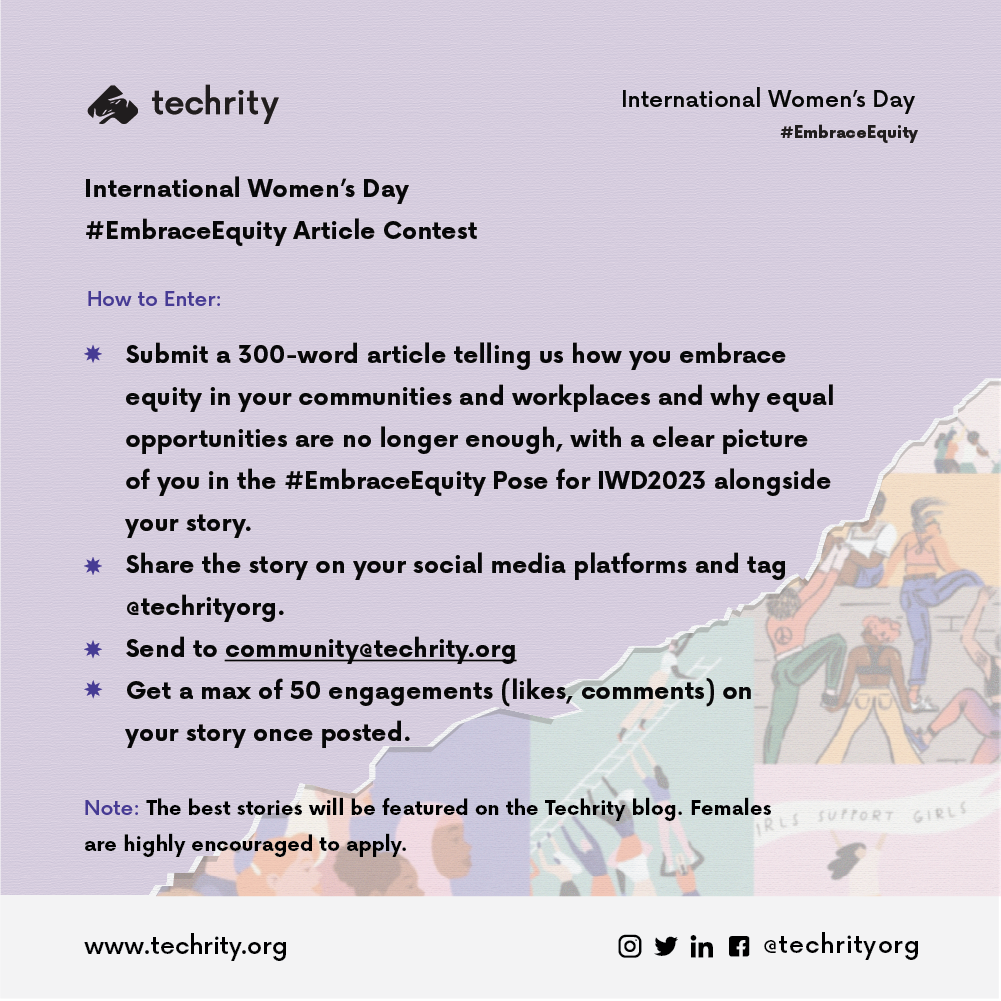
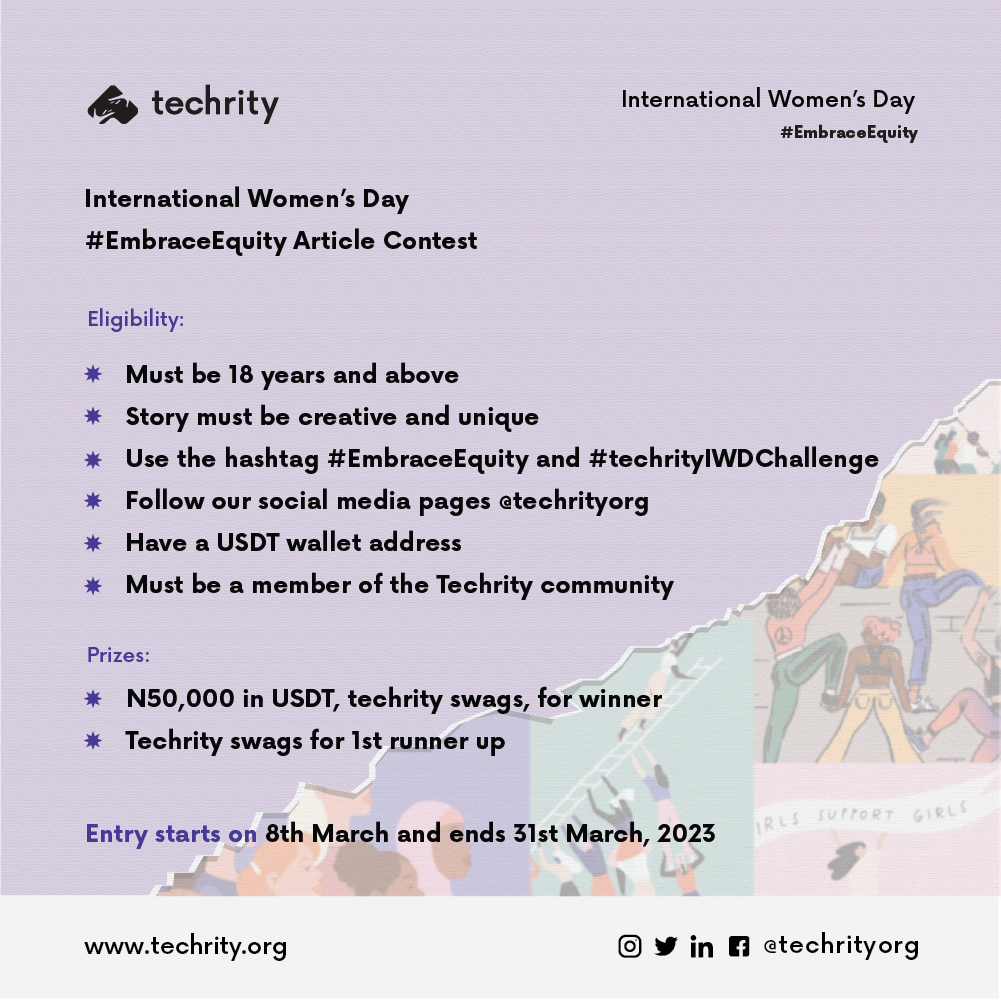
As part of the celebration of IWD2023, Techrity marked IWD by calling for an #EmbraceEquity Article Story Contest. The winner would go home with N50,000 in USDT and their story will be published on the Techrity Blog.

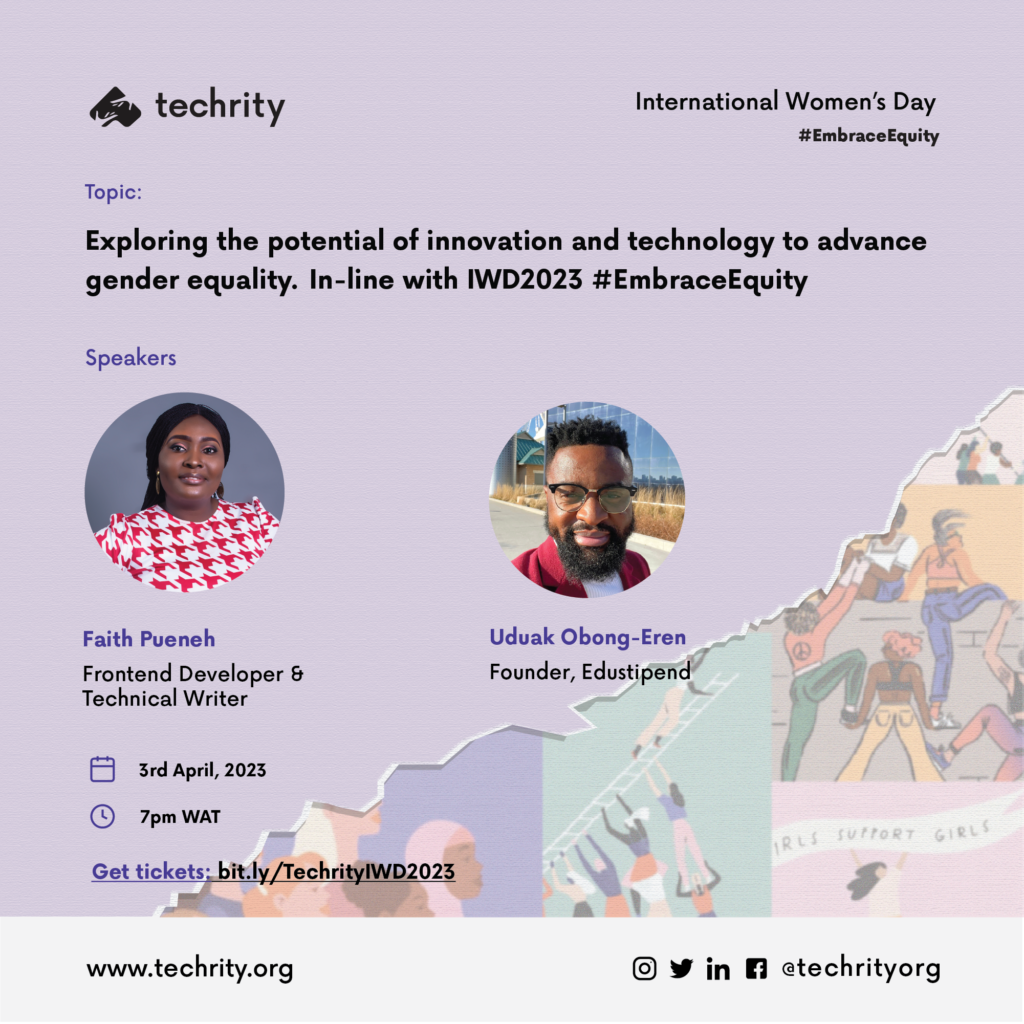
The capstone event held on the 3rd April 2023 on Twitter Space, with speakers; Faith Pueneh and Uduak Obong Eren. Listen to IWD2023 DigitALL: Innovation and Technology for Gender Equality recording.

Speaker for Techrity IWD2023 Event on Twitter Space

Glory Wejinya, a content writer and student at the Rivers State University emerged winner amongst 3 entries for the contest.

Here’s her story below;

Glory Wejinya explains in detail how she’s embracing equity in her community and workplace and why equal opportunities are no longer enough.

“Growing up in a community where women were mostly and still  referred to as a second option and the last choice, I became motivated to promote gender equity as a person. Although I have been unable to do as much as I intend to do, I have within my resources given my honest opinions on matters that affect women in rural communities and promote inclusivity.

To embrace equity means to embrace diversity, inclusion, and fairness. This involves creating a fair and just society where everyone has equal access to resources and opportunities.

Glory Wejinya

While equal opportunities are essential to achieving a fair and just society, having equal opportunities is not a direct solution to deeply rooted inequality and discrimination . This is mainly because not everyone can have equal access to these opportunities. Poverty and lack of access to quality education can greatly limit anyone’s ability to utilise the given opportunities.

Educating, training and equipping women to be ready to take up available roles is a great way to embrace equity in communities.

In 2022, I embraced equity via my contributions to the Domestic Violence Directory, 2022. Currently garnering over 100 downloads, this directory provides information for victims of domestic violence; identifying several domestic violence centres and responders in the 36 states of Nigeria.

Another way I am able to contribute my quota is by volunteering my time and expertise at Her Dream Initiative; a non-profit organisation that aims to empower girls and women all over the world; exposing females to numerous opportunities available to them, ranging from fellowships, and internships to scholarships. I do this through social media management as the publicity team lead of the organisation; lending my voice as a social media manager, creating content that fits the objectives and goals of the organisation, advocating women’s rights, and giving women their flowers”.

Want to reach out to Glory? Follow her on LinkedIn.

Thank you for reading!

Categories
General Tech For Good Techrity Programmes Volunteers Writers

Tech for Good 2022

Showcasing Tech Innovations for Social Good in Africa

The Tech for Good (T4G) is an annual conference that aims to showcase the impact of using Technology for Social Good in Africa.

The second edition of the just concluded Tech for Good conference was held on the 29th of October 2022 at the Rivers State ICT, Techcreek.

Purpose of Tech for Good

There is a lot of negative information being spread out there concerning Tech and its use in Africa. We created Tech for Good to solve this problem.

To understand more about the purpose of the Tech for Good conference, check out the first edition – Tech for Good 2021.

Highlights from the event

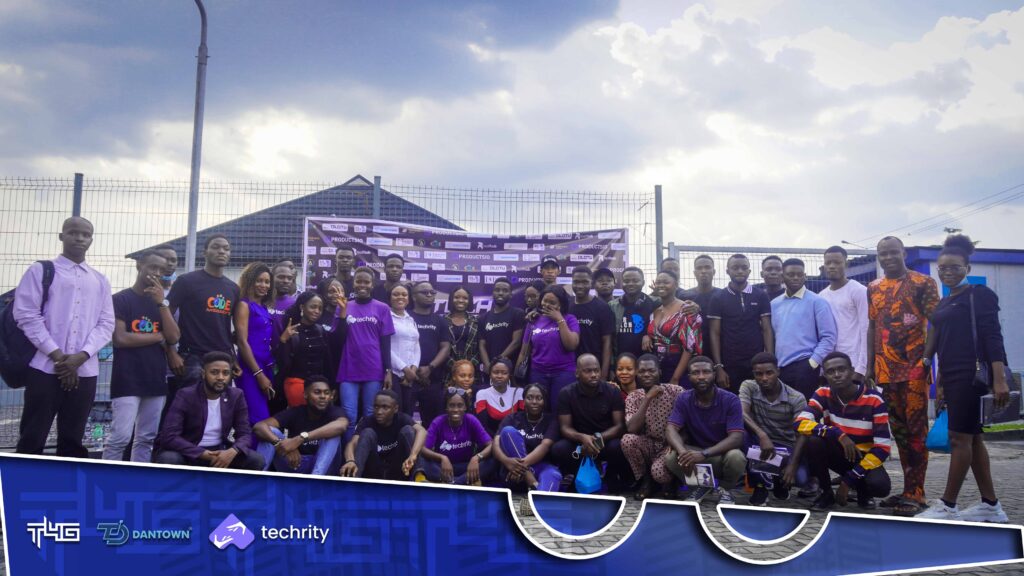
Tech for Good 2.0 was so loaded and full of impact, reporting over 250 persons in attendance, 5 speakers, 6 Social impact orgs, and over 20 people including organizations and startups awarded during the Tech for Good Awards.

Speaker Lineup

This year’s conference featured some seasoned speakers, such as;

  • Mr. Bruce Lucas – Founder and CEO of Olotusquare spoke on “The Journey so Far: Social Impact, Challenges of Tech in Africa”.
  • Davio White, a brand and product designer spoke on Designing for Social Impact
  • Umasoye Igwe, a creative writer and advocate for indigenous languages spoke on “How Tech is revolutionizing indigenous languages for Africans”
  • Sokaribo Senibo, a Software Developer spoke on “Leveraging Tech for Good: Veritable Use cases”
  • Tosin Emmanuel, founder of Blockchain Uniport spoke on “Blockchain Technology as a medium for Social impact in Africa”

Social Impact Project Showcase

The social impact project showcase aims to showcase projects and products built for social good in Africa.

Social impact projects like InformHER, was present to showcase their projects and products

  • InformHer

InformHer helps to empower young girls with the information needed to make decisions about their bodies and sex-related issues while making sure that they embrace their femininity

You can follow @helixgade on Social media to learn more.

Social Impact Orgs

Organizations and companies working tirelessly to ensure the vision of building Tech for Good were not left out, these organizations were invited to tell their Social Impact Story. The aim is to showcase the works of these companies and organizations in Tech.

Some organizations present include:

  • Accelerate Hub

Accelerate Innovation Hub is a technology incubation hub that focuses on facilitating student development in the area of technology and tech entrepreneurship. We aim to create a community that prompts collaboration, ideation, innovation, and synergy for student tech enthusiasts. 

You can follow @acceleratehubng on Social media or visit their website: http://acceleratehub.co/ 

Accelerate Hub – WInner of Social Impact Organization (Non profit) 2022 receiving its award
  • Code Ambassadors

Code Ambassadors Lab is an EdTech Start-up that inspires and equips children between the ages of 5-17 with tech(coding, robotics, Artificial intelligence, etc.), problem-solving, and critical thinking skills. We have trained over 3000 children and are partnered with over 10 organizations and schools within four years. 

The vision is to raise young tech founders in Africa who will leverage technology to solve problems.

You can follow @codeambassadors on Social media or visit their website: https://codeambassadors.org/

  • Technoville NG

Technoville innovation Nigeria is a leading technology organization aimed at social impact and innovative technology solutions. With a vision to “Ignite Curiosity”, it is committed to providing an environment where technology and innovative skills are attainable and curiosity is applauded.

Technoville was founded in 2018, by passionate young people who believe that technology can transform individuals and nations.

You can follow @technovillehq on Social media or visit their website: https://technovillehq.com/

Technoville Nigeria Team
  • Extend Africa

Extend Africa is a community for the immersive tech ecosystem in Africa.

We believe that with this platform, we can strategically project the works of extended reality creators in Africa to the world. We are also certain that through this platform, more people will find use cases of extended reality in ways that will immensely improve their lives.

You can follow @extendafrica on Social media or visit their website: https://extend.africa/

Gospel Ononwi – founder of Extend Africa
  • Blockchain Uniport

Blockchain Uniport is committed to bridging the gap between the student community and their knowledge of Cryptocurrencies and Blockchain Technology in general.

We are determined to build a community force of well-informed students who are equipped for the future of technology.

You can follow @blockchainuniport on Social media.

Tosin Emmanuel – Founder of Blockchain Uniport

Panel Session

The panel session brought together techies doing social impact work to tell their Tech for Good story;

Panelist session – Joy Nwaiwu, Wisdom Nwokocha, Philip Atimor, Godwin Jimmy, Somkene Mamah, Sokaribo Senibo, Solomon Eseme, Smith Nwokocha

Tech for Good Awards

The Tech for Good Social Impact Awards honors individuals, startups, non-profits, and volunteers who use their platforms to better their community and the global community at large

The following is the list of the awardees and nominees for the Tech for Good social impact awards.

Social Impact Icon 2022 (Green Category)

  • Louis Whyte Jonah – Accelerate Hub (nominated)
  • Wisdom Nwokocha – Mentorship (A)
  • Pepple Richard – Technoville (Award)
  • Godwin Jimmy Akpabio – Accelerate Hub, NFTikets (Award)
  • Philip Chukwunonso Obiorah – Co Lead, GDG Cloud, Port Harcourt (Award)
  • Faith Pueneh – Mentorship (nominated)

Social Impact Icon 2022 (Veteran Category)

  • Bruce Lucas – Olotu Square (Award winner)
  • Gino Osahon – GDG Cloud PH (Award winner)

Social Impact (Non-Profit)

  • Accelerate Hub (Award winner)
  • Code Ambassadors (nominated)
  • Harvoxx Tech Hub (nominated)

Startup for Good

  • Mently (Award winner)
  • NFTikets (Award winner)
  • Dantown (Award winner)
  • Bankable Wisdom(nominated)
  • Acend (nominated)

Volunteer of the year awards

  • Jennifer Etegbeke
  • Temitayo Alebiosu
  • Faith Agugoesi
  • Caleb Duff

Our Star Girl

Deborah Folorunsho, a student and member of Code Ambassadors showcased her project at this year’s Tech for Good conference. 

Deborah is a 14-year-old girl who built an app to help addicts recover from their addictions.

She was also featured on Guardian news recently in an article where she talked about her project in detail.

You can read more about her solution on the Guardian News.

Important Links

For more inquiries about the Tech for Good conference, send us a Hi to hello@techrity.org

Thanks for reading!!

Categories
News Tech Tech For Good Techrity Programmes

Tech for Good 2021

Showcasing Tech Innovations for Social Good in Africa.

What is Tech for Good?

The Tech for Good (T4G) is an annual conference that aims to showcase the impact of using Technology for Social Good in Africa.

It is the intentional use of technology to try and have a positive, measurable impact on the world. It’s about using technology to solve big social and environmental challenges.

Why Tech for Good?

There is a lot of negative information being spread out there concerning Tech and its use in Africa. We created Tech for Good to solve this problem.

First, the evolution of technology is beneficial to humans for several reasons. At the medical level, technology can help treat more sick people and consequently save many lives and combat very harmful viruses and bacteria. … Technology has also increased the productivity of almost every industry in the world.

Technology affects the way individuals communicate, learn, and think. It helps society and determines how people interact with each other on a daily basis. It’s made learning more interactive and collaborative, this helps people better engage with the material that they are learning and have trouble with. 

 In summary, it has become an intricate part of our being.

There is a lot of good being done in the Tech Space, startups, innovators, individuals, companies, NGOs are working tirelessly to ensure lives are improved. How much of those actions are being showcased especially in the international media?

T4G brings together students, communities, hubs, organizations, Non-profits, etc to explore veritable use cases for using technology for social good.

Aims and Objectives

  • Showcase innovations in Technology across African Continent
  • Foster Collaboration
  • Provide mechanisms for people to access or use technologies in an open, cost-efficient, and sustainable way.
  • Promote Diversity and Inclusion in Tech. Tech for Good welcomes everyone who has made an impact using Technology in Africa.

Event Recap

The Tech for Good Conference was held on the 2nd October 2021 at TechCreek, Rivers State ICT. Port Harcourt.

The event featured; 

  • Talks
  • Kickstart Award Presentation
  • Inaugural Ceremony

Event Stats

No of Attendees: over 250 attendees

Social Impact Orgs: 10

Social Impact Projects: 2

Speakers: 5

Partners/Sponsors: 2

Present at the Conference was;

Mr Ibifuro Asawo (SA to Rivers State Govt.) was represented by Ella Blaise. She spoke on the topic Driving Social Good Innovations and Youth Development using Technology  

  1. Daniel Don (Founder, Frontend Mentorship) spoke on Using your Tech Skills for Social Good 
  1. Goodnews (CEO, Dantown Multiservices) spoke on Using Blockchain for Social Good
  1. Stephen Okonkwo (Product Lead, Voyance) spoke on his Journey in Tech

Social Impact Organizations

Accelerate Hub was represented by the Women in Tech Accelerate Lead.

Fairexx Solutions was represented by Godfrey Ayaosi, Product Manager.

HerTechTrail was represented by Alex Chibueyim, Design Director at HerTechTrail.

CodeAmbassadors representative speaking at the Tech for Good Conf.

OlotuSquare was represented by Bruce Lucas, CEO OlotuSquare.

FemCode Africa was represented by Shullamite, Founder of FemCode.

TechnovilleNG was represented by the Founder, Technoville – Richard Sodienye Pepple

Kickstart Award Presentation

The award was presented to the recipients of the Kickstart Award Scholarship which consists;

  • Personal Laptop
  • Data support
  • 6months Training.

The recipients of the scholarship were;

  • Prince Onuzulike from Inama International College
  • Chijioke Egbomuche from Hybrid College
Prince Onuzulike receiving his scholarship
Prince Onuzulike receiving his T4G swag from our partner company Dantown
Prince Onuzulike and his mother and siblings with a representative from the Inama International College – Mavis Ejiofor (right)
Chijioke Egbomuche receiving his scholarship from the CEO, Dantown Mr Goodnews Igwe
Chijioke Egbomuche and his Father (Left)

Read more about the TechingTheYoung Outreach 2021.

A Look at Our Partners and Sponsors

Dantown is a fintech company that solves on-ramp and off-ramp payment problems by providing a secure environment through its mobile application, where users can trade cryptocurrency and gift cards.

Our services are geared with customers’ needs in mind. This is the reason we focus on securing the funds of customers, provide a 24/7 helpdesk service, and also offer great digital asset-to-fiat rates.

The company’s goal is to provide more services within the coming months that will further make financial settlements safer, easier and more accessible for the unbanked. 

Founder, Techrity in a group photo with the Dantown Team

Productsio is a learning hub for product builders. we train product makers to build products that are intuitive, that deliver real, usable and commercially valuable innovation through research and understanding in-depth the different cultural keys that go into making a product attractive to local markets.

Productsio representative, Iyerefa speaking
Productsio, sponsors of Tech for Good represented by the Productsio Team

Inaugural Ceremony

Techrity is a tech non-profit that began its operations in December 2020, incorporated in April 2021 and officially launched on 2nd October, 2021 focused on talent development and building innovative solutions using technology for social good in Africa.

We aim to bridge the gap in unemployment, gender inclusion and poverty by providing the vital resources needed to kickstart young talents into tech and build solutions for social good in Africa. 

We envision an Africa where everyone has equal access to opportunities. Has a motivation to pay it forward. We’re engineering the spirit of social good in Africans. We believe if we solve the problem of the digital divide, gender inclusion gap, unemployment and target more social innovations with technology we can inspire social good actions in others.

Tech for Good Team, Speakers, Special Guests cutting the inaugural cake
Tech for Good Team

You can follow the updates from the Tech for Good conference on Social Media using the hashtag:

  • #T4G
  • #techrity
  • #sdg9

Important Links

For enquiries. Send a message to: hello@techrity.org

Tech for Good Livestream is available on Youtube.

Thank you for reading!

Categories
Build4SocialGood General News Tech

Showcasing The Winners for the Techrity #Build4InformalSector Hackathon 2020 Prize For Social Good Innovation!

On 1st December, 2020, The Techrity #Build4SocialGood Hackathon Programme team announced the #Buil4InformalSector Virtual Hackathon.

We welcomed Software Developers, Designers and subject matter experts to ideate and build solutions for solving the United Nations Sustainable Development Goal for the African Continent.

Participants ideated and built solutions addressing UN’s Sustainable Development Goals 9, that is, promoting the industry, innovation, and infrastructure (SDG9), in the following areas.

1. Identity Management 
2. On-lending facility and access to credit through non-traditional financial channels
3. Credit Score and Reputation-based rating

For more info, see Announcing The #Build4InformalSector Hackathon 2020

We received a total of three project submissions for the On-lending facility and access to credit through non-traditional financial channels category.

The following teams submitted their solutions;

Team FundMyFarm

FundMyFarm is aimed at making smallholder farmers have access to informal credit facilities without any hassle whatsoever. We also make it possible for anyone who loves farming but does not have time to do it, to grow together with the smallholder farmers as they put smiles in the face of downtrodden while at the same time, their resources are working for them.


Team Trix

QuikMoni addresses the problem of SME access to credit without collateral.


Team Dorti

Dorti provides a system where users can assist or take care of garbage and get rewarded for it.

A total of 30 participants, 9 teams, and 3 projects were recorded for the #Build4InformalSector Hackathon 2020.

These projects were compiled and submitted to our panel of judges, and we are excited to announce that a winning team emerged.

Participating teams also got a chance to demo their projects in an online event on the 8 January 2021 in front of a live audience and received feedback from our highly esteemed judges.

View the Demo Day Event Recording.

Team Trix: QuikMoni emerged as the overall Winners of the Maiden #Build4InformalSector Hackathon 2020 Prize for Social Good Innovation.

The winning team has access to;

  1. A hub support 
  2. $250 cash prize.
  3. The Techrity #Build4SocialGood Incubation program.

Congratulations to Team Trix: QuikMoni for emerging winners of the #Build4InformalSector Hackathon 2020 and all of the participating teams who helped turn innovative ideas into practical solutions for Africa.

Visit the URL to the QuikMoni solution.

All teams’ prototypes and code can be found on the website and on the #Build4SocialGood Repository on Github.

We sincerely appreciate all participating teams, judges, mentors, speakers and partners who have been with us throughout the beginning of this hackathon. The time and effort invested towards building for social good and addressing the UN #sdgs challenges in Africa cannot go unnoticed.

We look forward to hosting our next #Build4SocialGood Hackathon coming up in the following months in 2021.

Thank you!

Categories
Build4SocialGood General Tech

Announcing Techrity’s #Build4InformalSector Hackathon 2020

Techrity’s #Build4SocialGood presents;

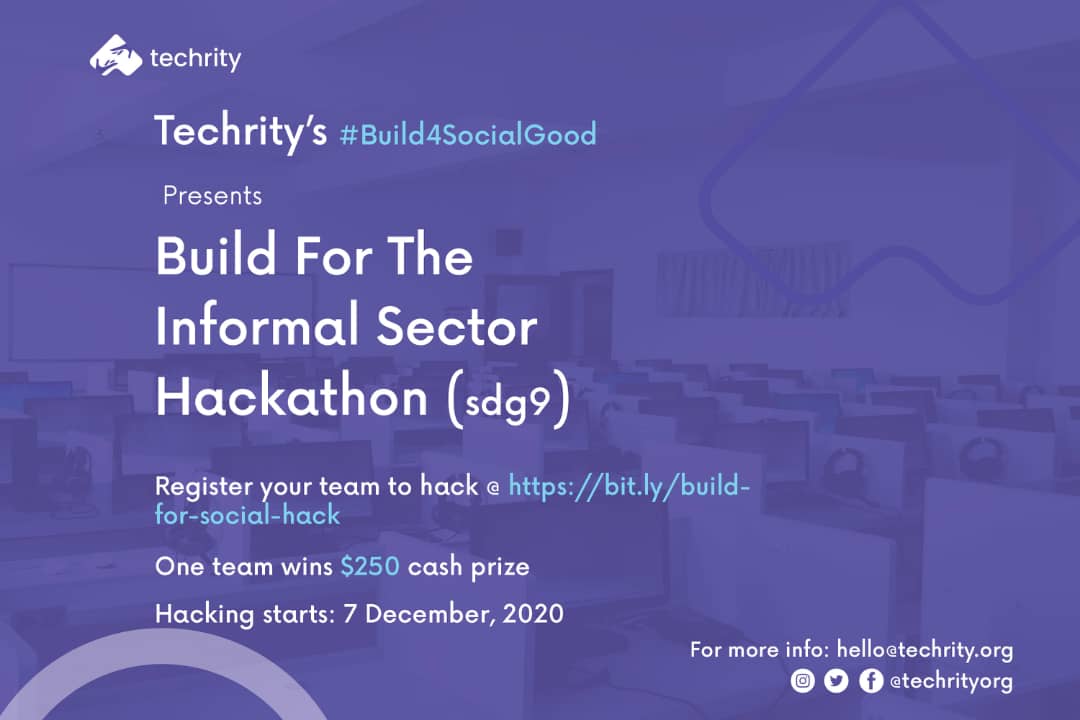
Build For The Informal Sector (sdg9) 

Prize

$250

Timeline of Activities

  1. Registration begins 1st December 2020 via Hackathon Registration
  2. Join the Slack Workspace
  3. Hackathon Starts: 7 December 2020
  4. Project Submission Deadline: 21-23rd December 2020 
  5. Judging starts: 28th December – 2nd January 2021
  6. Demo Day/Award Ceremony: 16th January 2021

Why #Build4Informal Sector?

Nigeria’s informal economy has grown considerably over the last decade.

These are the individuals and micro-enterprises whose economic well-being is birthed and buoyed on the fringes of the formal economy; business activities that remain unregulated, and oftentimes, completely unknown.

Initially, much of the rhetoric centred on the need to ‘manage’ this ever-expanding behemoth that the informal sector was becoming. This narrative has since evolved into one that seeks to formalise these businesses, by catering to their needs and providing them with much-needed support.

Like other parts of the economy, the informal sector has taken a hit from the COVID-19 crisis. Governments have mandated workers to take costly protective measures, such as the regular purchase of masks, the reduction in the number of passengers for motorcycle taxis, or the observance of curfews. Farmers have seen falling demand for their produce as restaurants have reduced their purchases in the face of dwindling traffic.

Key Areas Of Focus

We leave it to you to design the new conditions for the informal economy, and offer the following provocations as a place to get started for your MVPs, prototypes, etc;

  1. On-lending facility and access to credit through non-traditional financial channels
    1. For example, how might we build custom financial solutions for entrepreneurs to access credit outside the regular financial system, other methods of crowdfunding exist such as cooperative funding with little to no default on loan acquisition.
  2. Identity management
    1. Beyond the use of identity cards, bank verification numbers, etc., how can we design an economy where individuals can build a solid identity with other means of identification they can provide such as their telephone number, Social security numbers, school certificates, etc.
  3. Credit-score/reputation based rating
    1. Using purchasing behavior, community validation, etc. How can we design an economy that takes into cognizance an individual behavior as a form of credit score acquisition, for e.g, the ability to use an individual’s reputation overtime on social media as a means to build their credit and reputation score for use in accessing credit and lending facilities outside non-traditional financial systems.

For more info, see the Issues Board.

How to Join

  1. Register your team to hack: Hackathon Registration
  2. Join the slack channel: Techrity Slack Workspace
  3. Read the hackathon guide

How To Submit Hackathon Project

Follow the steps outlined on the #Build4SocialGood Repository readme instructions to submit your project.

Official Hashtags

Please promote this hackathon so it can reach a wider audience on Social Media using the following hastags.

#techrityB4SGHack2020
#techrity
#SDG9
#Build4InformalSector

We can’t wait to see what you have built!

Happy Hacking!!

Categories
News Social Tech Volunteers Writers

Call for Volunteer Writers on Techrity’s Blog!

Techrity, is a non-profit social enterprise, a community of people contributing to advance humanity through their time, money and skills. We believe in the power of using technology for sustainable human capital advancement. We’re all about inspiring the youth to take up careers in tech, through our Mentorship and Kickstart programs, we are also committed to solving social good problems using tech through our Build4SocialGood program.

Techrity is calling for Volunteer Writers!

We publish at the intersection between technology and writing and support sharing knowledge.  Techrity connects you with our community of mentors, techies, writers, software developers, editors and provides the capacity for high impact publishing.

Take a look at this short explainer video explaining what Techrity is all about!

Techrity’s Explainer Video

Benefits

  1. Writers get access to our community of mentors, writers, etc.
  2. All blog posts are credited to the author
  3. Enhance your writing career
  4. Gain visibility

How To Get Started

Want to volunteer to write for us?

Fill out this Application form, and you will be contacted.

To Find out more, Visit the Techrity Official Website.

Thank you!

Categories
General News Software Tech Techrity Programmes

The Build4SocialGood Hackathon Programme

techrity build for social images
techrity build for social good image

Inspire. Coach. Build

The Build4SocialGood Hackhaton brings together developers and techies yearly from all over Africa to develop ideas and build targeted software products for solving sustainable development goals.

Social good is an action that defines some sort of benefit to the general public. Our continent; Africa is laden with a myriad of social good problem which Technology can help to mitigate. We’re looking at building these software which would be managed by the community. Techrity encourages you to #Build4SocialGood and for the #Community. These projects will be managed and open sourced by the community and Winners of the challenge will go ahead to enhance their MVP and solutions in the incubation programme.

Are you passionate about applying your skills for social good, but no funds to kickstart it? Participate in our #Build4SocialGood Hackathon and get a chance to fund your ideas/startup. Hackathon winners will have access to hub support to assist them in their unique innovations. 

#Build4SocialGood Hackathon identify specific challenges for teams to build and provide solutions for social good problems. 

Hackathon participants also get access to mentors to support and direct them during the hackathon phase. 

Come join us, learn new skills, and build functioning prototypes to solve those challenges.

How to join our hackathon challenge

Call for team applications will be announced on the Techrity Build4SocialGood website. Teams will be selected based on merit and inclusivity.

Winners will go ahead to win the prize money and qualify for the incubation program.

Steps

Follow the steps below to register your team.

Step 1: Submit an Application

Visit https://techrity.org/register/hackathon to register your team.

Step 2: Receive a confirmation mail

The #Build4SocialGood team would send a mail outlining next steps.

Step 3: Join the Slack Channel

Prizes

Prizes will be announced in due course.

About Us

Techrity Logo

Techrity, is a non-profit social enterprise, a community of people contributing to advance humanity through their time, money and skills. We believe in the power of using technology for sustainable human capital advancement. We’re all about inspiring the youth to take up careers in tech, through our Mentorship and Kickstart programs, we are also committed to solving social good problems using tech through our Build4SocialGood program.

At Techrity, we believe your donates open doors of opportunities for everyone including the donor, receiver, this creates a circle of givers paying it forward for technology.

Your donation plants seeds of kindness in others, and this promotes a world of revolving kind-hearted people. Help learners get laptops and data to kickstart and make their journey in tech a success.

We encourage you to donate to fund any of our programmes as mentioned. Visit the Techrity Donation page to help someone kickstart their tech career today!.

Organizations, startups etc, can fund a hackhaton programmes and get their ideas tested and developed by our community.


To find out more about what we have in store for our partners, please fill the contact form and we will get back to you in no time.

Thanks.


Categories
General Partners Social Techrity Programmes

Introducing Techrity Partners and Sponsors

Techrity Partners

Want to partner with Techrity to advance the common goal? Find out more in this short article.

Our partners program provides partners willing to fund/donate to any of the Kickstart, Mentorship or Build4SocialGood programmes organized by Techrity with an array of benefits.

Techrity encourages Startups, Organization, Companies and the Government to join in advancing the common goal of “Helping New Talents and Building Tech Solutions“.

Techrity, is a non-profit social enterprise, a community of people contributing to advance humanity through their time, money and skills. We believe in the power of using technology for sustainable human capital advancement. We’re all about inspiring the youth to take up careers in tech, through our Mentorship and Kickstart programs, we are also committed to solving social good problems using tech through our Build4SocialGood program.

At Techrity, we believe your donates open doors of opportunities for everyone including the donor, receiver, this creates a circle of givers paying it forward for technology.

We encourage you to donate to fund any of our programmes as mentioned. Visit the Techrity Donation page to help someone kickstart their tech career today!.

To find out more about what we have in store for our partners, please fill the contact form and we will get back to you in no time.

Our Awesome Partners

HerTechTrail

HerTechTrail is a non-profit raising African Women to build sustainable careers in Tech, by equipping them with relevant Tech skills and providing them access to opportunities.

Follow @hertechtrail on Twitter.

Accelerate Hub

Accelerate hub, facilitates student development in the area of information technology and tech-entrepreneurship.

Visit the Accelerate Hub Website to find out more or follow @acceleratehubng on Twitter.

This list will be updated regularly.

Thanks.