
Categories
Uncategorized

AI at Work: Will A Robot Be My Next Colleague?

Image credit: freepik.com

From scheduling meetings to brainstorming ideas, AI is reshaping the workplace. But will it replace you or empower you?
The workplace is currently experiencing a massive transformation. Artificial intelligence (AI) is no longer a futuristic dream but an active force shaping how we work. From virtual assistants managing schedules to advanced AI models generating creative content, the integration of AI into our daily workflows is accelerating. The question remains: Will AI replace human workers or serve as a valuable colleague, enhancing productivity and efficiency?
This article delves into AI’s role in the workplace, exploring its impact on job roles, automation, and how we collaborate with technology. We will examine the rise of robot assistants, the future of automation, and how professionals can adapt to an AI-driven work environment.

The Rise of AI in the Workplace

Artificial intelligence has become an essential part of modern business operations. Companies across industries leverage AI-powered tools to improve efficiency, reduce costs, and enhance decision-making. AI is no longer confined to tech giants; small businesses, healthcare providers, financial institutions, and retail chains are all integrating AI into their operations.

How AI is Changing Workplaces

AI is changing workplaces in the following ways:
1. Automating Repetitive Tasks: AI excels at handling repetitive and time-consuming tasks, such as data entry, appointment scheduling, and customer service inquiries.
2. Enhanced Decision-Making: AI-driven analytics provide businesses with deep insights, helping managers make informed decisions based on real-time data.
3. Personalised User Experience: AI-powered recommendations and predictive analytics personalise customer interactions, improving satisfaction and engagement.
4. Workforce Augmentation: AI does not necessarily replace employees but augments their abilities, enabling them to focus on strategic and creative work.

Examples of AI in Action

  • Chatbots and Virtual Assistants: AI chatbots like ChatGPT, Siri, Gemini, and Google Assistant streamline communication by answering queries and performing tasks. Businesses also use AI-driven chatbots like Ziva and Leo to handle customer inquiries, reducing wait times and improving service.
  • AI in Finance: Financial institutions rely on AI algorithms for fraud detection, credit scoring, and investment analysis.
  • AI in Healthcare: AI-powered diagnostic tools assist doctors in identifying diseases, enhancing accuracy and efficiency.

Robot Assistants: Colleagues, Not Competitors

Image credit: freepik.com

One of the most visible manifestations of AI in the workplace is the rise of robot assistants. These AI-powered tools and machines are designed to collaborate with humans, improving efficiency rather than replacing human workers.

How Robot Assistants Benefit the Workplace

  • Increased Productivity: Robots can work 24/7 without breaks, ensuring continuous operations.
  • Cost Savings: Automating tasks reduces labour costs and minimises errors.
  • Improved Safety: In high-risk industries like construction and manufacturing, robots handle dangerous tasks, protecting human workers.
  • Enhanced Creativity: By taking over tedious tasks, AI allows employees to focus on innovation and problem-solving.

The Future of Automation and Job Roles

While AI-driven automation is changing how we work, it also creates new jobs. The future workforce must adapt to an AI-integrated environment, focusing on skills that complement automation rather than compete with it.

Job Roles That will be immensely Affected by AI

  • Repetitive Task-Based Roles: Jobs that involve routine, predictable tasks—such as data entry, telemarketing, and certain administrative functions—are more susceptible to automation.
  • Customer Service and Support: AI chatbots handle basic inquiries, reducing the need for extensive customer support teams.
  • Manufacturing and Logistics: Robotic automation in warehouses and factories is reducing reliance on manual labour.
  • Financial Analysis: AI-driven predictive analytics assist in risk assessment, investment management, and fraud detection.

Emerging Job Roles

AI is not just eliminating jobs—it is also creating new ones. As automation takes over repetitive tasks, new roles are emerging in AI development, maintenance, and ethics.

  • AI Ethics Consultants: Ensure AI systems are transparent, fair, and unbiased.
  • Data Scientists: Analyse large datasets to derive actionable insights.
  • AI Trainers: Teach AI models to improve accuracy and reliability.
  • AI Maintenance and Support Specialists: Ensure AI-driven systems function efficiently.

Skills for the AI-driven workforce

To stay relevant in an AI-powered workplace, professionals need to develop the following skills:

  • Critical Thinking: AI excels at processing data, but humans are needed for interpretation and strategic decision-making.
  • Emotional Intelligence: AI lacks human empathy, making soft skills essential for leadership and teamwork.
  • Adaptability: The ability to learn new technologies and adapt to changing job requirements will be crucial.
  • AI Literacy: Understanding how AI works and leveraging it effectively will be key skills across industries.

Will AI Replace or Empower Workers?

Image credit: freepik.com

The debate over AI replacing jobs versus empowering workers continues. The truth lies somewhere in between. While AI will inevitably automate specific tasks, it will also enhance human capabilities, leading to greater efficiency and innovation.

Ethical Considerations and Challenges

Despite its advantages, AI poses ethical and social challenges:

  • Job Displacement: Certain roles may become obsolete, requiring reskilling initiatives.
  • Bias in AI Systems: AI algorithms can reflect biases in training data, leading to ethical concerns.
  • Privacy and Security Risks: AI systems collect and analyze vast amounts of data, raising concerns about data security and privacy.

Preparing for the AI-Integrated Future

Organizations and employees alike must prepare for an AI-driven future. Here’s how:

What Organizations Can Do

  • Invest in Employee Training: Providing upskilling opportunities ensures a smooth transition to an AI-powered workplace.
  • Adopt Ethical AI Practices: Implementing transparent AI governance prevents bias and ensures fairness.
  • Foster Human-AI Collaboration: Encouraging teamwork between AI tools and human employees maximizes productivity.

What Employees Can Do

  • Embrace Lifelong Learning: Staying updated with AI trends and acquiring relevant skills will enhance career prospects.
  • Develop a Growth Mindset: Being open to change and continuous learning will make employees more adaptable.
  • Leverage AI Tools: Understanding how to use AI effectively can enhance productivity and job performance.

Final Thoughts

AI in the workplace is here to stay. Rather than fearing automation, professionals should focus on automation to enhance their skills and productivity rather than fearing it. The future of work isn’t about humans vs. robots—it’s about working together for more incredible innovation and efficiency.
As AI continues to evolve, the key to success will be collaboration, adaptability, and a commitment to lifelong learning. Whether AI becomes a valuable colleague or a disruptive force depends on how we choose to integrate and manage it within our workplaces.
Categories
How-Tos Tech

How Techrity is Building Africa’s Tech Workforce with The Opportunity Board

Introduction

The African tech space is leading in the global digital revolution, with the largest youth population brimming with potential. This agile, young, and creative population is poised with problem-solving skills, motivation, and the ability to compete on a global scale

What This Means for Africa and The Tech Space

According to Statista, over 28 million jobs in Nigeria and 17 million in Kenya will require digital skills by 2030. The number of jobs requiring digital skills in Africa is expected to grow exponentially annually, with a high demand for skilled, vibrant, and motivated tech talent.

Africa is rightly positioned to take advantage of the current shortfall in the global tech workforce. This is due to a report from the World Economic Forum (WEF) in 2017, which stated that Sub-Saharan Africa is the world’s youngest region. By 2030, the continent’s working-age population is set to increase by two-thirds, from 370 million adults in 2010 to over 600 million in 2030.

Yet a significant gap persists between the skills available, access to work tools, opportunities, and demands of the rapidly evolving digital economy.

The Growing Problem

Sub-Saharan Africa has the world’s second-largest youth population after Asia. With more than 60% of its population under the age of 25, Sub-Saharan Africa is already the world’s youngest region today – and, by 2030 more than one-quarter of the world’s total under-25 population.

However, skilled professionals in the tech industry struggle to connect their skills to available opportunities. Many struggle with unreliable job postings and limited access to opportunities, such as a lack of data and a laptop, to help them on their career journey.

This is a far cry for a continent that currently has 13% of the world’s working-age population, which is set to increase rapidly to more than 17% by 2030.

A New Dawn for African Tech Professionals

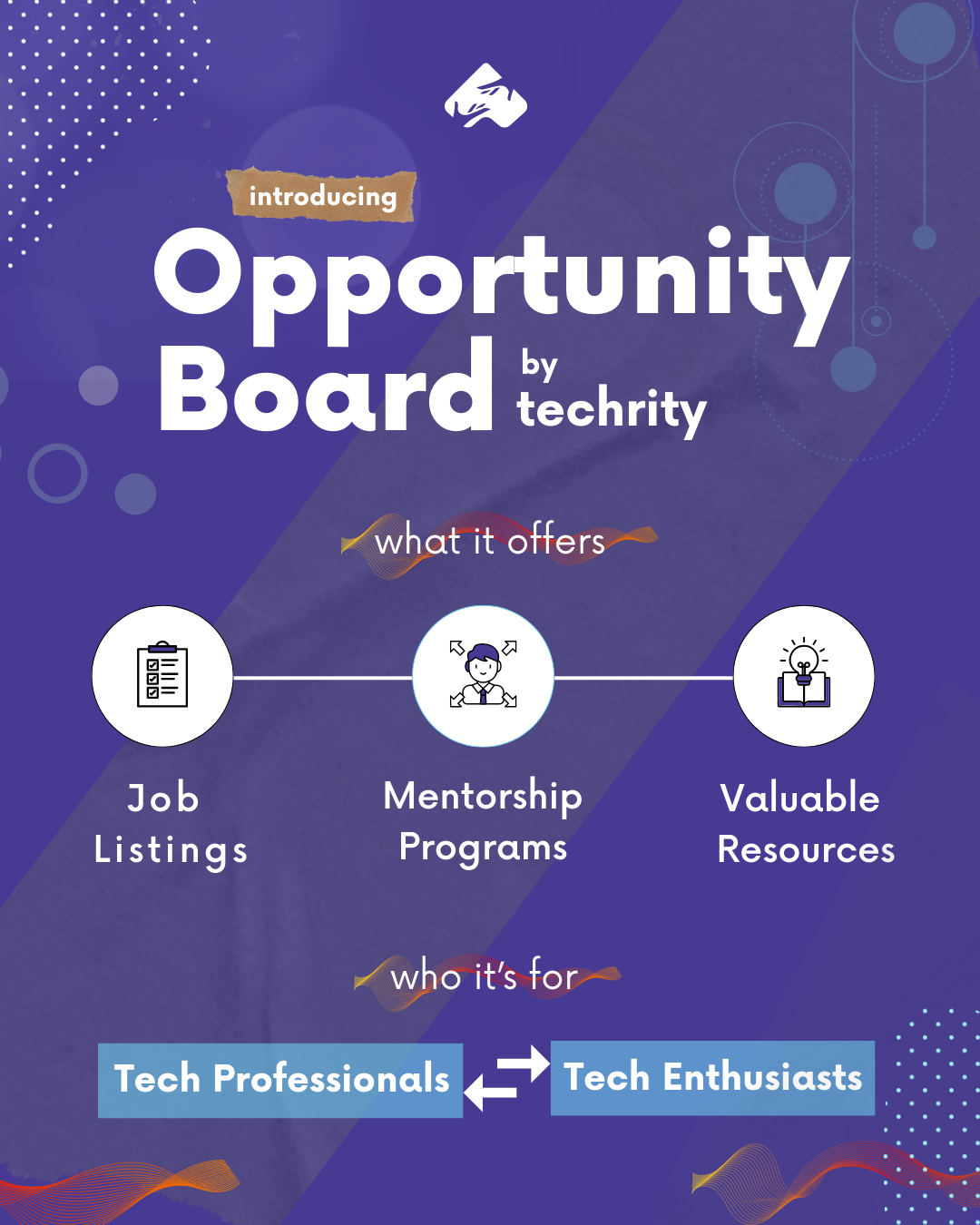
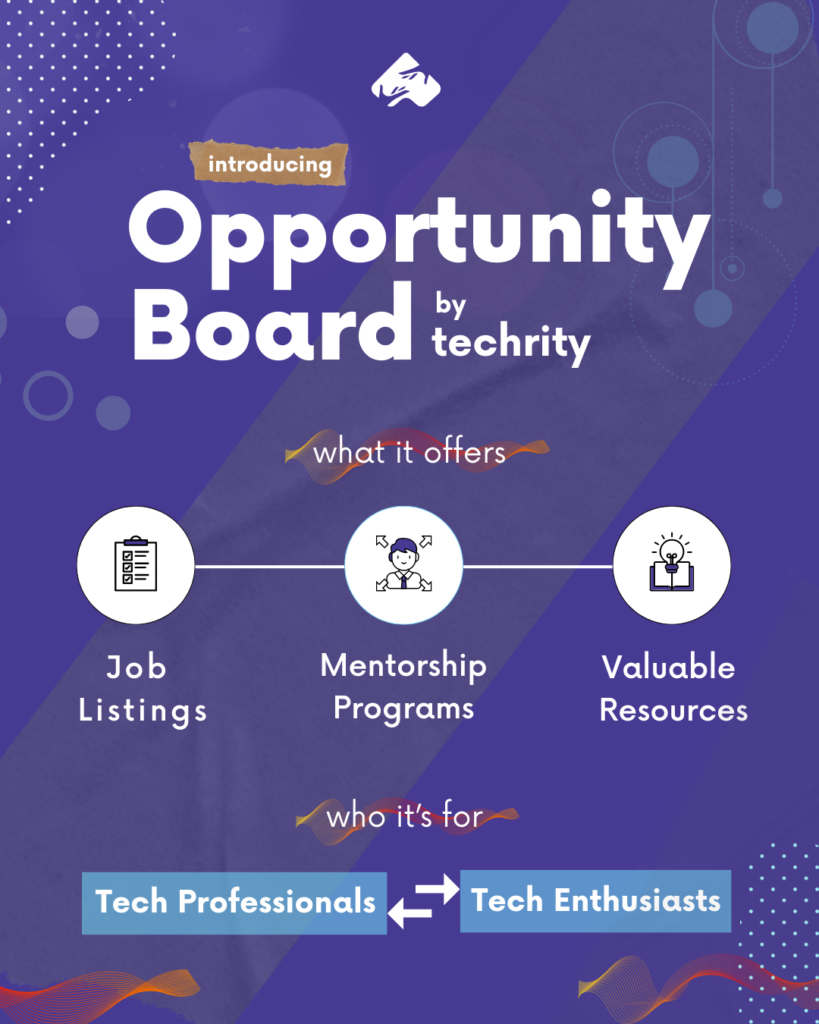
Techrity is stepping up to provide a bold and innovative solution; the Opportunity Board is a platform designed to connect aspiring African professionals with the resources and openings they need to amplify their hard work and talent.

The Opportunity Board will be more than just a job board; it is a home for techies like you and the next generation of professionals to gain access to everything they need to get a job, learn a new tech skill, get data support to enter the tech space, master a tech skill, and digital tools to aid their work.

Connecting Talents with Opportunities

At its core, the Opportunity Board is a vital link between African talent and the global marketplace. It curates a diverse range of opportunities, including:

Job Openings

The board features listings from companies across various tech sectors actively seeking African talent, from entry-level positions to senior management roles.

Internships

Recognizing the importance of practical experience, the platform highlights internship programs that allow students and recent graduates to gain valuable on-the-job training.

Mentorship and Training Programs

To address skills gaps, Techrity partners with leading technical professionals, educational institutions and tech companies to offer guided mentorship training programs, workshops, and certifications that equip individuals with in-demand skills.

Laptop and Data Support

Financial and connectivity constraints can often hinder further learning and training for tech enthusiasts in Africa. The Opportunities Board provides information on how to apply for unlimited access to laptops, grants, and data support from several organizations specifically targeted at African professionals.

Volunteer Opportunities

Get real-world experiences to master your skills with many listings and volunteer opportunities from credible tech companies. These opportunities allow individuals to give back to their communities and make a meaningful impact in the tech space.

Who is This Platform For?

  • Techies looking to compete globally from Africa
  • Motivated and enthusiastic tech talents that do not have access to data to continue learning and mastering a tech skill
  • African tech companies looking to hire the best tech talents in Africa
  • African tech talents looking to practice their skills in a reputable startup through an internship
  • African tech professionals looking for digital work tool support to enable them compete equally.

Empowering You for The Future You Deserve

Beyond simply listing opportunities, Techrity aims to empower individuals with all they need to make informed career decisions. The opportunity board also offers resources such as:

Career Guides

Providing insights into different tech roles, required skills, and career paths.

Salary Benchmarks

Helping individuals understand their market value and negotiate fair compensation.

Company Reviews

Offering insights into company culture and employee experiences

Conclusion

Techrity’s Opportunity Board is transforming tech hiring in Africa by addressing the core challenges faced by job seekers, tech enthusiasts and employers. The platform creates a more efficient and inclusive job market by connecting talents to unseen opportunities and facilitating global job access.

Whether you’re a tech professional seeking your next opportunity, need data support, workplace tools for productivity, or an employer looking for top-tier talent, Techrity’s Opportunity Board is the ideal solution.

It’s a platform to watch and that holds immense promise for unlocking the continent’s vast potential.

Categories
Uncategorized

Building an Attractive Personal Brand Online as a Tech Person in 2025

Image Credit: Freepik.com

In today’s competitive job market, having a strong personal brand is essential for standing out, gaining credibility, and attracting new opportunities. This is especially true for tech professionals, where innovation, skill-sets, and the ability to solve real-world problems can be game-changers. Establishing a compelling personal brand can catapult your career to new heights, whether you’re a software developer, data analyst, product manager, or cybersecurity expert.

In this article, we will be looking at the details of building an attractive personal brand online. We will provide detailed strategies, case studies, and actionable steps to help you position yourself as a go-to expert in your field.

1. Understanding Personal Branding in 2025

What is Personal Branding?

Personal branding encompasses how you present your professional identity, both in the offline and online world. For tech professionals, this means highlighting your technical skills, problem-solving abilities, and personal values. It also involves showcasing your personality, work ethic, and vision. A well-established personal brand helps you connect with your target audience, employers, clients, or peers.

Why is Personal Branding Important?

i. Career Growth

In 2025, recruiters and hiring managers often review your online presence before considering your resume. A strong personal brand increases your chances of being found and recognized for opportunities that match your skill set. For instance, tech professionals who have made a name for themselves by consistently sharing knowledge and showing off their skills on platforms like LinkedIn or GitHub have potentials of attracting job opportunities.

ii. Networking

In tech, networking isn’t just about attending events and building relationships online. A powerful personal brand allows you to network effortlessly with like-minded people in your field.

Networking and meeting other professionals in your field exposes you to various opportunities.

iii. Influence and Authority

Tech professionals who consistently share valuable insights and content are perceived as thought leaders. Your expertise in a niche area can be recognized, allowing you to become an authority in your field. This is a significant advantage when it comes to personal branding.

iv. Opportunities

Having a personal brand can open doors to high-profile speaking engagements, collaborations with industry leaders, and opportunities for brand partnerships. Furthermore, a solid brand helps with business development, attracting potential clients or employers looking for your expertise.

Monetization

A personal brand also provides an avenue for monetizing your knowledge. Whether through content creation on YouTube, selling an online course, or consulting, your brand is the foundation for these income-generating opportunities.

2. Defining Your Unique Value Proposition (UVP)

What is a UVP?

Your Unique Value Proposition (UVP) is essentially the thing that makes you stand out from the crowd. Having a clear UVP helps you communicate your strengths effectively in a world filled with tech professionals. It’s what will help you attract the right audience—whether employers, clients, or peers.

How to Define Your UVP

i. Identify What Sets You Apart

Think about the skills, experiences, and values that distinguish you from others. Are you a developer who specializes in AI-driven applications? Are you a cybersecurity expert passionate about ethical hacking? Your UVP needs to highlight this uniqueness. Write down the things that make you different from others in your field. This could be technical skills, personal passions, or a unique problem-solving perspective.

ii. Focus on Solving Problems

A powerful UVP solves a problem. Ask yourself: “What problems do I help others solve with my skills?” Maybe you help startups optimize their data infrastructure or offer affordable, high-quality web development services for small businesses.

Example: A data analyst focusing on turning raw data into actionable insights for small businesses could define their UVP as “Helping small businesses make data-driven decisions with affordable, user-friendly solutions.”

iii. Your Mission

Your mission also drives your UVP. What is your greater purpose in the tech space? Are you focused on accessibility in tech? On solving a particular societal issue through technology? Your mission becomes your UVP’s foundation and should resonate with your target audience.

Actionable Tip: Write a mission statement that reflects your purpose in tech and tie it to your UVP. This mission statement can evolve but helps you maintain focus as your brand grows.

3. Optimizing Your Online Presence

Image Credit: Freepik.com

A. Crafting a Professional LinkedIn Profile

LinkedIn remains the one of the most powerful tool for professional networking in the tech world. To build a compelling personal brand, your LinkedIn profile must reflect your UVP and engage visitors immediately.

i. Profile Photo

Your profile photo is the first thing people see, so make it count. A high-quality, professional head-shot creates an impression of competence and seriousness. Avoid using casual pictures or selfies.

ii. Headline

Your LinkedIn headline is critical. Rather than just stating your job title, make it compelling by explaining what you do and how you create value.

Example: “Data Scientist | Empowering businesses with AI-driven solutions” or “Cybersecurity Specialist | Protecting organizations from evolving cyber threats.”

iii. Summary

The summary section is your opportunity to tell your story. Explain who you are, what you do, and why you do it. Use storytelling to make it engaging; this section is often the first one potential employers or clients read.

Example: “I’m a passionate data scientist who thrives on solving complex problems with innovative AI solutions. With over 5 years of experience working with Fortune 500 companies, I help businesses turn data into actionable insights that drive growth.”

iv. Experience and Skills

Your experience and skills should directly reflect your UVP. Showcase your most relevant work experience, achievements, and the projects that best demonstrate your capabilities.

Tip: Don’t just list your roles—talk about specific accomplishments. For example, if your SEO strategy increased website traffic by 30%, make sure that’s mentioned!

v. Engagement

Engage with others’ posts by commenting on trends, sharing your thoughts, or providing value through your posts. This boosts visibility and reinforces your expertise.

B. Creating a Personal Website or Portfolio

Image Credit:Freepik.com

A personal website or portfolio is essential for showcasing your work. It’s more than just a digital resume; it’s a space to display your achievements, thought leadership, and unique perspective.

i. About Page

The About page should introduce you to your visitors. Who are you, what do you do, and why are you passionate about it? This is where your personal story matters—let it shine!

ii. Blog Section

A blog section is a powerful way to share your thoughts and experiences. You can write about current trends, new technologies, or personal lessons you’ve learned in your career. Regularly posting to your blog boosts SEO, keeps your audience engaged, and positions you as an authority in your field.

iii. Portfolio Page

Your portfolio should showcase your best work, including case studies, code samples, or product designs. It’s essential to demonstrate your abilities rather than just talking about them.

iv. Contact Page

Make it easy for people to contact you for opportunities, collaborations, or advice. A contact form, email address, or even links to your social media profiles are essential.

C. Optimizing Your Twitter/X and Other Social Media

While LinkedIn is professional, Twitter (now X) allows you to engage with a broader tech community. Many tech thought leaders and industry experts have built their brands mainly on Twitter.

D. Share Valuable Content

Share your thoughts, experiences, and insights into the tech industry on Twitter. It is an excellent platform to discuss emerging trends, tools, and topics that excite you.

E. Engage with Industry Leaders

By commenting on and retweeting the content of industry leaders, you can catch the attention of others in your space. Engaging with key influencers can open doors to collaborative opportunities.

F. Use Relevant Hashtags

Hashtags like #AI, #DataScience, #DevOps, and #TechTips allow your content to reach a broader audience interested in your niche.

4. Content Creation: The Key to Thought Leadership

Image Credit: Freepik.com

Creating and sharing valuable content positions you as a thought leader and establishes your authority, allowing you to connect deeply with your audience.

A. Blogging

Writing blog posts on platforms like Medium and Dev.to, or your website can help showcase your knowledge and establish authority in your field. Topics can range from tutorials to industry insights.

B. Video Content

YouTube is an excellent platform for tutorials, sharing how you were able to solve various problems with your code, and product demos. You can also create shorter videos for platforms like TikTok or Instagram.

C. Open Source Contributions and GitHub Projects

Contributing to open-source projects on GitHub shows practical proof of your skills. It also helps you build connections with other developers and demonstrates your commitment to the community.

D. Podcasts and Webinars

Starting a podcast or hosting a webinar allows you to share knowledge, interact with other thought leaders, and engage with a broader audience.

E. Writing an E-book or Online Course

Creating an e-book or online course can significantly amplify your brand. Platforms like Udemy and Teachable provide the tools to monetize your knowledge while further establishing your authority in your field.

6. Networking and Community Engagement

Networking is a crucial component of building your brand. It’s not just about meeting new people; it’s about cultivating meaningful relationships with individuals with similar professional interests. Networking helps you to stay informed, receive support, and create collaborative opportunities.

Image Credit: Freepik.com

7. Personal Branding Strategies for Tech Professionals

A. Continuous Learning and Skill Development

A strong personal brand requires constant improvement. Technology evolves quickly, and staying up-to-date with the latest trends and acquiring new skills is essential.

i. Upskilling and Certifications

As technology rapidly evolves, staying relevant means learning new skills. Platforms like Coursera, Udemy, and edX offer certifications in various tech fields, including AI, machine learning, cloud computing, and cybersecurity. Obtaining certifications helps improve your knowledge and adds to your credibility.

ii. Attending Events

In addition to formal courses, attending events like Tech for Good and Hack for Good, is another great way to stay ahead of the curve. These events often provide insights into the latest technologies, tools, and frameworks shaping the tech industry.

B. Creating a Strong Online Presence with Consistency

Having an online presence is crucial, but consistency is key. Regularly posting valuable content on platforms like LinkedIn, Twitter, or personal blogs is essential for reinforcing your brand.

i. Consistency in Content Creation

Whether you post about industry news, share tutorials, or write blogs, your content should align with your expertise. Consistent posting increases your visibility and demonstrates your commitment to your niche.

ii. Branding Your Online Presence

All your online profiles—whether on LinkedIn, Twitter, or personal websites—should be cohesive and reflect your UVP. This includes your professional profile photos, bios, and content themes.

C. Leveraging Analytics and Feedback

Understanding how your audience engages with your content allows you to refine your personal branding strategy.

i. Monitor Engagement Metrics

Using analytics tools like Google Analytics for your website, or LinkedIn and Twitter insights for social platforms, helps you track how your content is performing. Are people engaging with your posts? Are they commenting or sharing?

ii. Gathering Feedback

Don’t be afraid to ask your network for feedback. This could be through surveys, informal conversations, or feedback on your blog posts. Feedback helps you understand how your brand is perceived and where you can improve.

8. Measuring and Adjusting Your Personal Brand

A. Setting Personal Branding Goals

Like any professional endeavor, personal branding requires goals. Without clear goals, it’s easy to become lost in the noise.

Short-Term Goals

Short-term goals could include tasks like optimizing your LinkedIn profile, writing a blog post, or getting more involved in online communities. Set clear deadlines for these tasks to ensure steady progress.

Long-Term Goals

Long-term goals might involve becoming a recognized thought leader in a specific area of tech, publishing a book, or landing speaking engagements at top tech conferences.

Tip: Write down your goals and revisit them regularly to track your progress. It will help keep you motivated and focused.

Conclusion: The Power of Personal Branding

Personal branding is no longer optional; it’s a necessity, especially in the ever-evolving world of technology. By understanding your unique value proposition, optimizing your online presence, creating valuable content, networking, and constantly improving your skills, you can build a powerful personal brand that will open doors to new opportunities, collaborations, and career growth.

The key is consistency, authenticity, and dedication. Personal branding is a continuous process, and as long as you remain engaged with your community, stay committed to learning, and build meaningful relationships, your brand will continue to grow and thrive.

Categories
Uncategorized

How to Crack Interviews to Get Your Desired Job in 2025

LinkedIn Sales Solution Via Unsplash

Nigeria’s tech sector is on an exciting journey of rapid growth, playing a key role in contributing about 20% to the country’s economic progress. With the government’s inspiring 3 Million Technical Talent Programme, the goal is to empower three million individuals with training by 2027, greatly enhancing our industry’s talent pool. 

In addition to governmental efforts, more people are getting remote work for local and international clients and companies. Preparing for your dream job in 2025 can be an exciting journey, and strategic interview preparation is key! 

This guide is packed with friendly tips and valuable insights specially designed for tech professionals of all levels. Together, let’s navigate the changing interview landscape with confidence and ease!

1. Understand the Job Market in 2025

Bekeen.co via Unsplash

The first step towards positioning yourself as a top candidate is being adaptable. Whether you’re looking for remote work, on-site, or hybrid, you need to be adaptable to the demands and needs of your industry. 

Employers highly value professionals who swiftly adjust to new technologies and methodologies. Demonstrating a history of embracing change and learning new skills can set you apart.

Having soft skills in 2025 is another way to be adaptable. Beyond technical expertise, qualities such as effective communication, teamwork, and problem-solving are important. Employers seek individuals who collaborate seamlessly and contribute to a positive work environment.

Our Tip: Try to conduct thorough research on your prospective employers. Understand their technological frameworks, organizational culture, and some recent projects or achievements. That way, you can tailor your application and interview responses to align with the company’s specific vision and demonstrate genuine interest and initiative.

2. Master the Basics: Building a Strong Foundation

HJ via Unsplash

Sometimes, we find ourselves rushing to learn complex concepts and overlook the importance of the basics. It’s truly essential for everyone, whether you’re just starting out or already have experience, to have a solid understanding of these fundamental ideas. 

If you’re a beginner, focus on understanding data structures (like arrays, linked lists, trees, and graphs) and algorithms (such as sorting and searching techniques). Engage in regular coding exercises to enhance problem-solving skills. Platforms like Khan Academy, freeCodeCamp, and even YouTube, offer a plethora of problems tailored for beginners.

For experts, be prepared to discuss your significant projects in detail. Highlight the challenges encountered, the solutions implemented, and the impact of your work. This showcases your depth of experience and problem-solving abilities.

Explore complex areas such as system architecture, scalability issues, and performance optimization. Demonstrating expertise in these select areas can separate you from other candidates.

Our Tip: Regularly participate in coding challenges and hackathons. These not only sharpen your skills but also provide practical experience in problem-solving under time constraints.

3. Ace the Behavioral Interview

In 2024, behavioral interviews became a standard recruitment practice, and they will remain essential in 2025. These interviews aim to evaluate how you have managed different situations in the past. 

The picture that hiring managers get from your response will provide them with an insight into your future performance. To ace the behavioral interview, think of the highly effective STAR technique (Situation, Task, Action, Result) when answering your questions.

Our Tip: Reflect on your past experiences and identify key moments that highlight your skills and growth. Practice articulating these stories concisely, focusing on your specific contributions and the outcomes achieved.

4. Technical Interviews: Go Beyond the Code

In 2025, technical interviews will have evolved beyond the traditional sense of what job candidates were used to in 2024 to assess a broader range of competencies beyond mere coding.

There has always been a clamor for real-world problem-solving. Instead of generic technical interview questions, expect scenario-based questions that require you to devise solutions to complex, real-world challenges in the world you see and interact with daily. This tests your ability to apply theoretical knowledge practically.

While artificial intelligence and machine learning may not be directly related to the role you are applying to, understanding their basics can be beneficial. Familiarity with concepts like neural networks, supervised vs. unsupervised learning, and common algorithms can give you an edge.

Additionally, interviews for senior positions will emphasize creating scalable and efficient systems. It’s a great opportunity to showcase your understanding of system components, and data flow, and share how you would tackle potential bottlenecks!

Our Tips:

Use Coding Platforms like LeetCode, HackerRank, and AlgoExpert to practice coding problems. Also, consider system design resources and books that offer deep insights into building robust systems. 

Enroll in introductory courses on platforms like Coursera or Udemy to build a foundational understanding. Finally, mock interviews with peers or mentors also help to simulate the interview environment. This practice can help reduce anxiety and improve your delivery during actual interviews.

5. Practice Virtual Interviews

Olga Gryb via Unsplash

The prevalence of remote work has made virtual interviews a standard part of the hiring process. Nowadays people wear sweatpants under their very formal shirt and tie to seal 6 figure job interviews in their bedroom. 

There is a high need to make a good impression and your technical setup is one way. Ensure your internet connection is stable, and your webcam and microphone are functioning correctly. Always test your setup before the interview to avoid technical glitches.

Our Tip: Keep your interview environment as professional as possible. Pick out a quiet, well-lit space free from distractions. A neutral background minimizes potential distractions and keeps the focus on you. As always, maintain eye contact by looking at the camera, using appropriate gestures, and nodding.

Conclusion

2025 is all about making conscious efforts that bring you closer to your dream tech job and understanding the hiring landscape. Industry experts expect rapid advancements and changes in employer expectations. 

Remember, interviewers often look for foundational knowledge to make sure candidates can confidently tackle core responsibilities. Look out for resources and tips from the Techrity blog as we update our community with goodies from time to time.

Frequently Asked Interview Questions (FAQs)

Ian Mikraz via Unsplash

What are the most common technical questions asked in 2025?

Questions often revolve around algorithms, data structures, and system design. For example, you might be asked to optimize a large-scale search engine query.

How should I prepare for AI-related interview questions?

Start by understanding basic AI concepts like neural networks and machine learning models. Use beginner-friendly courses on platforms like edX or Coursera.

What should I focus on as a beginner in tech?

Build a strong foundation in coding and problem-solving. Highlight any projects, internships, or certifications to showcase your skills.

How do I negotiate salary after an offer?

Research market trends using platforms like Payscale or Levels.fyi. Clearly articulate your value, and don’t hesitate to counteroffer professionally.

How can I handle rejection after an interview?

Seek constructive feedback, analyze areas of improvement, and focus on upskilling. Rejection is part of the process so use it as a learning opportunity.

Categories
Career advice How-Tos Team Management

How Remote Workers Are Staying Motivated During the Holidays

Christmas, Easter, Salah, National Days, no matter the one, the holiday season can be challenging for freelancers who need to stay productive while the world takes a break. If you are a newbie freelancer experiencing the holiday season for the first time, it can all be overwhelming.

While some established freelancers might have the luxury or freedom to take days off during the holidays, others might not. Imagine having to deal with tasks on Christmas Eve while your family is two rooms away laughing over Home Alone 2 (that is a Christmas classic; no one should be missing that!). 

So how do you, as a remote worker, stay motivated during these festive periods, complete tasks, and still manage to celebrate? This article bares all the tricks to escape “vacation mode.”

First Things First, Should I Be Working During Holidays?

The holiday period allows remote workers to spend more time with family, travel, or focus on that hobby they’ve been ignoring all year. Most freelancers make enough to turn down jobs during this busy time of the year. 

However, people new to their respective niches or industries might not have that luxury. The holiday period presents an opportunity for some to earn extra cash heading into the new year.  

Remember that flexibility is one of the reasons people work remotely. People who work from home can go grocery shopping in between checking off tasks from their holiday jobs. But this has big implications. 

It sometimes encroaches on the work-life balance, and if your client is in a different time zone or simply impatient, you might have a harder time than most. But it is perfectly normal to work during the holidays if you can manage to do so and still keep up with the festivities.

Six Ways To Self-Motivate During the Holidays

Image from Unsplash

For the most part, the holiday spirit and desire to lay in bed all day sets in. You stare at blank screens where codes should be. In the worst-case scenario, instead of feeling the Christmas spirit, you get Christmas blues. How can you stay on top of your goals and complete your tasks? 

1. Redecorate Your Workspace

Holiday decorations add to the feel of the season and the celebration. Most of the time, they kindle joy and happiness for the spirited. Imagine the dopamine rush you could get just by staring at that winter wonderland snow globe. If candles, lights, and paper ornaments are more your style, please use them around your office or directly on your desk. The goal is to add elements of the holiday season that trigger happy thoughts and feelings, keeping you enthusiastic in your home office.

2. Set Up Holiday Schedule

Tis the season of good cheer, but ’tis also the season of busy schedules and, sometimes, marketing budget cuts. If you seek career or business growth during the holidays or are new to remote work, you desperately need a holiday schedule. While this might seem out of character for the traditional nature of what freelance workers are used to, it will do you a world of good. For one, it will help you find that work-life balance and avoid “desk-rotting.” Here are a few tips to set up that EOTY holiday schedule:

  • Prioritize tasks
  • Organize according to deadlines and difficulty
  • Take meal breaks, chore breaks, and family time 
  • Use panner tools

3. Reward Your Milestones and Progress

The concept of self-reward might seem a little difficult for most people but it is a great way to stay highly motivated during the holidays. You are never going to run short of distractions during festive seasons. Even if you live alone, you still need to make visits, jump on personal calls, receive visitors, or make a snack. 

You could factor in walks, snacky treats, half an hour of leisure, or a warm bath as rewards for progress recorded on your tasks. This not only motivates you to do so much more, it also helps you to complete it in record time. You look forward to the next tasks and earn the reward it brings.

4. Open Communication With Clients

Image from Unsplash

It’s easy to get sidetracked and lost in the festivities, and you forget how serious certain projects on your desk are. Keeping an open communication allows for effective two-way conversations during this season concerning assigned tasks. But it makes sense first to communicate the extent of your availability and how frequently they can reach out. This helps all parties involved set and understand clear boundaries but remain flexible.

5. Don’t Ignore Sleep

You cannot expect to maintain high levels of motivation if you are not well-rested. What better time of the year to do so than on the holidays? Sleep is a form of self-care, but it does more than eliminate fatigue. It clears the mind and resets your stress levels. If you don’t get enough sleep during the day because of your work schedule, then night’s rest must be unnegotiable. 

If you are struggling with committing to hours of needed rest, remember that in the long run, this could affect your productivity and concentration. While your busy schedule might not allow you to sleep over long hours, you can keep a regular sleeping and waking schedule. Most freelancers say they make out time for afternoon siestas if they stare at the screen too much.

6. Give Yourself Much-needed Breaks

All work and no play certainly makes Jack a dull freelancer. And all the endless notifications, emails, and irregular distractions can hamper your motivation and productivity. This is why you must give yourself breaks between tasks when you run out of creative juices. 

If you require technology-free timeouts, go for fresh air, meditate a little, or read a few chapters of your current reading list. Taking several short breaks over the day aims to boost your creativity levels and clear your clogged mind.

Conclusion

We are all about surviving these busy schedules while remaining adaptable and flexible. But you need your motivation levels to beat the top and your well-being. With these few tricks and tips, you can stay ahead of your schedules and tasks as you look forward to the new year. Got any more tips for how you are staying motivated these holidays? Share them below!

If you are feeling demotivated this holiday season, join our community at Techrity, where tech and dev professionals work from home and share their experiences.

Categories
General Software Tech

The Rise Of No-code And Low-code Development

The primary goal of no-code and low-code platforms is to make the building process of software simpler and faster. These tools have been designed to minimize the necessity of extensive coding knowledge by making it quite easy for users to build applications with limited technical knowledge.

Right now, I am going to take you through the difference between No-code and Low-code platforms.

AI generated image

No-code Platforms

No-code platforms are tailored to users who have no programming knowledge. They leverage visual interfaces where users can design and build applications through drag-and-drop functionality. Essentially, no-code platforms abstract away the complexity of programming languages by providing pre-built components that can be assembled into fully functional applications.

No-code platforms allow users to create simple websites and mobile apps to complex business process automation tools and even Customer Relationship Management (CRM) systems. Popular examples include Wix, Bubble, and Airtable.

Low-code Platforms

Low-code platforms target the user who perhaps can understand coding or at least feel comfortable writing a small amount of code. These tools offer more flexibility than no-code options but still greatly reduce how much code needs to be written in application development.

Low-code platforms do support faster development compared to traditional coding; at the same time, they provide an drag-and-drop interface for easy design, while also allowing developers to create custom code for more advanced functionality. Examples of low-code platforms include OutSystems, Mendix, and Microsoft Power Apps.

While no-code platforms are targeted at non-technical users exclusively, in the case of low-code platforms, both technical and non-technical users have a wider scope for complexity and customization with the possibility of rapid development.

Why Are No-code and Low-code Platforms Gaining Popularity?

1. Shortage of Developers: One of the main reasons for the increasing interest in no-code and low-code platforms is the continuous shortage of professional developers. While the demand for tailor-made software and digital solutions grows, it is increasingly hard for businesses to fill in developer positions. According to LinkedIn, there is a huge gap in technological skills, and companies cannot find candidates for software developer positions.

No-code and low-code platforms alleviate this problem by making non-technical resources, popularly known as “citizen developers,” perform the tasks of app development. In other words, no-code and low-code platforms free business teams from the bondage of depending on IT departments or outsourcing agencies to develop applications for their specific needs. This is a big plus for SMBs that cannot afford to have full-time developers on their payrolls.

2. Faster Time-to-Market: In today’s fast-paced business environment, the ability to get products and solutions to market quickly is more important than ever. Traditional development cycles can take months or even years, especially for large-scale projects. No-code and low-code platforms dramatically shorten the development timeline, enabling businesses to create and deploy apps in a fraction of the time.

This speed is particularly valuable for startups and businesses in competitive industries looking to move as fast as possible to stay ahead of the curve. By embracing no-code and low-code platforms, these businesses can iterate and adapt more quickly-testing and refining ideas with minimal risk.

3. Cost Efficiency: Building custom software traditionally involves hiring a team of developers, designers, and project managers. These development projects tend to be expensive, and the costs can easily add up. No-code and low-code development platforms reduce the requirement for large teams, thus cutting down some of the costs related to app development.

No-code and low-code platforms are cost-effective methods for businesses to implement simple applications or develop internal tools. Beyond reduced development costs, the benefits also include lower maintenance expenses, since apps built on such platforms are typically easier to manage and update.

4. Agility and Flexibility: The fast-changing landscape of modern business demands solutions that can be quickly adapted and updated. No-code and low-code platforms offer businesses the agility to make changes in real-time, whether it’s adding new features, fixing bugs, or updating content.

Because these platforms allow users to change and develop applications without having to wait for extensive development cycles, businesses can quickly adapt to market conditions, customer needs, or internal demands. This level of flexibility means that companies can stay competitive, no matter how fast things change.

5. Empowering Non-Technical Users: No-code and low-code development platforms makes it possible for business professionals, marketers, and other employees to be directly involved in contributing to the development process of an application, hence reducing bottlenecks and allowing the business to scale up their operations with no sole dependency on IT.

No-code and low-code platforms provide the tools to the business users to build their own apps. Therefore, it fosters the collaboration of technical and non-technical teams. In turn, all of this builds up a more agile and responsive development process driven by real-world business needs.

Challenges and Considerations

Despite their many advantages, no-code and low-code platforms do not come without challenges and limitations.

  1. Scalability: While no-code and low-code platforms are great for small to medium-sized projects, they’re not always the right solution for enterprise-scale applications. Apps built on these platforms can start to encounter performance issues or struggle to scale with growing demand.
  2. Security and Compliance: All software applications are concerned with security, and no-code and low-code platforms are no exception. While some platforms offer robust security features, they may not meet the same rigorous standards as custom-built applications. For industries with strict compliance requirements (e.g., healthcare, finance), it’s important to thoroughly vet the platform to ensure it adheres to industry regulations.
  3. Limited Customization: Low-code platforms are more customisable than no-code platforms, but low-code platforms can be limited in one way or another. For instance, users may have very specific or complex features that require implementation beyond the capacity of the platform. In such cases, the development process may demand more specialised knowledge or may not be possible at all.
  4. Vendor lock-in: Many of the no-code and low-code platforms are proprietary, meaning the application built on such a platform is often tied to the vendor’s ecosystem. If you ever want to switch to another tool or migrate your app to traditional ways of development, it will be a cumbersome and painful process. To mitigate this risk, businesses should carefully evaluate platform options and consider long-term scalability before fully committing to a particular tool.

The Future of No-code and Low-code Development

The future of no-code and low-code development looks very bright. As these platforms continue to evolve, they will get much more powerful, flexible, and user-friendly. With the improvements in artificial intelligence (AI) and machine learning (ML), we are bound to see no-code and low-code platforms embed much more intelligent automation for much faster and more efficient development.

Moreover, as demand for software applications widens among various industries, no-code and low-code development platforms are positioned to further become highly instrumental in supporting business growth and innovation without requiring large teams of developers.

In the next few years, the future for no-code and low-code tools is probably in addition to usage by citizen developers, integration in enterprise software systems that will allow for hybrid development approaches whereby business teams will develop alongside IT professionals to create such powerful applications.

Conclusively, no-code and low-code platforms provide something for everyone-from entrepreneurs trying to develop their first app, corporate professionals who want to automate some process, all the way to a developer trying to get faster development lifecycles. Understanding the advantages, challenges, and future potential of these platforms gives companies the capability to leverage them to the fullest and shapes the path towards more agile and innovative software development.

Categories
Best practices General

Protecting Your Data In The Cloud

Cloud storage has indeed transformed how we manage and access data, enabling us to store, retrieve, and share files from virtually anywhere with an internet connection. Businesses leverage cloud storage to streamline operations, while individuals rely on it to safeguard personal memories and important documents.

Consequently, like many technological advancements, cloud storage has its risks. Cybersecurity threats such as data breaches, unauthorized access, and information loss loom large. By addressing common concerns, sharing relatable examples, and offering practical tips, we aim to empower you to keep your data safe while enjoying the benefits of cloud technology.

Why Cloud Security Matters

Photo from Unsplash

Imagine you’ve stored important business contracts, personal tax documents, or cherished family photos in the cloud. One day, you wake up to discover that this information has been accessed without your permission or, worse, deleted. The emotional and financial toll of such incidents is profound, making cloud security not just a technical issue but a deeply personal one.

Imagine you’ve stored important business contracts, personal tax documents, or cherished family photos in the cloud. One day, you wake up to discover that this information has been accessed without your permission or, worse, deleted. The emotional and financial toll of such incidents is profound, making cloud security not just a technical issue but a deeply personal one.

The Risks of Cloud Storage

Before exploring solutions, let’s take a closer look at the most common risks associated with cloud storage:

  1. Data Breaches: Unauthorized access to sensitive data can occur due to weak passwords, insider threats, or sophisticated hacking techniques. Once compromised, this information can be sold on the dark web or used to harm individuals and organizations.
  2. Data Loss: Accidents happen. Files can be mistakenly deleted or corrupted during a system error. Without a reliable backup system, recovering lost data may be impossible.
  3. Data Tampering: Altering the contents of files can have serious repercussions. Imagine a financial report being manipulated to mislead stakeholders or a legal document being altered without your consent.
  4. Denial of Service (DoS) Attacks: In a DoS attack, malicious actors flood a cloud storage provider’s servers with traffic, rendering your data inaccessible. For businesses, this can lead to downtime and loss of revenue.

Storytime: Recent Cloud Security Breaches

  • 2024 Microsoft Data Breach: In a significant data breach, Microsoft’s cloud storage service was compromised, affecting numerous high-profile organizations, including airports, financial institutions, educational institutions, and healthcare providers. The breach highlighted the importance of robust cloud security measures.
  • Nigerian Data Breaches: Nigeria has also experienced its share of data breaches. For example, in 2020, the Nigerian National Identity Management Commission (NIMC) suffered a data breach, exposing the personal data of millions of Nigerians. Another notable breach occurred in 2022, when the Nigerian Ports Authority (NPA) was hacked, resulting in the theft of sensitive data.

How To Protect Your Data In The Cloud

  1. Choose a reputable cloud storage provider: When selecting a cloud storage provider, look for one that has a strong track record of security and compliance. Some popular cloud storage providers that prioritize security include: Google Drive, Microsoft OneDrive, and Amazon.
  2. Use Strong Passwords and Enable Two-Factor Authentication: A strong password is your first line of defence. Use a password manager like LastPass or 1Password to generate and store complex, unique passwords for each account. Enabling 2FA adds an extra layer of security. This feature requires a secondary verification step, such as entering a code sent to your phone or email, making it harder for unauthorized users to access your account.
  3. Encrypt your data: Encrypting your data can help protect it from unauthorized access. Look for cloud storage providers that offer encryption features. For an additional layer of protection, consider third-party encryption tools like Boxcryptor or Cryptomator.
  4. Use access controls: Access controls can help limit who can access your data in the cloud. Look for cloud storage providers that offer access control features, such as: Role-Based Access Control (RBAC) and File-Level Access Control.
  5. Monitor your account activity: Monitoring your account activity can help you detect and respond to potential security incidents. Look for cloud storage providers that offer account activity monitoring.
  6. Use a cloud security gateway: A cloud security gateway can help protect your data in the cloud by providing an additional layer of security. Look for cloud security gateways that offer features such as encryption and access controls.
  7. Regularly back-up your data: Regularly backing up your data can help ensure that it’s available and recoverable in the event of a security incident or data loss. Look for cloud storage providers that offer automatic backup features, such as: versioning and snapshots.
  8. Use a secure internet connection: Avoid accessing your cloud storage over public Wi-Fi networks, which are vulnerable to eavesdropping. If you must use public Wi-Fi, protect your connection with a Virtual Private Network (VPN).
  9. Keep your software up to date: Outdated software can have vulnerabilities that hackers exploit. Keeping your software up to date can help ensure that you have the latest security patches and features. Make sure to regularly update your operating system, browser, and other software.
  10. Use two-factor authentication for all accounts: Using two-factor authentication (2FA) can help add an extra layer of security to all of your accounts. Consider using a 2FA app like Authy, Microsoft Authenticator or Google Authenticator.

Cloud Storage Security Tools For Everyone

  • Cloud Security Gateways: Netskope and Skyhigh Networks
  • Encryption Tools: Boxcryptor and Cryptomator
  • Access Control Tools: Okta and OneLogin
  • Backup and Recovery Tools: Backblaze and CrashPlan

Cloud security isn’t a one-way street. Providers can only implement safeguards to protect their infrastructure, but users must also take responsibility for securing their data. Think of it as a partnership: both parties must work together to ensure robust security.

By working together, we can ensure that cloud storage remains a secure and reliable option for storing and managing sensitive data.

Categories
General

Building Inclusive Tech: Why Designing Digital Tools for Underserved Communities is Important

Photo from Unsplash

Some decades ago, you needed different box-shaped bulky devices to listen to the news, listen to music, see a film, or even tell the weather. Today, with your handheld mobile phone and the Internet, you can reach billions of people and web pages while instantly networking with thousands.

In 2024, approximately 4.8 billion people, or 60.42% of the world’s population, will be smartphone users. This shows that the human race has undergone tremendous growth and change with the advancement of new digital tools and technologies. 

Despite these strides, regions without access to digital tools or limited traditional services and infrastructures are still disadvantaged.

The solution? 

This article contains that and more, including an explanation of underserved/marginalized communities and how to provide equitable access to the tech and digital tools they require.

Let’s go!

What are Undeserved or Marginalized Communities?

The concept of marginalization stems from a familiar word: margin.

Think of a sheet of a notebook. The margins are usually the extreme sides of the paper where you get to write numbers. 

The margins of the paper are very small and restricted away from the middle compared to the rest of the paper. With this in mind, we can deduce that marginalized communities are isolated, disempowered, or treated as insignificant relative to the rest. 

These underserved communities are victims of power and economic imbalances, making them susceptible to discrimination and neglect. In the modern society, access to digital tools are either restricted or nearly impossible for such communities. For instance, in India, 650 million people are without internet connection, making it the largest populace of individuals lacking internet connection in 2024.

Photo from Unsplash

In Africa, 87.4% of Burundi’s teeming population lives without internet access. The story isn’t much different in Nigeria. Despite recent positive internet penetration trends, 120 million Nigerians have zero access to mobile internet.

Citing just internet penetration, we can paint a picture of how millions of people from underserved communities will never benefit from certain technological improvements or digital tools like smartphones, the internet, fintech, and digital medical care. 

Marginalized and underserved societies are common in developing nations where millions live below the poverty line. These societies face several barriers and disadvantages, including:

  • Very limited financial infrastructure
  • Poor and slow infrastructural development
  • Poor educational resource
  • Geographical isolation

These factors have possibly accounted for growth stagnation or poor access to innovative digital solutions that could change lives. The global digital economy itself has few restrictions on entry. 

A teenager in the USA could sit in their room hunched over their laptop writing codes for companies or running cyber security services remotely. In an hour’s work, such a privileged teen can earn the yearly earnings of another teenager’s family of five from a disadvantaged community.

The difference?

Access to tech and digital tools at an early age.

But if traditional services and infrastructure have been historically non-existent, what then? 

Inclusive Digital Tools: Definition and Key Characteristics

Photo from Unsplash

Inclusive technology is any digital tool built to offer users equal access to key services and essential infrastructures despite their background or standing in the digital economy.

Without adequate infrastructure that stagnates underserved communities, individuals and well-meaning tech NGOs can bridge this digital divide gap. One of the foremost ways to do so is by providing transformative but inclusive digital tools and promoting digital inclusion campaigns.

These tech or tools foster digital inclusion ,which is simply the unrestricted use of Information and Communication Technology (ICT) by a populace irrespective of:

  • Age 
  • Ethnicity or race
  • Gender 
  • Cognitive ability
  • Socio-economic background 
  • Mobility 
  • Nationality 

Characteristics of Inclusive Digital Tools

Digital inclusion campaigns typically offer digital literacy training, access to the internet, online infrastructures, inclusive technology software, and hardware. For a tool to be considered inclusive, it should meet these criteria:

  • Affordable: Inclusive digital tools must be priced so that low-income or financially disadvantaged users can afford them. Subsidies or differently priced models should be available if possible.
  • Accessible: In addition to being affordable, inclusive digital tools should be easy to use, regardless of the user’s disability or level of education or literacy.
  • Versatility and Interoperability: The ability to function with different platforms and systems while offering variety marks a inclusive digital tool.
  • User-focused: An inclusive digital tool must be designed with user-centricity in mind. From design to manufacture to installation and use, these tools must meet the target user’s needs.
  • Wide Reach: Another mark of digital inclusive tech is its ability to reach large numbers of people with ease and precision while maintaining efficient scalability. 
  • Technical Support: Whether it’s multilingual options or the chance to speak to a skilled professional about existing issues, inclusive tools must have sound technical support so users can successfully and confidently utilize them. 

How Techrity is Bridging the Digital Divide

Techrity is one of Africa’s budding digital inclusion champions, serving underserved communities. When asked why we aspire to a digitally inclusive continent, we say, “Why not?”

Our society has many economic, political, and historical barriers. Nonetheless, through our mentorship programs and Tech For Good initiative, we foster fairness and equity while tearing down structural barriers. 

Techrity

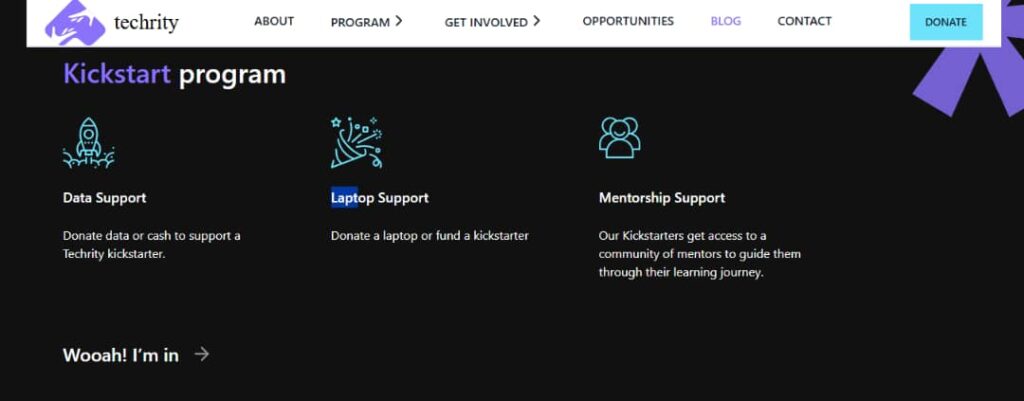
One of the long term missions of Techrity is to onboard disadvantaged newbies in the tech scene with as little confusion and stress as possible. We do this through our effective Kickstart Program:

  • Data Support
  • Laptop Support
  • Mentorship

With this three-fold assistance towards the fight against digital inequity, we are ensuring that thousands of individuals gain needed IT skills, allowing underserved communities actively participate in the digital economy, and boost financial independence and employability!

You can be a part of this unique quest for change by donating here in a few easy steps or by joining our community.

Categories
Tech Tech For Good

 Emerging Trends in Technology

The trends in technology are vast. We have since grown from the invention of ICs, Transistors, and Microprocessors to the Internet in the 1990s. Most especially the late 1950s and early 1960s marked a pivotal era as Integrated Circuits, commonly known as ICs invented by Jack Kilby and Robert Noyce were used to power the digital revolution.

Some Notable Trends In Technology

Health-tech

The Healthcare Industry has experienced a massive improvement in patient healthcare services due to recent trends in technology.

Technologies like brain-computer interfaces (BCIs) are being developed to help individuals with disabilities control prosthetics or communicate through thought alone. Companies like Neuralink are at the forefront of this innovation, aiming to treat neurological conditions and potentially enhance cognitive capabilities.

Biotechnology leverages biological systems to develop products and solutions for healthcare, agriculture, and more. CRISPR gene editing, for instance, allows for precise modifications to DNA, offering potential cures for genetic disorders. Editas Medicine and CRISPR Therapeutics are pioneering this field, promising revolutionary treatments.

Quantum Computing Technologies

Quantum computers use the principles of quantum mechanics to perform calculations at unprecedented speeds. These computers can solve complex problems in cryptography, material science, and pharmaceuticals. Companies like IBM and Google are making significant strides, with IBM’s Quantum Experience and Google’s Sycamore processor leading the charge.

Artificial Intelligence (AI)

Artificial Intelligence (AI) is transforming industries by automating tasks, providing insights through data analysis, and enabling new levels of personalization. OpenAI’s GPT-4 and Google’s DeepMind are examples of AI systems pushing the boundaries of what machines can do.

AI-powered virtual assistants like Amazon’s Alexa, Apple’s Siri, and Google Assistant are becoming increasingly sophisticated. They help users with tasks ranging from setting reminders to controlling smart home devices, providing a more intuitive and interactive user experience.

Knowledge graphs organize information in a way that machines can understand, enabling better data analysis and AI applications. Companies like Google use them to improve search results and enterprises to enhance data management.

Smart Spaces

Digital twins are virtual replicas of physical objects or systems that support real-time monitoring and simulation. They are used in various industries, including manufacturing, healthcare, and urban planning, to optimize performance and predict maintenance needs. Siemens and General Electric are leaders in developing digital twin technologies.

Smart spaces integrate digital and physical environments to create interconnected, intelligent systems. These include smart homes, cities, and workplaces that enhance convenience, safety, and efficiency. Companies like Cisco and Microsoft are developing solutions to integrate IoT devices and AI to create smart spaces.

Autonomous Vehicles

Self-driving cars, flying cars, and drones represent significant advancements in transportation and logistics. They promise to reduce accidents, improve traffic management, and increase delivery efficiency. Tesla’s Autopilot and Waymo’s self-driving cars are leading examples of autonomous vehicle technology.

Computer Vision

Recent developments in computer vision enable machines to interpret and make decisions based on visual data. Applications include facial recognition, autonomous navigation, and quality inspection in manufacturing. Companies like NVIDIA and Intel are advancing computer vision capabilities and integrating them into various products and services.

Blockchain and Decentralized Identity

Blockchain technology provides a secure, decentralized ledger for recording transactions. It is the foundation of cryptocurrencies like Bitcoin and Ethereum, and it also has applications in supply chain management, finance, and digital identity. Companies like IBM and ConsenSys are exploring diverse use cases for blockchain technology.

The Decentralized Identity approach allows individuals to control their personal information without relying on central authorities. Blockchain technology underpins decentralized identity solutions, providing enhanced privacy and security. Projects like Microsoft’s Decentralized Identity and Sovrin Network are pioneering this field.

Renewable Tech and Sustainable Tech

Technologies focused on harnessing renewable energy sources like solar, wind, and hydropower are crucial for a sustainable future. Companies like Tesla (with its solar products) and Vestas (wind turbines) are at the forefront of renewable tech.

Sustainable Tech involves developing technologies that minimize environmental impact and promote sustainability. Innovations in this area include biodegradable materials, energy-efficient systems, and circular economy solutions. Companies like Patagonia and Beyond Meat are examples of businesses integrating sustainable tech.

Green Technology focuses on reducing environmental impact through innovation. This includes everything from electric vehicles to green building materials. Tesla’s electric cars and LEED-certified buildings are prominent examples of green technology.

No Code Development

No-code platforms enable users to create applications without needing to write code. This democratizes software development, allowing more people to build solutions. Platforms like Bubble and Webflow are making no-code development accessible and powerful.

Internet of Behaviour (IoB)

Internet of Behaviour (IoB) combines data from various sources to influence behavior. It uses data analytics and behavioral science to understand and guide user actions. Applications include personalized marketing, healthcare interventions, and workplace productivity tools.

Benefits of Emerging Technologies to the Tech World

Innovation and Efficiency

Emerging technologies drive innovation, leading to the creation of new products and services. They enhance efficiency in various processes, reducing costs and time.

Problem-Solving

They offer solutions to complex problems, from healthcare to climate change, improving the quality of life and sustainability.

Economic Growth

By fostering new industries and job creation, emerging technologies contribute to economic growth and competitiveness.

Accessibility and Connectivity

Technologies like 5G and blockchain improve connectivity and accessibility, enabling more people to participate in the digital economy.

Challenges Posed by Emerging Technologies to the Tech World

Security and Privacy

As technology advances, so do the risks of cyberattacks and data breaches. Protecting sensitive information becomes increasingly complex.

Ethical Concerns

Issues such as AI bias, surveillance, and the impact on employment raise significant ethical questions.

Regulation and Compliance

Keeping up with rapid technological advancements poses challenges for regulatory bodies to ensure safety and compliance without stifling innovation.

Environmental Impact

The production, use, and disposal of new technologies can endanger the environment if not managed sustainably.

Remember, as these technologies evolve, staying informed and adaptable will be crucial for leveraging their full potential and addressing the critical challenges they pose.

Categories
Best practices

Clean Code Principles

Clean code is any code that is easy to read, understand, and modify. It is written to be easily understood by developers, including the future version of the original author. A clean code is like a well-written essay: it has a clear structure, uses meaningful names, and follows consistent formatting. It is devoid of unnecessary complexity and is designed to be as simple as possible while still achieving its objectives.

Features Of A Clean Code

  1. Readability: Clean code is easy to read and comprehend. When other developers (or even you, at a later time) look at your code, they should be able to understand its purpose and functionality quickly. This involves using clear and descriptive names for variables, functions, and classes, and logically organizing the code.
  2. Maintainability: A clean code is easier to maintain and extend. This means that when you need to add new features or fix bugs, you can do so with confidence, knowing that your changes will not dis-organize or slow down an existing functionality.
  3. Testability: A clean code is typically easier to test. A well-structured and modular code lends itself to easier unit testing and integration testing, which are essential for ensuring the reliability of the software.
  4. Scalability: A clean code can handle growth more gracefully. As your project evolves and scales, well-written code can adapt to new requirements and changes without becoming unmanageable.
  5. Collaboration: In team settings, a clean code facilitates better collaboration. When code is easy to read and understand, team members can more easily contribute, review, and enhance each other’s work.

Principles of A Clean Code

1. Meaningful Names: Names are fundamental elements of code, and their clarity can significantly impact code readability. They are used for variables, functions, classes, and modules. Good naming can significantly improve code readability. Here are some guidelines for naming:

  • Be Descriptive: Use names that describe the purpose of the variable or function. For example, ‘calculateMonthlyInterest’ is more descriptive than ‘calcInt’. Descriptive names help developers understand the code’s functionality without needing to decipher abbreviations or cryptic names.
  • Avoid Abbreviations: Abbreviations can be ambiguous and hard to understand. Instead of ‘num’, use ‘number’. This makes the code more readable and reduces confusion.
  • Use Pronounceable Names: If a name is hard to pronounce, it will be hard to remember. Choose names that are easy to pronounce and remember. For example, ‘createTimestamp’ is easier to pronounce than ‘crtTmstmp’.
  • Consistent Naming Conventions: Stick to a consistent naming convention throughout your codebase, such as camelCase for variables and functions and PascalCase for classes.

2. Single Responsibility Principle (SRP): The Single Responsibility Principle states that a class or function should have only one reason to change. What this means is that each class or function should have only one responsibility or job. Adhering to SRP makes your code more modular and easier to maintain. For example, a function that handles user authentication and data fetching should be split into two separate tasks.

3. Keep It Simple, Stupid (KISS): The KISS principle emphasises simplicity in design. Avoid overcomplicating your code with unnecessary complexity. Simple code is easier to read, understand, and maintain. Strive for the simplest solution that works.

4. Don’t Repeat Yourself (DRY): The DRY principle states that you should avoid duplicating code. Duplicate code can lead to inconsistencies and make maintenance more difficult. If you find yourself copying and pasting code, consider restructuring it into a reusable function or module.

5. Write Small Functions: Small functions are easier to read, understand, and test. Ideally, a function should do one thing and do it well. If a function grows too large or tries to handle multiple responsibilities, consider breaking it down into smaller functions.

6. Use Comments Wisely: Comments should complement clean code, not replace it. Comments can be helpful, but they should be used sparingly. Use comments to explain the “why” behind your code, not the “what.” For example, explaining why a particular algorithm was chosen or why a specific workaround is used can be helpful.

7. Consistent Formatting: Consistent formatting improves readability and helps maintain a uniform style throughout the codebase. Use a consistent style for indentation and spacing. Many development environments offer tools or plugins to enforce consistent formatting. Adopting such tools can help maintain uniformity across the codebase.

8. Avoid Magic Numbers: Magic numbers are hard-coded values that appear without explanation. They can make code difficult to understand and maintain. Instead of using magic numbers, define constants with meaningful names. For example, use ‘MAX_USERS = 100’ instead of ‘100’.

9. Error Handling: Proper error handling is important for writing robust code. Instead of relying on error codes, use exceptions to manage errors effectively. Exceptions can convey more context about the error and allow for cleaner error handling. Ensure that your code can gracefully handle unexpected situations without crashing.

10. Testing: Writing tests for your code ensures that it works as expected and makes it easier to restructure and extend. Aim for high test coverage and write tests that cover different edge cases. Use unit tests for individual functions and integration tests for larger components.

11. Refactoring: Regularly refactor your code to improve its structure and readability. Refactoring involves making small changes to the code without changing its external behaviour. This helps keep the codebase clean and maintainable.

12. Use Version Control: Utilise version control systems like Git to track changes, collaborate with others, and manage different versions of your codebase effectively.

Write clear and descriptive commit messages to document the purpose of changes and make it easier for others (or yourself) to understand the history of the codebase.

13. Documentation: Provide adequate documentation for complex code, APIs, and public interfaces to assist other developers in understanding and using your code effectively. Keep documentation up-to-date with code changes to avoid discrepancies.

Importance Of Clean Code

A clean code is important for several reasons, all of which contribute to the overall quality and efficiency of software development.

  1. Improved Communication: A clean code acts as a form of communication among developers. It conveys the developer’s intent and logic through its structure and naming conventions, reducing the need for extensive explanations or documentation.
  2. Enhanced Debugging: Debugging is significantly easier with clean code. When code is well-organised and logical, identifying the source of bugs and issues becomes more straightforward. This can reduce the time and effort required to fix problems.
  3. Facilitates Refactoring: As requirements change, code often needs to be refactored. Clean code is easier to refactor because its structure and design adhere to principles that support modification without introducing new issues.
  4. Better Performance: While a clean code doesn’t guarantee performance improvements, well-written code often avoids performance pitfalls like unnecessary computations or inefficient algorithms. Performance enhancements can be more effectively applied to clean code.
  5. Long-Term Maintenance: Software maintenance is a critical aspect of development. Clean code reduces the risk of introducing bugs during maintenance and makes it easier to understand the impact of changes.

By following the principles outlined in this article, you can produce code that is not only functional but also easy to read, maintain, and extend.