
Categories
Uncategorized

The Rise of New Jobs: 10 Careers That Will Thrive by 2030

Introduction

Rapid technological advancements, climate change, and evolving societal needs are shaping the future of work globally. By 2030, the job market will look vastly different, with roles that seems exciting.

From designing and communicating through the virtual worlds to auditing AI systems and navigating the decentralized economy, future careers will require a unique mix of technical expertise, creativity, and adaptability.

In this article, we’ll explore some of the most intriguing and unexpected jobs that will emerge by 2030 due to advancements in artificial intelligence, machine learning, data analysis and other emerging technologies.

10 Job roles that will trend by 2030

1. AI and Machine Learning Specialists

Artificial intelligence is becoming increasingly sophisticated, intelligent systems that perform tasks on behalf of humans will play an important role in the workforce.

AI/machine learning specialists design and develop AI models to automate processes and solve complex problems. They use machine learning concepts to optimize data processing and create predictive models.

What they’ll do:

  • Designing and validating AI models.
  • Extracting insights using AI tools.
  • Fine-tune AI systems to improve accuracy and efficiency.
  • Working with teams to integrate AI solutions.
  • Develop and train AI systems to automate processes, analyze data and improve decision-making.

This will be a key role because their work will efficiently revolutionize industries by leveraging AI to enhance efficiency and decision-making across industries. automating repetitive tasks, and enabling humans to focus on higher-value work.

Opportunities will be open in several companies, such as OpenAI, Google (DeepMind), Microsoft, Facebook (Meta) and Apple.

2. Prompt Engineers

As AI language models like ChatGPT become more sophisticated, prompt engineers will specialize in crafting adequate inputs to optimize AI outputs.

What they’ll do:

  • Develop strategies for interacting with AI systems.
  • Train teams on how to use AI tools effectively.
  • Continuously refine prompts to improve accuracy and relevance.

Prompt engineering is a hotcake, most especially with the adoption of AI in almost every business case, from note-taking to research and marketing.

Having a skill that can unlock the full potential of AI and bridge the gap between human intent and machine understanding is crucial and will be heavily rewarded.

Companies interested in these skills include serial marketing companies, research institutes, and tech companies.

3. Metaverse Planners

The metaverse, a collective virtual shared space, is no longer a futuristic concept. It is here to stay and by 2030, Metaverse planners will be in high demand and big companies like Meta, Microsoft, and Roblox are investing heavily in building immersive digital worlds.

What they’ll do:

  • Design and manage virtual environments for work, education, and entertainment.
  • Collaborate with architects, game designers, and software developers.
  • Ensure user-friendly and inclusive experiences in the metaverse.

With multibillion-dollar tech companies investing in creating the metaverse and rapidly integrating it into everyday life, the need for Metaverse planners will shape how we interact with digital worlds.

4. Blockchain Technology Developers and Experts

The future of decentralization, spanning blockchain technology and the decentralized internet or Web3, depends heavily on the skills of developers, key opinion leaders or KOLs, content creators, marketers, and others to influence the rapid digital economy movement. Companies with high interest include Coinbase, Binance, Ripple, Consensys, IBM Blockchain, JP Morgan, and Accenture.

What they’ll do:

  • Build decentralized applications (dApps) and smart contracts.
  • Develop and manage blockchain-based financial systems.
  • Educate businesses and individuals on Web3 technologies.

User ownership of the internet, Defi, and other decentralized technology use cases are revolutionizing industries like finance, gaming, and supply chain management, creating a demand for skilled professionals to tap into by 2030.

5. Environmental Engineer

Climate change and social issues are on the rise daily. Climate change has led to increasing the frequency and intensity of natural disasters, including earthquakes, fire outbreaks in America, and floods in Africa and other parts of the world.

Environmental engineers will leverage technology to design systems to prevent, control, or remediate environmental hazards. They work on waste treatment, pollution control, and environmental compliance.

What they’ll do:

  • Design systems for pollution control.
  • Create and coordinate waste treatment and recycling.
  • Create digital systems to ensure environmental regulations are met.
  • Analyze geological data to identify patterns and risks.
  • Develop and implement technologies to reduce atmospheric carbon.

Other roles like earthquake forecasters, climate change reversers, and change advocates will help reverse the effects of climate change, save lives, reduce economic losses, and ensure a sustainable future.

These engineers will play a vital role in protecting public health and the environment by developing sustainable solutions.

Companies hiring include environmental consultancies, NGOs, government agencies such as UNICEF, WHO, Bill and Melinda Gates Foundation, Ford Foundation ad more.

6. Big Data Specialist

Big Data Specialists are crucial in today’s world, where every decision is influenced by numbers. Their role involves using statistical and analytical techniques to collect, analyze, identify trends, correlations, and anomalies in large datasets to provide actionable insights that inform business decisions.

What they’ll do:

  • Collect, gather and analyze data from various sources.
  • Applying statistical data analysis techniques to extract insights.
  • Creating visual representations of data for stakeholders.
  • Identifying recurring patterns for strategic planning.
  • Building predictive models for future trends.

Big Data Specialists bridge the gap between raw data and strategic business decisions, making them indispensable in a data-centric economy.

Companies hiring include Tech firms (Google, Amazon), financial institutions, healthcare institutes.

7. AI-Powered Healthcare Specialists

Medical professionals like doctors, nurses and other healthcare workers provide critical healthcare services, addressing aging populations and global health demands.

AI is revolutionizing the way healthcare is administered by healthcare professionals from using AI-driven solutions for diagnostics, treatment planning, and personalized medicine to building custom healthcare solutions.

What they’ll do:

  • Interpret medical data using AI tools.
  • Providing patient care in various settings.
  • Managing remote healthcare services.
  • Coordinating with healthcare teams.
  • Develop personalized treatment plans based on AI insights.
  • Collaborate with doctors and researchers to improve diagnostic methods.

Background knowledge of AI, healthcare informatics, and medical knowledge would be of great advantage to enable early detection and personalized care, transforming healthcare outcomes.

Mental health care will leap forward with VR therapy, exploring VR environments to treat conditions like PTSD, anxiety, and phobias.

You can work in hospitals, clinics, telehealth providers such as IBM Watson Healthcare, NVIDIA Clara, John’s Hopkins Hospital, Healthcare, Philips, Siemens Healthineers, and Tempus.

8. Cyber-security Specialists

Cybersecurity is a field that will always need skilled talents. Cybersecurity specialists protect digital and physical assets from threats by developing, improving, and monitoring security measures. They assess risks, manage encryption protocols, and respond to cybersecurity incidents.

With recent account hacks and cyber attacks on financial institutions and large corporations using AI, these specialists are vital for safeguarding sensitive data and infrastructure.

What they’ll do:

  • Actively search for and neutralizes cyber threats before they can cause harm.
  • Ensure that organizations comply with data protection regulations and safeguard user data.
  • Carryout risk assessment to identify security risks to data and systems.
  • Applying encryption protocols to manage encryption.
  • Responding to cybersecurity incidents, threats and attacks.

Certain skills make this job role exceptional for professionals such as knowledge of data privacy laws, risk management, and cyber ethics can get you started.

Companies such as Palo Alto Networks, CrowdStrike, IBM Security, Darktrace, FireEye, Cisco, Symantec, McAfee, and Fortinet.

9. FinTech Analyst

FinTech analysts analyze financial technologies to optimize digital banking, payments, and blockchain systems. They assess the impact of new technologies on finance and develop strategies for emerging FinTech solutions.

What they’ll do:

  • Forecasting financial trends using AI and data models.
  • Evaluating the impact of new technologies.
  • Creating strategies for emerging FinTech solutions.

FinTech Analysts play a crucial role in shaping the future of digital finance by integrating technology and financial expertise.

Companies that will hire actively include Banks (JPMorgan Chase), cryptocurrency platforms (Coinbase), payment processors (PayPal).

10. Robotics Engineer

You must have heard of Silas Adekunle, who is currently the highest paid robotics engineer in the world. Known for creating the first intelligent gaming robot, MekaMon and other innovative works like Reach Robotics and Awarri.

Robotics engineers design and implement robotic systems to enhance automation and efficiency. They develop algorithms for motion control and collaborate with cross-functional teams.

What they’ll do:

  • Creating robotic systems for business needs.
  • Programming motion control algorithms.
  • Working with teams to integrate robotic solutions.

Robotics Engineers drive innovation by developing cutting-edge automation technologies.

You can get started in Automotive companies like Tesla, GAC, Ford, Toyota, Ecommerce and manufacturing giants like ABB, Walmat, etc.

Conclusion

Technological innovation, environmental challenges, and societal evolution will shape the jobs of 2030. The future workforce is brimming with new and exciting roles however, a recent report from the World Economic Forum (WEF) suggests that about 50 – 59% of workers will need reskilling by 2030 to avoid losing their jobs.

This has been validated by a huge decline in roles such as administrative assistants, cashiers, and content writers due to the implementation of AI in those case studies.

The possibilities are endless for those willing to embrace change and develop new skills.

Are you ready to step into the careers of tomorrow? Take that step now.
Categories
How-Tos Tech

How Techrity is Building Africa’s Tech Workforce with The Opportunity Board

Introduction

The African tech space is leading in the global digital revolution, with the largest youth population brimming with potential. This agile, young, and creative population is poised with problem-solving skills, motivation, and the ability to compete on a global scale

What This Means for Africa and The Tech Space

According to Statista, over 28 million jobs in Nigeria and 17 million in Kenya will require digital skills by 2030. The number of jobs requiring digital skills in Africa is expected to grow exponentially annually, with a high demand for skilled, vibrant, and motivated tech talent.

Africa is rightly positioned to take advantage of the current shortfall in the global tech workforce. This is due to a report from the World Economic Forum (WEF) in 2017, which stated that Sub-Saharan Africa is the world’s youngest region. By 2030, the continent’s working-age population is set to increase by two-thirds, from 370 million adults in 2010 to over 600 million in 2030.

Yet a significant gap persists between the skills available, access to work tools, opportunities, and demands of the rapidly evolving digital economy.

The Growing Problem

Sub-Saharan Africa has the world’s second-largest youth population after Asia. With more than 60% of its population under the age of 25, Sub-Saharan Africa is already the world’s youngest region today – and, by 2030 more than one-quarter of the world’s total under-25 population.

However, skilled professionals in the tech industry struggle to connect their skills to available opportunities. Many struggle with unreliable job postings and limited access to opportunities, such as a lack of data and a laptop, to help them on their career journey.

This is a far cry for a continent that currently has 13% of the world’s working-age population, which is set to increase rapidly to more than 17% by 2030.

A New Dawn for African Tech Professionals

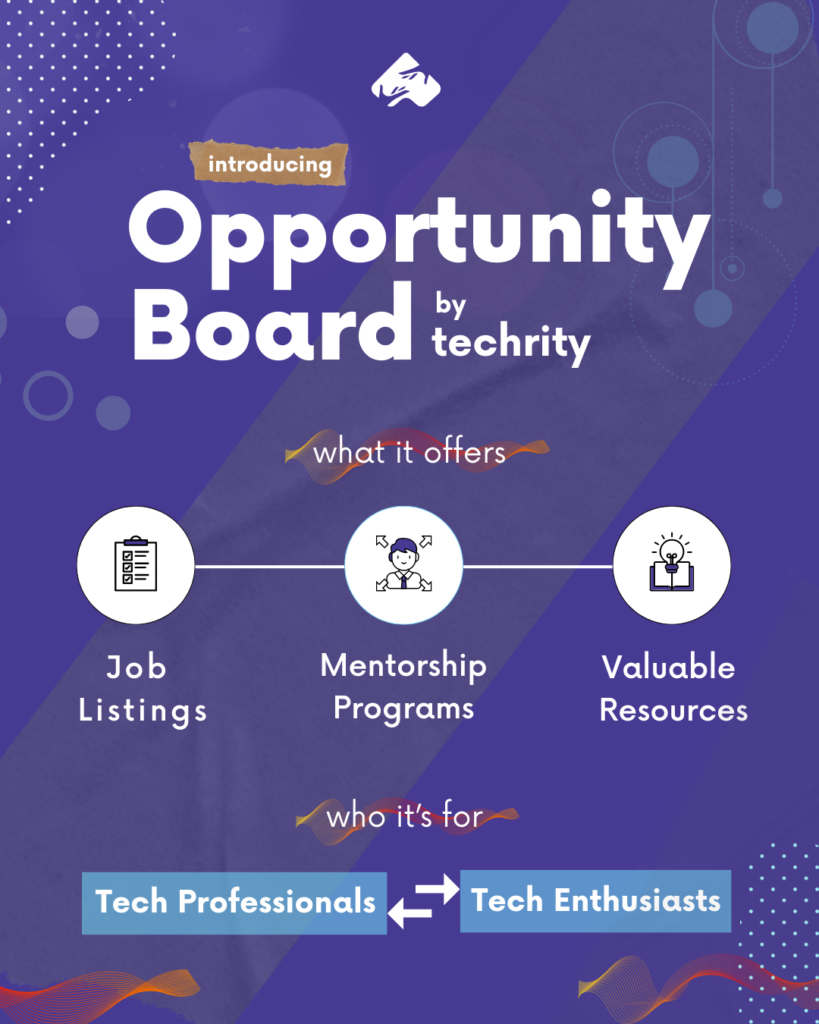
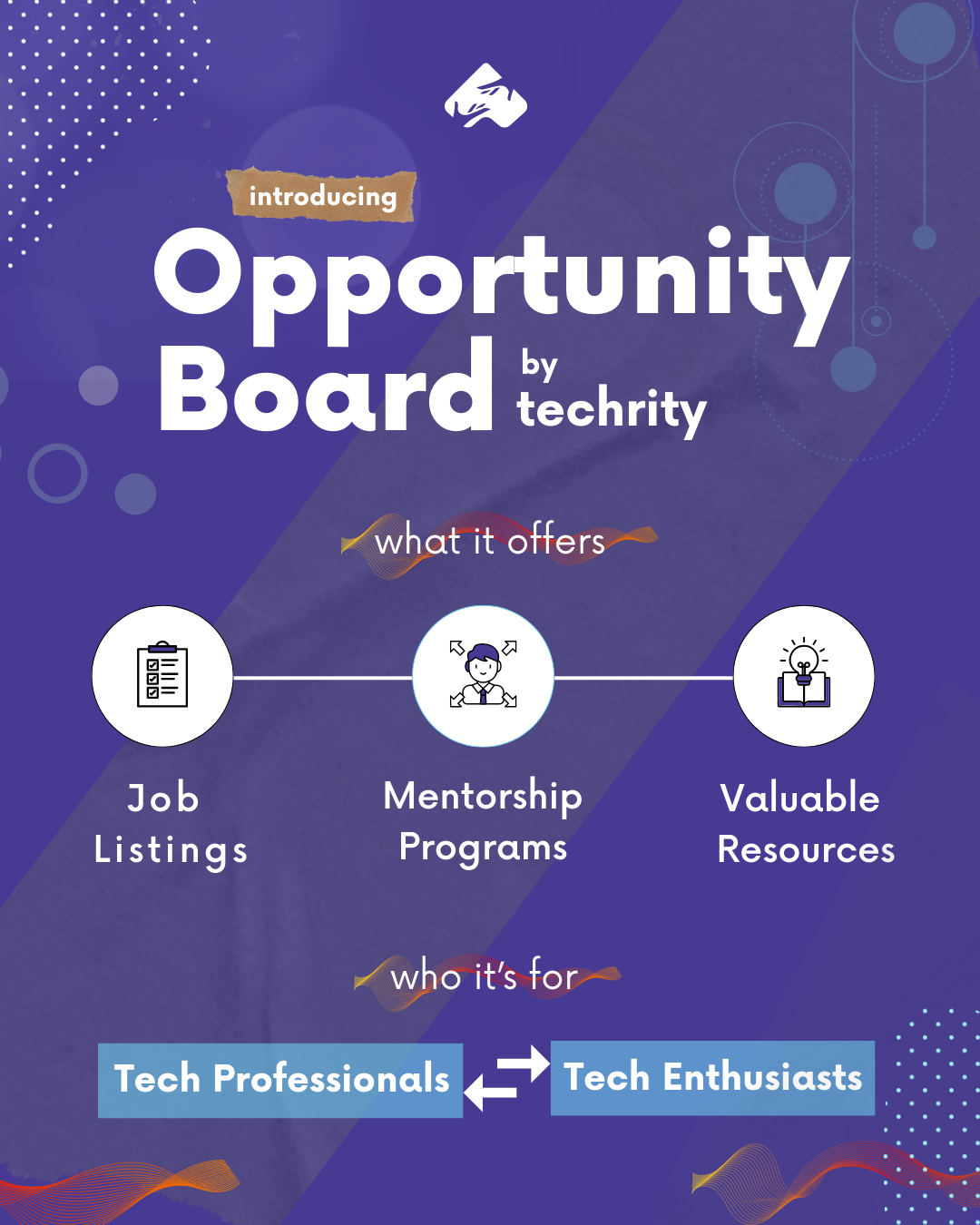
Techrity is stepping up to provide a bold and innovative solution; the Opportunity Board is a platform designed to connect aspiring African professionals with the resources and openings they need to amplify their hard work and talent.

The Opportunity Board will be more than just a job board; it is a home for techies like you and the next generation of professionals to gain access to everything they need to get a job, learn a new tech skill, get data support to enter the tech space, master a tech skill, and digital tools to aid their work.

Connecting Talents with Opportunities

At its core, the Opportunity Board is a vital link between African talent and the global marketplace. It curates a diverse range of opportunities, including:

Job Openings

The board features listings from companies across various tech sectors actively seeking African talent, from entry-level positions to senior management roles.

Internships

Recognizing the importance of practical experience, the platform highlights internship programs that allow students and recent graduates to gain valuable on-the-job training.

Mentorship and Training Programs

To address skills gaps, Techrity partners with leading technical professionals, educational institutions and tech companies to offer guided mentorship training programs, workshops, and certifications that equip individuals with in-demand skills.

Laptop and Data Support

Financial and connectivity constraints can often hinder further learning and training for tech enthusiasts in Africa. The Opportunities Board provides information on how to apply for unlimited access to laptops, grants, and data support from several organizations specifically targeted at African professionals.

Volunteer Opportunities

Get real-world experiences to master your skills with many listings and volunteer opportunities from credible tech companies. These opportunities allow individuals to give back to their communities and make a meaningful impact in the tech space.

Who is This Platform For?

  • Techies looking to compete globally from Africa
  • Motivated and enthusiastic tech talents that do not have access to data to continue learning and mastering a tech skill
  • African tech companies looking to hire the best tech talents in Africa
  • African tech talents looking to practice their skills in a reputable startup through an internship
  • African tech professionals looking for digital work tool support to enable them compete equally.

Empowering You for The Future You Deserve

Beyond simply listing opportunities, Techrity aims to empower individuals with all they need to make informed career decisions. The opportunity board also offers resources such as:

Career Guides

Providing insights into different tech roles, required skills, and career paths.

Salary Benchmarks

Helping individuals understand their market value and negotiate fair compensation.

Company Reviews

Offering insights into company culture and employee experiences

Conclusion

Techrity’s Opportunity Board is transforming tech hiring in Africa by addressing the core challenges faced by job seekers, tech enthusiasts and employers. The platform creates a more efficient and inclusive job market by connecting talents to unseen opportunities and facilitating global job access.

Whether you’re a tech professional seeking your next opportunity, need data support, workplace tools for productivity, or an employer looking for top-tier talent, Techrity’s Opportunity Board is the ideal solution.

It’s a platform to watch and that holds immense promise for unlocking the continent’s vast potential.

Categories
Uncategorized

Mindfulness Meditation for Tech Professionals: A Guide to Regaining Focus and Power

Introduction

Software developers, programmers, designers, writers or testing professionals often face what we call mental blocks. These high levels of stress lead to decreased productivity and burnout as a result of constant switching between solving complex problems, tight deadlines, and juggling multiple tasks.

Mindfulness meditation can significantly improve mental well-being and productivity.

Mindfulness means paying attention to the present moment while acknowledging and accepting one’s thoughts and feelings without judgment. For developers, this practice can enhance focus during coding sessions, reduce stress during debugging, and improve overall problem-solving capabilities.

It helps you focus on your breath, bodily sensations, or surroundings while calmly acknowledging distractions and bringing attention back to the present. Mindfulness meditation is a powerful tool for software developers and tech professionals to maintain mental clarity and emotional balance.

What is Mindfulness?

Mindfulness means paying attention to the present moment while acknowledging and accepting one’s thoughts and feelings without judgment. For developers, this practice can enhance focus during coding sessions, reduce stress during debugging, and improve overall problem-solving capabilities. It helps you focus on your breath, bodily sensations, or surroundings while calmly acknowledging distractions and bringing attention back to the present.

Mindfulness meditation is a powerful tool for software developers and tech professionals to maintain mental clarity and emotional balance.

Why You Need to Meditate

According to several research reports, ample evidence validates the high impact of regular meditation practice on an individual. Meditation can increase gray matter in areas responsible for memory and learning, reduce mind-wandering activity, enhance error detection and bug-finding capabilities, and ultimately Improve focus during long coding or meeting sessions.

Proven Benefits of Meditation

Better Focus and Concentration

Meditation helps train the brain to maintain attention, reducing distractions and improving deep work sessions.

Reduced Stress and Anxiety

Regular mindfulness practice lowers cortisol levels, helping developers manage stress better.

Improves Problem-Solving Skills

A calm and clear mind allows for better logic and decision-making in coding and troubleshooting.

Increased Creativity

Decluttering the mind, meditation fosters creative thinking and innovation.

Better Work-Life Balance

Mindfulness helps maintain a healthy separation between work and personal life.

Improved Collaboration

Being mindful enhances empathy and communication, making teamwork more effective.

These benefits directly translate to reduced stress, better code quality, increased productivity, and improved mental well-being.

Practical Mindfulness Exercises to Practice

To effectively integrate mindfulness into coding routines, developers can adopt several practical exercises:

Mindful Coding Sprints

Set a timer for 25 minutes to utilize the Pomodoro Technique. Before starting, take three deep breaths and set an intention for the session. After coding intensely for 25 minutes, take a 5-minute break to stretch or practice a quick mindfulness exercise.

Mindful Code Reviews

Approach code reviews with curiosity rather than judgment. Center yourself before starting the review process and focus on one line or block of code at a time.Breath Awareness: Before beginning work each day, spend a few minutes focusing solely on your breath. This simple practice helps clear mental clutter and prepares you for.

Code Block Meditation (5-10 minutes)

This practice helps maintain focus during intensive coding sessions:

What to do:

  • Sit comfortably at your desk
  • Take three deep breaths
  • Open your code editor
  • Focus on a single block of code
  • Read each line slowly, observing without making changes
  • Notice thoughts about “improving” or “fixing” the code
  • Let these thoughts pass without acting on them
  • Return focus to simply observing the code

This practice helps develop the ability to observe code objectively before making changes, leading to better architectural decisions.

Debug Breath (1-2 minutes)

Use this technique when feeling frustrated during debugging:

What to do:

  • Stop typing
  • Place your hands on your desk
  • Take five slow breaths, on each inhale, acknowledge the bug’s complexity, on each exhale, release the urge to solve it immediately
  • Return to debugging with renewed patience

Recommended Resources to Help You Practice Meditation

Books

Here are 11 go-to books to help you practice meditation and mindfulness:

  1. “Wherever You Go, There You Are” by Jon Kabat-Zinn

A practical guide to mindfulness, this book teaches you how to be fully present in your daily life. Through simple meditation practices, it helps you slow down, reduce stress, and find peace in the moment.

2. “Digital Minimalism” by Cal Newport

This book explores the impact of digital overload and offers strategies to reclaim focus and happiness. Newport encourages intentional tech use, helping you disconnect from distractions and live more meaningfully.

3. “The Miracle of Mindfulness” by Thich Nhat Hanh

A timeless classic on mindfulness, this book introduces meditation as a way to bring peace into everyday tasks. Whether washing dishes or walking, Hanh teaches how to be present in everything you do.

4. “The Little Book of Mindfulness” by Dr. Patrizia Collard

This quick read offers simple, 10-minute mindfulness exercises to reduce stress and boost well-being. It’s perfect for anyone looking to start a mindfulness practice without feeling overwhelmed.

5. “Planting Seeds” by Thich Nhat Hanh

Designed for families and educators, this book teaches mindfulness to children through fun activities. It helps kids (and adults) develop kindness, focus, and emotional resilience.

6. “Meditation for Busy People” by Rajneesh Osho

Osho offers a practical approach to meditation for modern, hectic lives. It offers easy techniques that fit into daily routines, helping you find calm without needing hours of stillness.

7. “The Science of Being and Art of Living” by Maharishi Mahesh Yogi

A deep dive into Transcendental Meditation, this book explains how meditation can unlock human potential, reduce stress, and create a happier, more fulfilling life.

8. “Awakening the Mindless Life and How to Live in the Present Age” by Dr. Sanjeev Goel

This book blends mindfulness with modern science. It shows how to live in the present moment despite life’s distractions and offers practical tools to reduce stress and boost well-being.

9. “The Things You Can See Only When You Slow Down” by Haemin Sunim

A beautifully written guide on slowing down and appreciating life. Through short reflections, Sunim shares wisdom on love, work, and mindfulness in a fast-paced world.

10. “The Mindfulness Solution” by Ronald D. Siegel

A science-backed guide to using mindfulness for mental health and well-being. It provides practical exercises to manage stress, anxiety, and daily challenges.

11. “Ikigai” by Hector Garcia & Francesc Miralles

This book uncovers the Japanese secret to a long and happy life: finding your purpose (Ikigai). It blends philosophy, science, and real-life examples to help you live passionately and meaningfully.

Applications

Conclusion

Mindfulness serves as an invaluable tool to regain control of your mind and calmness; the way we work and live is being challenged every day as the need to maintain work life balance continues to grow at a rapid pace; your ability to embrace these practices will not only support your performance as a developer or tech professional but also contributes to healthier ways of life, relationships with people, and positive moods to tap into productivity.

Categories
Uncategorized

Building an Attractive Personal Brand Online as a Tech Person in 2025

Image Credit: Freepik.com

In today’s competitive job market, having a strong personal brand is essential for standing out, gaining credibility, and attracting new opportunities. This is especially true for tech professionals, where innovation, skill-sets, and the ability to solve real-world problems can be game-changers. Establishing a compelling personal brand can catapult your career to new heights, whether you’re a software developer, data analyst, product manager, or cybersecurity expert.

In this article, we will be looking at the details of building an attractive personal brand online. We will provide detailed strategies, case studies, and actionable steps to help you position yourself as a go-to expert in your field.

1. Understanding Personal Branding in 2025

What is Personal Branding?

Personal branding encompasses how you present your professional identity, both in the offline and online world. For tech professionals, this means highlighting your technical skills, problem-solving abilities, and personal values. It also involves showcasing your personality, work ethic, and vision. A well-established personal brand helps you connect with your target audience, employers, clients, or peers.

Why is Personal Branding Important?

i. Career Growth

In 2025, recruiters and hiring managers often review your online presence before considering your resume. A strong personal brand increases your chances of being found and recognized for opportunities that match your skill set. For instance, tech professionals who have made a name for themselves by consistently sharing knowledge and showing off their skills on platforms like LinkedIn or GitHub have potentials of attracting job opportunities.

ii. Networking

In tech, networking isn’t just about attending events and building relationships online. A powerful personal brand allows you to network effortlessly with like-minded people in your field.

Networking and meeting other professionals in your field exposes you to various opportunities.

iii. Influence and Authority

Tech professionals who consistently share valuable insights and content are perceived as thought leaders. Your expertise in a niche area can be recognized, allowing you to become an authority in your field. This is a significant advantage when it comes to personal branding.

iv. Opportunities

Having a personal brand can open doors to high-profile speaking engagements, collaborations with industry leaders, and opportunities for brand partnerships. Furthermore, a solid brand helps with business development, attracting potential clients or employers looking for your expertise.

Monetization

A personal brand also provides an avenue for monetizing your knowledge. Whether through content creation on YouTube, selling an online course, or consulting, your brand is the foundation for these income-generating opportunities.

2. Defining Your Unique Value Proposition (UVP)

What is a UVP?

Your Unique Value Proposition (UVP) is essentially the thing that makes you stand out from the crowd. Having a clear UVP helps you communicate your strengths effectively in a world filled with tech professionals. It’s what will help you attract the right audience—whether employers, clients, or peers.

How to Define Your UVP

i. Identify What Sets You Apart

Think about the skills, experiences, and values that distinguish you from others. Are you a developer who specializes in AI-driven applications? Are you a cybersecurity expert passionate about ethical hacking? Your UVP needs to highlight this uniqueness. Write down the things that make you different from others in your field. This could be technical skills, personal passions, or a unique problem-solving perspective.

ii. Focus on Solving Problems

A powerful UVP solves a problem. Ask yourself: “What problems do I help others solve with my skills?” Maybe you help startups optimize their data infrastructure or offer affordable, high-quality web development services for small businesses.

Example: A data analyst focusing on turning raw data into actionable insights for small businesses could define their UVP as “Helping small businesses make data-driven decisions with affordable, user-friendly solutions.”

iii. Your Mission

Your mission also drives your UVP. What is your greater purpose in the tech space? Are you focused on accessibility in tech? On solving a particular societal issue through technology? Your mission becomes your UVP’s foundation and should resonate with your target audience.

Actionable Tip: Write a mission statement that reflects your purpose in tech and tie it to your UVP. This mission statement can evolve but helps you maintain focus as your brand grows.

3. Optimizing Your Online Presence

Image Credit: Freepik.com

A. Crafting a Professional LinkedIn Profile

LinkedIn remains the one of the most powerful tool for professional networking in the tech world. To build a compelling personal brand, your LinkedIn profile must reflect your UVP and engage visitors immediately.

i. Profile Photo

Your profile photo is the first thing people see, so make it count. A high-quality, professional head-shot creates an impression of competence and seriousness. Avoid using casual pictures or selfies.

ii. Headline

Your LinkedIn headline is critical. Rather than just stating your job title, make it compelling by explaining what you do and how you create value.

Example: “Data Scientist | Empowering businesses with AI-driven solutions” or “Cybersecurity Specialist | Protecting organizations from evolving cyber threats.”

iii. Summary

The summary section is your opportunity to tell your story. Explain who you are, what you do, and why you do it. Use storytelling to make it engaging; this section is often the first one potential employers or clients read.

Example: “I’m a passionate data scientist who thrives on solving complex problems with innovative AI solutions. With over 5 years of experience working with Fortune 500 companies, I help businesses turn data into actionable insights that drive growth.”

iv. Experience and Skills

Your experience and skills should directly reflect your UVP. Showcase your most relevant work experience, achievements, and the projects that best demonstrate your capabilities.

Tip: Don’t just list your roles—talk about specific accomplishments. For example, if your SEO strategy increased website traffic by 30%, make sure that’s mentioned!

v. Engagement

Engage with others’ posts by commenting on trends, sharing your thoughts, or providing value through your posts. This boosts visibility and reinforces your expertise.

B. Creating a Personal Website or Portfolio

Image Credit:Freepik.com

A personal website or portfolio is essential for showcasing your work. It’s more than just a digital resume; it’s a space to display your achievements, thought leadership, and unique perspective.

i. About Page

The About page should introduce you to your visitors. Who are you, what do you do, and why are you passionate about it? This is where your personal story matters—let it shine!

ii. Blog Section

A blog section is a powerful way to share your thoughts and experiences. You can write about current trends, new technologies, or personal lessons you’ve learned in your career. Regularly posting to your blog boosts SEO, keeps your audience engaged, and positions you as an authority in your field.

iii. Portfolio Page

Your portfolio should showcase your best work, including case studies, code samples, or product designs. It’s essential to demonstrate your abilities rather than just talking about them.

iv. Contact Page

Make it easy for people to contact you for opportunities, collaborations, or advice. A contact form, email address, or even links to your social media profiles are essential.

C. Optimizing Your Twitter/X and Other Social Media

While LinkedIn is professional, Twitter (now X) allows you to engage with a broader tech community. Many tech thought leaders and industry experts have built their brands mainly on Twitter.

D. Share Valuable Content

Share your thoughts, experiences, and insights into the tech industry on Twitter. It is an excellent platform to discuss emerging trends, tools, and topics that excite you.

E. Engage with Industry Leaders

By commenting on and retweeting the content of industry leaders, you can catch the attention of others in your space. Engaging with key influencers can open doors to collaborative opportunities.

F. Use Relevant Hashtags

Hashtags like #AI, #DataScience, #DevOps, and #TechTips allow your content to reach a broader audience interested in your niche.

4. Content Creation: The Key to Thought Leadership

Image Credit: Freepik.com

Creating and sharing valuable content positions you as a thought leader and establishes your authority, allowing you to connect deeply with your audience.

A. Blogging

Writing blog posts on platforms like Medium and Dev.to, or your website can help showcase your knowledge and establish authority in your field. Topics can range from tutorials to industry insights.

B. Video Content

YouTube is an excellent platform for tutorials, sharing how you were able to solve various problems with your code, and product demos. You can also create shorter videos for platforms like TikTok or Instagram.

C. Open Source Contributions and GitHub Projects

Contributing to open-source projects on GitHub shows practical proof of your skills. It also helps you build connections with other developers and demonstrates your commitment to the community.

D. Podcasts and Webinars

Starting a podcast or hosting a webinar allows you to share knowledge, interact with other thought leaders, and engage with a broader audience.

E. Writing an E-book or Online Course

Creating an e-book or online course can significantly amplify your brand. Platforms like Udemy and Teachable provide the tools to monetize your knowledge while further establishing your authority in your field.

6. Networking and Community Engagement

Networking is a crucial component of building your brand. It’s not just about meeting new people; it’s about cultivating meaningful relationships with individuals with similar professional interests. Networking helps you to stay informed, receive support, and create collaborative opportunities.

Image Credit: Freepik.com

7. Personal Branding Strategies for Tech Professionals

A. Continuous Learning and Skill Development

A strong personal brand requires constant improvement. Technology evolves quickly, and staying up-to-date with the latest trends and acquiring new skills is essential.

i. Upskilling and Certifications

As technology rapidly evolves, staying relevant means learning new skills. Platforms like Coursera, Udemy, and edX offer certifications in various tech fields, including AI, machine learning, cloud computing, and cybersecurity. Obtaining certifications helps improve your knowledge and adds to your credibility.

ii. Attending Events

In addition to formal courses, attending events like Tech for Good and Hack for Good, is another great way to stay ahead of the curve. These events often provide insights into the latest technologies, tools, and frameworks shaping the tech industry.

B. Creating a Strong Online Presence with Consistency

Having an online presence is crucial, but consistency is key. Regularly posting valuable content on platforms like LinkedIn, Twitter, or personal blogs is essential for reinforcing your brand.

i. Consistency in Content Creation

Whether you post about industry news, share tutorials, or write blogs, your content should align with your expertise. Consistent posting increases your visibility and demonstrates your commitment to your niche.

ii. Branding Your Online Presence

All your online profiles—whether on LinkedIn, Twitter, or personal websites—should be cohesive and reflect your UVP. This includes your professional profile photos, bios, and content themes.

C. Leveraging Analytics and Feedback

Understanding how your audience engages with your content allows you to refine your personal branding strategy.

i. Monitor Engagement Metrics

Using analytics tools like Google Analytics for your website, or LinkedIn and Twitter insights for social platforms, helps you track how your content is performing. Are people engaging with your posts? Are they commenting or sharing?

ii. Gathering Feedback

Don’t be afraid to ask your network for feedback. This could be through surveys, informal conversations, or feedback on your blog posts. Feedback helps you understand how your brand is perceived and where you can improve.

8. Measuring and Adjusting Your Personal Brand

A. Setting Personal Branding Goals

Like any professional endeavor, personal branding requires goals. Without clear goals, it’s easy to become lost in the noise.

Short-Term Goals

Short-term goals could include tasks like optimizing your LinkedIn profile, writing a blog post, or getting more involved in online communities. Set clear deadlines for these tasks to ensure steady progress.

Long-Term Goals

Long-term goals might involve becoming a recognized thought leader in a specific area of tech, publishing a book, or landing speaking engagements at top tech conferences.

Tip: Write down your goals and revisit them regularly to track your progress. It will help keep you motivated and focused.

Conclusion: The Power of Personal Branding

Personal branding is no longer optional; it’s a necessity, especially in the ever-evolving world of technology. By understanding your unique value proposition, optimizing your online presence, creating valuable content, networking, and constantly improving your skills, you can build a powerful personal brand that will open doors to new opportunities, collaborations, and career growth.

The key is consistency, authenticity, and dedication. Personal branding is a continuous process, and as long as you remain engaged with your community, stay committed to learning, and build meaningful relationships, your brand will continue to grow and thrive.

Categories
Hackathon Social Tech For Good

Bridging the Gap in Hiring: The Journey of AssessMe.AI at Hack for Good 2024

Introduction
Hello! I’m Aaditya Srivastava, a Computer Science student specializing in Artificial Intelligence. This year, I had the incredible opportunity to participate in Hack for Good 2024, an esteemed challenge hosted by Techrity. During the event, I introduced AssessMe.AI—a platform aimed at revolutionizing the recruitment and assessment process using AI-driven automation.

The Problem
The hiring process today is fraught with challenges. Companies struggle to attract suitable candidates, ensure fairness, and make data-driven decisions efficiently. These gaps can lead to prolonged hiring cycles, missed opportunities, and even harm to an organization’s reputation.

The Solution: Introducing AssessMe.AI
AssessMe.AI is a comprehensive solution designed to tackle these recruitment challenges. It integrates AI-driven tools to automate, enhance, and simplify hiring workflows for both recruiters and candidates.

Key Features:

  1. Personalized Assessments
    • For Candidates:
      • Curate interview questions tailored to their preparation needs.
      • Conduct AI-powered virtual interviews.
      • Receive detailed feedback and analytics across six key interview parameters.
    • For Recruiters:
      • Host personalized interview assessments.
      • Use virtual AI interviews for unbiased evaluations.
      • Rank candidates based on actionable insights and performance data.
  2. AI Feedback and Analytics
    Candidates gain valuable insights into their strengths and areas for improvement, while recruiters receive a ranked list of candidates to streamline decision-making.
  3. Intuitive User Interface
    The platform ensures a seamless user experience for both recruiters and job seekers through its modern, responsive design.

How It Works

  • Candidate Preparation: Candidates can curate self-interview questions, customize their sessions, and receive feedback based on detailed analytics.
  • Recruiter Assessment: Recruiters can host tailored AI-driven assessments, with results and rankings automatically generated for efficient evaluation.

Technologies Powering AssessMe.AI
To create a robust, user-friendly platform, AssessMe.AI leverages:

  • Next.js & React.js: For fast server-side rendering and responsive UI.
  • TypeScript: Ensuring error-free, maintainable code.
  • TailwindCSS & Shadcn UI: Delivering a sleek, modern design with rapid development capabilities.
  • OpenAI Whisper API: Enabling advanced speech-to-text for accurate transcriptions and analysis.
  • React Flow: For visualizing recruitment workflows with clarity and precision.

Hackathon Experience
Participating in Hack for Good 2024 was both challenging and rewarding. It pushed me to explore new dimensions of problem-solving, including:

  • Enhancing AI prompts to generate precise, JSON-formatted answers.
  • Reducing latency in audio outputs for smoother user interactions.
  • Testing and debugging incrementally proved critical for optimizing algorithms.

Through this experience, I learned that refining code step-by-step significantly improves efficiency. Each hurdle helped me grow as a developer, sharpening my technical and analytical skills.

AssessMe.ai Demo presentation at Hack for Good 2024

AssessMe.ai Demo presentation at Hack for Good 2024

Impact and Future Prospects
AssessMe.AI has the potential to transform the recruitment landscape by:

  • Reducing time-to-hire by up to 50%.
  • Ensuring fairness and improving hiring quality through data-backed decision-making.

Looking ahead, I aim to scale AssessMe.AI globally, tailoring it to meet the unique needs of diverse industries and businesses worldwide.

Conclusion
I am immensely thankful to Techrity for organizing Hack for Good 2024. This platform not only gave me the chance to showcase AssessMe.AI but also offered a space for growth, innovation, and collaboration.

The journey doesn’t end here. I remain committed to enhancing AssessMe.AI—a platform that bridges the gap between candidates and recruiters, making hiring faster, fairer, and more effective.

Thank you for following my story, and I look forward to what the future holds!

Categories
Tech Tech For Good

 Emerging Trends in Technology

The trends in technology are vast. We have since grown from the invention of ICs, Transistors, and Microprocessors to the Internet in the 1990s. Most especially the late 1950s and early 1960s marked a pivotal era as Integrated Circuits, commonly known as ICs invented by Jack Kilby and Robert Noyce were used to power the digital revolution.

Some Notable Trends In Technology

Health-tech

The Healthcare Industry has experienced a massive improvement in patient healthcare services due to recent trends in technology.

Technologies like brain-computer interfaces (BCIs) are being developed to help individuals with disabilities control prosthetics or communicate through thought alone. Companies like Neuralink are at the forefront of this innovation, aiming to treat neurological conditions and potentially enhance cognitive capabilities.

Biotechnology leverages biological systems to develop products and solutions for healthcare, agriculture, and more. CRISPR gene editing, for instance, allows for precise modifications to DNA, offering potential cures for genetic disorders. Editas Medicine and CRISPR Therapeutics are pioneering this field, promising revolutionary treatments.

Quantum Computing Technologies

Quantum computers use the principles of quantum mechanics to perform calculations at unprecedented speeds. These computers can solve complex problems in cryptography, material science, and pharmaceuticals. Companies like IBM and Google are making significant strides, with IBM’s Quantum Experience and Google’s Sycamore processor leading the charge.

Artificial Intelligence (AI)

Artificial Intelligence (AI) is transforming industries by automating tasks, providing insights through data analysis, and enabling new levels of personalization. OpenAI’s GPT-4 and Google’s DeepMind are examples of AI systems pushing the boundaries of what machines can do.

AI-powered virtual assistants like Amazon’s Alexa, Apple’s Siri, and Google Assistant are becoming increasingly sophisticated. They help users with tasks ranging from setting reminders to controlling smart home devices, providing a more intuitive and interactive user experience.

Knowledge graphs organize information in a way that machines can understand, enabling better data analysis and AI applications. Companies like Google use them to improve search results and enterprises to enhance data management.

Smart Spaces

Digital twins are virtual replicas of physical objects or systems that support real-time monitoring and simulation. They are used in various industries, including manufacturing, healthcare, and urban planning, to optimize performance and predict maintenance needs. Siemens and General Electric are leaders in developing digital twin technologies.

Smart spaces integrate digital and physical environments to create interconnected, intelligent systems. These include smart homes, cities, and workplaces that enhance convenience, safety, and efficiency. Companies like Cisco and Microsoft are developing solutions to integrate IoT devices and AI to create smart spaces.

Autonomous Vehicles

Self-driving cars, flying cars, and drones represent significant advancements in transportation and logistics. They promise to reduce accidents, improve traffic management, and increase delivery efficiency. Tesla’s Autopilot and Waymo’s self-driving cars are leading examples of autonomous vehicle technology.

Computer Vision

Recent developments in computer vision enable machines to interpret and make decisions based on visual data. Applications include facial recognition, autonomous navigation, and quality inspection in manufacturing. Companies like NVIDIA and Intel are advancing computer vision capabilities and integrating them into various products and services.

Blockchain and Decentralized Identity

Blockchain technology provides a secure, decentralized ledger for recording transactions. It is the foundation of cryptocurrencies like Bitcoin and Ethereum, and it also has applications in supply chain management, finance, and digital identity. Companies like IBM and ConsenSys are exploring diverse use cases for blockchain technology.

The Decentralized Identity approach allows individuals to control their personal information without relying on central authorities. Blockchain technology underpins decentralized identity solutions, providing enhanced privacy and security. Projects like Microsoft’s Decentralized Identity and Sovrin Network are pioneering this field.

Renewable Tech and Sustainable Tech

Technologies focused on harnessing renewable energy sources like solar, wind, and hydropower are crucial for a sustainable future. Companies like Tesla (with its solar products) and Vestas (wind turbines) are at the forefront of renewable tech.

Sustainable Tech involves developing technologies that minimize environmental impact and promote sustainability. Innovations in this area include biodegradable materials, energy-efficient systems, and circular economy solutions. Companies like Patagonia and Beyond Meat are examples of businesses integrating sustainable tech.

Green Technology focuses on reducing environmental impact through innovation. This includes everything from electric vehicles to green building materials. Tesla’s electric cars and LEED-certified buildings are prominent examples of green technology.

No Code Development

No-code platforms enable users to create applications without needing to write code. This democratizes software development, allowing more people to build solutions. Platforms like Bubble and Webflow are making no-code development accessible and powerful.

Internet of Behaviour (IoB)

Internet of Behaviour (IoB) combines data from various sources to influence behavior. It uses data analytics and behavioral science to understand and guide user actions. Applications include personalized marketing, healthcare interventions, and workplace productivity tools.

Benefits of Emerging Technologies to the Tech World

Innovation and Efficiency

Emerging technologies drive innovation, leading to the creation of new products and services. They enhance efficiency in various processes, reducing costs and time.

Problem-Solving

They offer solutions to complex problems, from healthcare to climate change, improving the quality of life and sustainability.

Economic Growth

By fostering new industries and job creation, emerging technologies contribute to economic growth and competitiveness.

Accessibility and Connectivity

Technologies like 5G and blockchain improve connectivity and accessibility, enabling more people to participate in the digital economy.

Challenges Posed by Emerging Technologies to the Tech World

Security and Privacy

As technology advances, so do the risks of cyberattacks and data breaches. Protecting sensitive information becomes increasingly complex.

Ethical Concerns

Issues such as AI bias, surveillance, and the impact on employment raise significant ethical questions.

Regulation and Compliance

Keeping up with rapid technological advancements poses challenges for regulatory bodies to ensure safety and compliance without stifling innovation.

Environmental Impact

The production, use, and disposal of new technologies can endanger the environment if not managed sustainably.

Remember, as these technologies evolve, staying informed and adaptable will be crucial for leveraging their full potential and addressing the critical challenges they pose.

Categories
Best practices Coaches General Hackathon

Tips For Winning A Hackathon Challenge

Hackathons are tools that drive creativity and innovation by tackling challenges to provide solutions. In a hackathon competition,  individuals with similar interests collaborate to deliver a solution to an existing or predicted problem. The hackathon organizers, sponsors, or partners usually outline the challenges and the judges decide the winners after the presented solutions, provided criteria and guidelines are met. It is an opportunity for creatives and innovative minds to leverage communication, teamwork, and presentation skills to solve problems and challenges quickly.

HOW HACKATHONS WORK

Hackathons are carried out online, onsite, or hybrid depending on the sponsor. When COVID-19 brought the world to a standstill in 2020 and different country-specific restrictions and measures were put in place, most hackathons were organized virtually. But in recent times, there has been a gradual return to fully onsite hackathons. 

The various technologies, tools, and challenges that participants can use and work on are announced 1–2 days before the hackathon begins. Partners and sponsors introduce the challenges to all participants including important information regarding the competition even if you don’t understand the challenge to work before coming, the explanations will dig deeper into them for you, so listen carefully.

Eventaully, each hackathon submission is judged by a metric to determine the winning team or solution. The success metric is measured differently depending on the organizers, judges, or themes. Common metrics used include quality of prototypes, minimum viable product(MVP) development, website functionality, improvement in engagement scores, reduction in implementation time, and Participation metrics.

TYPES OF HACKATHONS

Hackathons come in many forms and depend on the objective, goal, or sponsors. They all fall into one of the types listed below:

Niche/Theme Based: Niche or theme-based hackathons are specially crafted by single or multiple sponsors to provide solutions to challenges by using a specified or company-created tool and resource such as API. Common theme-based hackathons include Finance, Healthcare, Diversity, and Open Source. For instance,  Digital Healthcare is a hackathon focused on driving solutions to the healthcare sector. The required outcome could be to create a web application, video game, or anything significant.

Custom Hackathons: A hackathon is custom if it addresses solutions to problems by leveraging a language, framework, or profile. For instance, a hackathon that uses a programming language such as Java, Python, or Ruby on Rails to solve a problem. In this type of hackathon, how you use the programming language is preferred above what you can build. For profile-based hackathons, this involve student-only or female-only hackathons that accept only people in those categories as participants to work on challenges or topics to claim a reward.

MISTAKES YOU SHOULD NEVER MAKE DURING A HACKATHON

To succeed in a hackathon there are mistakes you should avoid. These mistakes are not bound to first-timers or amateurs alone but also applicable to experienced hackathon participants and previous winners of one or more hackathons.

  • Avoid changing teammates along the way or quickly selecting teammates based on their appearances, stickers on laptops, or gadgets. Doing this may jeopardize your team’s strength and efficiency since the competition is constrained by time.
  • Avoid using tools that you and your teammates are not familiar with. Hackathons are good places to learn new tools but do not try to build using a new tool without understanding the basics of that tool, it might not end well.
  • Avoid trying to build a solution that is too complex to be done within the stipulated time. You’d be requiring too much from your teammates.
  • Avoid allotting unreasonable time frames for the accomplishment of major product milestones.
  • Avoid working alone. Seek support from teammates, mentors, or sponsors when you have to.
  • Avoid imposing your opinions and thoughts on your teammates without considering other alternatives from their perspective.
  • Avoid prioritizing aesthetics over functionality.
  • The hackathon rules are very important and must be adhered to if you don’t want your team to be disqualified. Familiarize yourself with the hackathon’s rules and fundamental problem statements.
  • Do not repeat an already existing solution by modifying some features to wow the judges.

HOW TO WIN AN HACKATHON

Here are 10 tips for first timers, and experienced hackathon participants to ace any hackathon competition with ease

  • Have a complete team: Diverse your team skills and abilities to include developers, UI/UX designers, product/project managers, marketers, and those with social skills.
  • Teamwork is the key: Teamwork is important for winning a hackathon. Listen to the opinions of your teammates, appreciate their contributions and ideas, and be open generally to a variety of ways to achieve the same goal.
  • Apply empathy: Be kind enough to understand your teammates, and discover their strengths and weaknesses to coordinate your team, delegate properly and motivate each other.
  • Build only key components within the given time: Focus on building the key features the solution needs and distribute the most important features to your teammates, ensuring each team member knows what is to be built individually.
  • Focus on the hackathon 100%: Hackathons are filled with distractions demanding your attention. You must stay fixed on the solution you are building.
  • Appreciate the uniqueness of your solution: If you have a novel solution that you can pull off with the hackathon time frame then go for it and pay less attention to what other teams are building. Some might just be reinventing the wheel when there is no need.
  • Prepare your presentation: Invest ample time to work on your presentation, including your demo, and make it as simple and interactive as possible. Your presentation is the second most important part of the hackathon, after your solution. Highlight the problem statement, key features, and why you made the product, how it works, and how it solves the problems of the end users”. 
  • Document all the ideas: Write down the ideas, concepts, and complaints of each team member during the brainstorming session and use the Prioritization Matrix to pick between what is important and needed, important and not needed for the product.
  • Gather some information: Gather basic knowledge of your sponsors, judges, and audience to help you customize your presentation and demo to fit their needs. Use social media sites like LinkedIn, X, and Pinterest or strike up conversations at the hackathon during lunch or Q&A sessions.

WHERE TO FIND HACKATHON RESOURCES

If you have been having a hard time searching for hackathons, here are some resources for you to explore.

  • DevPost: DevPost is an epicenter for hackathons. It is stocked up with different types and categories of hackathons by level, length, theme, location, and status. You will also find guides, tricks, and tips for organizers and participants in hackathons.
  • NaijaHacks:  NaijaHacks is a go-to spot for all things on hackathons. It offers guides on team formation, mentors, prizes, and workshops. It also has tutorials broken down into sectors including Blockchain, VR/AR, Machine Learning,  Mobile/Web Development, Hardware, Miscellaneous, and an introduction to Git for beginners.
  • DoraHacks: This is the hub for Web3 hackathons, it features ongoing and upcoming hackathons to browse and participate in. Individuals and communities can also use their platform to host hackathons
  • Hackathons International: Hackathons International is a global organization that provides problem-solving strategies, toolkits, and resources for participants and organizers to host/successfully participate in hackathons globally.
  • GitHub: GitHub is a repository of hackathon projects and resources including tutorials, templates, code from past hackathons, and tools to help you practice your skills, and provide key tips to winning projects.  It is a good source of inspiration and insight into successful hackathon approaches. Typing “hackathon projects” into the search box on GitHub will return a curated list of hackathon resources.
  • Stack Overflow: If you are encountering a coding roadblock, this is your centre for solution. Stack Overflow is an online Q&A forum for experienced and beginner developers. It contains several solutions to common problems. Whatever you are struggle with, someone else has faced it before and shared a solution on the platform.  
  • API Docs: Application Programming Interface description documents include, tutorials, references, and examples that show and explain to developers what is possible with your API and how to use it. This depends on the hackathon theme or your project idea, you can leverage APIs from various platforms. Ensure to always refer to the official documentation for specific instructions and usage examples to be sure. You can check out Spotify documentation Spotify Web Documentation.

WHY YOU SHOULD PARTICIPATE IN A HACKATHON

Immediate Recruitment: Many participants in hackathons got jobs only by participating. Companies organize most hackathons to provide solutions to an existing problem or desire to launch a new product to target a market. The solution you build can come in handy, which can ultimately lead to you being recruited to continue the development of the solution.

Find out more: Due to the practical nature of hackathons, it provides a unique opportunity for beginners, intermediate, and experts to gain more experience and insights into a particular tool, application, or technology. For example, a participant may have theoretical knowledge of a programming language but may have yet to have the chance to apply it in a real-world project. By participating in a hackathon focused on that language, they can learn new techniques, best practices, and shortcuts from their peers.

Opportunity to Network: Hackathons attract a diverse group of participants, including students, professionals, entrepreneurs, and industry experts. Through team collaboration, workshops, and networking sessions, participants can forge valuable connections with people who share similar interests or work in related fields.

Build Technical and Problem-Solving Skills: Hackathons present participants with time-sensitive challenges that require innovative solutions. These challenges often span across a wide range of domains, from software development and data analysis to hardware prototyping and social impact projects. By tackling these challenges, participants can enhance their ability to think creatively, break down complex problems into manageable tasks, and adapt to unexpected obstacles.

Grow Your Social Skills: Hackathons foster a collaborative environment where participants must effectively communicate and work together to achieve their goals. Team members may come from different backgrounds, disciplines, or even countries, requiring them to bridge cultural and language barriers. Through brainstorming sessions, code reviews, and project presentations, participants can improve their verbal and written communication skills, as well as their ability to give and receive constructive feedback.

Launch a Career: Hackathons are real-world opportunities to meet your first and long-term mentors, business partners, and angel investors.  A hackathon is an opportunity to build a solution to a challenge that enables you to spot a market that is open to exploit creating a new career role for you.

Strengthen your Resume: Hackathon participation is highly regarded by employers as it demonstrates a candidate’s practical skills, creativity, and passion for learning. Including hackathon projects on a resume can showcase a candidate’s ability to work under pressure, collaborate with others, and deliver results within a limited timeframe. Moreover, winning a hackathon competition can further validate a candidate’s abilities and differentiate them from other job applicants.

Categories
Best practices General How-Tos

Open-source Contribution Guidelines

One of the easiest ways to convince recruiters to hire you is by showcasing a rich portfolio containing, at least, one open-source contribution project. For entry and junior developers (and maybe senior developers), this is not open for debate as the benefits of contributing to open-source projects are immense. Not only does contributing to open-source projects broaden your experience and skills, but it also provides an orifice of exposure to industry-standard tools and practices.

So, how do you get started?

FIND A PROJECT

The first step is to find an open-source project that interests you. You can start by exploring platforms like GitHub, GitLab, or Bitbucket. These platforms host millions of open-source projects of technologies and domains. Look for projects with a clear and active community, as this will make it easier to get started and receive support.

To find the right project, consider browsing trending repositories or searching for projects based on your interests. Many platforms offer tags or categories that can help you narrow down your search.

For example, if you’re interested in web development, you might search for projects tagged with “JavaScript” or “React.” If you’re into data science, look for projects involving “Python” or “Machine Learning”.

EVALUATE THE PROJECT

Before diving in, take some time to evaluate whether you want to contribute to the project. Consider factors such as:

Project Goals: Ensure the project’s goals align with your interests and objectives. Understanding the project’s mission and vision can help you stay motivated and make meaningful contributions.

Technology Stack: Check whether you’re familiar with the programming languages and tools used in the project. Contributing to a project using a stack you’re comfortable with can help you contribute more effectively and learn faster.

Community: Assess whether the community is active and welcoming to new contributors. An active community often means better support and more opportunities for collaboration. Look at the project’s issue tracker, pull request activity, and community forums or chat groups to gauge this.

READ DOCUMENTATION

Familiarize yourself with the project’s documentation. Most projects have detailed documentation that explains how the software works, how to set it up locally, and how to contribute to it. Reading the documentation will give you a good overview of the project’s architecture, coding standards, and contribution process.

Good documentation typically includes a README file with an introduction to the project, installation instructions, and a contribution guide. Some projects also have a Code of Conduct, which outlines the expected behavior of contributors. Pay attention to these documents as they provide essential information for new contributors.

FIND AN ISSUE TO WORK ON

After reading the documentation, it’s time to find an issue to work on. Most open-source projects use issue trackers to keep track of bugs, feature requests, and other tasks. Look for issues labeled as “good first issue” or “beginner-friendly” as these are usually suitable for newcomers. You can also filter issues based on your skill level, the type of task, or the programming language you’re comfortable with.

When selecting an issue, start with something small and manageable. This will help you get acquainted with the project’s workflow and build confidence. As you gain more experience, you can gradually take on more complex issues.

GATHER MORE INFORMATION

Once you’ve found an issue you’d like to work on, it’s essential to gather more information. Here are some steps you can take:

Read Comments and Discussions: Many issues have comments and discussions that provide additional context or clarify the problem. Reading through these can help you understand the issue better and avoid redundant efforts.

Ask Questions: If you have any doubts or need more information, don’t hesitate to ask questions in the project’s chat or forum. The project maintainers and other contributors will be happy to help you get started and provide guidance along the way.

Review Related Code: Sometimes, looking at related code or previous pull requests can provide insights into how similar issues were resolved. This can help you understand the coding standards and practices followed by the project.

WORK ON YOUR SOLUTION

With all the necessary information at hand, it’s time to start working on your solution. Here’s what you should do:

Fork the Repository: Fork the project’s repository to your own GitHub account. This creates a copy of the project where you can make changes without affecting the main codebase.

Create a New Branch: Create a new branch for your changes. It’s good practice to name your branch descriptively, such as “fix-issue-123” or “add-feature-x.”

Follow Coding Standards: Adhere to the project’s coding standards and conventions. This ensures that your code is consistent with the rest of the codebase and makes it easier for maintainers to review your changes.

Write Clear and Focused Code: Keep your changes focused and well-documented. Write clear commit messages that explain the purpose of each change. This helps maintainers understand your work and makes it easier to track changes.

SUBMIT YOUR SOLUTION

Once you’ve completed your solution, it’s time to submit it for review:

Create a Pull Request (PR): Create a pull request on the project’s repository. This notifies the maintainers that you’ve made changes and would like them to be reviewed and merged into the main codebase.

Describe Your Changes: In your pull request description, explain the problem you’re solving and the solution you’re proposing. Reference the issue you’re addressing and provide any relevant context or information.

Respond to Feedback: The project maintainers and other contributors will review your code, provide feedback, and help you make any necessary changes. Be open to feedback and willing to make revisions to improve your contribution.

Once your PR has been approved, your changes will be merged into the main codebase, and you’ll have made your first open-source contribution. Celebrate this milestone and take pride in your achievement.

ADDITIONAL TIPS

Be Patient and Open to Feedback: Open source projects often have many contributors and maintainers with different opinions and approaches. Be patient when waiting for feedback and open to constructive criticism.

Respect the Community: Adhere to the project’s Code of Conduct and respect the community guidelines. Maintaining a positive and respectful attitude fosters a welcoming environment for all contributors.

Keep Learning: Continuously improve your skills by learning from other contributors and exploring new technologies. The more you learn, the more valuable your contributions will become.

Ask for Help: Don’t be afraid to ask for help or clarification when needed. The open-source community is generally supportive and eager to assist newcomers.

Document Your Journey: Keep track of your contributions and document your learning process. This can be valuable for your personal growth and can also help you showcase your experience to potential employers.

Network with Other Contributors: Engaging with other contributors can lead to valuable connections and collaborations. Attend meetups, join community chats, and participate in discussions to expand your network.

Stay Updated: Open source projects are constantly evolving. Stay updated with the latest changes by following the project’s repository, joining mailing lists, or subscribing to newsletters. This ensures you are aware of new issues, features, and updates.

Contribute Beyond Code: Contributions to open-source projects are not limited to code. You can help by writing documentation, designing graphics, managing community events, or even translating content. These contributions are equally valuable and help the project thrive.

CONCLUSION

Contributing to open source projects is a rewarding experience that allows you to learn new skills, connect with other developers, and give back to the community. By following these simple steps, you can make your first contribution with confidence and start making a positive impact on the world of open source software.

Remember that every contribution, no matter how small, adds value to the project and the community. Whether you’re fixing a typo in the documentation, resolving a bug, or adding a new feature, your efforts are appreciated.

Categories
General

Choosing A Career Path In Tech

With countless opportunities awaiting exploration, it’s essential to equip yourself with the knowledge and insights needed to chart a course toward a rewarding tech career. Whether you’re a seasoned professional seeking a new challenge or a newcomer eager to make your mark, this comprehensive guide will illuminate the path to success in the dynamic world of technology.

Discovering Your Tech Passion

Before diving in, ask yourself:

  1. Do I prefer hands-on technical work, creative design, or strategic thinking?
  2. Do I thrive in collaborative teams or enjoy independent work?
  3.  Am I drawn to specific industries like healthcare, finance, or gaming?
  4. What excites me about technology?

By answering these questions, you can align your career trajectory with your personal aspirations.

Career Pathways Available In Technology

  1. Software Development – If you love building websites, databases, and collaborating with a team, you should consider software development. Software development is in two phases: the frontend development and backend development. With an experience in software development you rank up to become one of the most in-demand skilled professionals in the world.
  2. Data Science and Analytics – Do you love numbers, arithmetic, or solving general problems? The field of data analytics offers boundless opportunities for those with a knack for numbers and a passion for problem-solving.
  3. Cybersecurity – With cyberattacks on the rise, organisations are seeking skilled experts to fortify their defences and protect sensitive data from malicious actors. You can decide to be a cybersecurity professional to safeguard the digital realm against cyber threats and vulnerabilities as a cybersecurity professional.
  4. Artificial Intelligence and Machine Learning – If you fascinated about how algorithms work and evolve with data inputs, you should consider Artificial Intelligence and Machine Learning.
  5. Cloud Computing – If you’re an architect, engineer, or strategist, there’s ample room for growth in this burgeoning field. In cloud computing, you can build scalable infrastructure and on-demand services power the digital economy.
  6. UI/UX Design – Are you very creative? You can craft seamless user experiences and captivating interfaces as a UI/UX designer. From wireframes to prototypes, your creativity and attention to detail will shape the digital experiences of tomorrow.

After Choosing A Path, What’s Next?

No matter which tech path you choose, building a robust toolkit of skills and experiences is essential for success. Consider:

  1. Pursuing internships, co-op placements, or freelance projects to gain hands-on experience.
  2. Contributing to open-source projects to showcase your skills and collaborate with like-minded individuals.
  3. Seeking out mentorship and networking opportunities to glean insights and advice from seasoned professionals.

By continually honing your skills and expanding your network, you’ll be well-equipped to thrive in the competitive landscape of tech.

List Item List Item
Categories
Career advice Tech

Benefits of Working Remotely.

techrity_kickstart_image
techrity kickstart

The outbreak of the Coronavirus pandemic in 2020 necessitated a change in work structures around the world. This development led to a shift in organizational attention, to the immense potential of a system that could accommodate millions of people working independently from different locations to achieve organizational goals.

Remote Work – Brief History 

Remote workers did not just appear from anywhere. The practice of working from any location other than an office is as old as man and the internet.

History shows that the practice of working in offices and factories originated just after world war 1 – the industrial revolution, long after man had revolutionized the systems of trade and business.

Despite the increase in office culture over the years, remote jobs and the practice of remote work have remained relevant, co-existing side-by-side with office practice for the completion of unfinished tasks after work hours.

Remote working has always been an integral part of our work culture even though it hadn’t been given widespread acceptance as we now have it. From the usage of staff-only servers where information is passed from superior to subordinate; to online staff meetings and social media conferencing, in one way or another, we all have done remotely what ought to be done within the confines of an office.

This article discusses the advantages of working from home, as well as how working from home, can enhance global living standards. It goes on to explain how a “work from home” policy might help an organisation’s output.

Why Remote Work?

Working from home has the following advantages:

  • Improved Employee Productivity
  • Reduction in Operational Cost
  • Improved Market Penetration
  • High Staff Retention Ratio
  • Better Work-Life Balance

Improved Employee Productivity

An analysis of efficiency on remote work was carried out in March 2021 by Jose Maria Barrero of the autonomous Institute of Technology, Mexico, and Steven .J. Davis of Chicago booth. The statistical results showed that, as of March 2021, a year after the coronavirus pandemic, 60% of America’s working population worked remotely and were said to be more productive working from home.

Employees who work from home are generally more productive than those who add an office to their workspace. This is so because the freedom to establish their work hours allows employees to work when they are most productive, rather than the usual 9 to 5 hours.

Remote work eliminates the stress that comes with having to pick the right outfit for work, and most importantly, commuting. With an almost weightless gadget like a P.C (personal computer) and an internet connection, loads of work can quickly be done – a clear definition of Productivity.

“Remote work allows individuals to figure when they’re most relaxed and within the most efficient state of mind, leading to increased productivity”.

Reduced Operational Costs

Operational costs are the expenses that a company incurs in order to stay in business. Organisations invest a lot of money every year to keep their offices in good shape – from repairs to replacements to upgrades, keeping an office is pricey for what it is worth.

Working from home helps to keep these expenses to a bare minimum. Remote working focuses on worker output and work flexibility rather than amassing operational expenditures. Because these people work remotely and report online, it allows a firm to choose a more flexible headquarters that doesn’t have to be as large to suit a large number of employees.

Working from home saves money on rent and reduces the need for multiple branch offices across the country. It reduces business overhead costs like electricity tariffs and office building insurance. As a result, working remotely reduces unneeded costs from an organisation’s total revenue, increasing the amount of profit available at the end of the fiscal year.

Remote work focuses on worker production and job flexibility rather than operational expenditures“.

Improved Market Penetration

Simply said, market penetration refers to the level to which a company’s product offering is valued, purchased, and consumed by the local population.

Remember that working remotely allows a company to save money on operations. A lower operational cost corresponds to a lower manufacturing cost. With lower production costs, businesses can concentrate on producing high-quality goods and selling them at lower prices, making the product more appealing to the general public (Ceteris paribus and vis-à-vis, the lower the price, the higher the demand).

Working remotely also assists with market penetration through unconscious online marketing activities. Employees are sometimes unaware of the process, hence the term “unconscious.”

The frequent use of the internet to search, send, and receive data causes the internet to save certain keywords related to a company’s product offering, so that whenever a random user performs a search query using any of the keywords, the product offering is listed as one of the possible results, keeping the product in front of potential customers at all times. This is unintentional and so extremely cheap.

“With a lowered cost of production, businesses may specialise in producing quality items and selling for lower prices, making the merchandise more appealing within the broader market”.

Higher Employee Retention

Rapid employee turnover rate in an organisation reflects managerial incompetence and bad working conditions. Employees are more likely to stay with a company if they believe the company is committed to their personal development.

Working from home reduces the likelihood of employee turnover in the first two years of employment. This is because employees who work remotely have greater control of their time, feel more trusted and valued, enjoy their remuneration which does not have to get spent on commuting to long-distance offices, can share the workload through different time zones in the day, place more value on teammates and receive all the incentives they deserve at the right time- an effect of increased profit.

Remote workers are 13 per cent more likely than on-site workers to stay in their current jobs for the next five years or longer.

“Employees who work from home have more control over their time, feel more trusted and revered, and luxuriate in their salary because they’re not required to commute to long-distance workplaces”.

Better Work-Life Balance

One quotation that makes employees want to quit their jobs and start their own firm, which seems like achieving their ambitions, is “A pay-check is the bribe you get for choosing not to pursue your dreams.”

Working remotely allows you to make a paycheck while working for a business and pursuing your passions at the same time, dear employee. Working from home allows you to spend more time with your family while still being able to attend work on a daily basis.

With remote employment, a father no longer has to miss his son’s basketball game due to a long work day, and a mother no longer has to miss her daughter’s eighteenth birthday due to an important business trip. Remote work engenders profitability and happiness, a clear win-win situation.

“Working remotely, dear employee, allows you to earn a paycheck while working for an organisation and pursuing your dream at an equivalent time.

Remote Work and The Nigerian Transport Dilemma 

Nigerians who don’t own cars understand that jumping from shuttle to shuttle while trying to make your way to work every morning is enough reason to have a bad day.

Chances are that, when you finally make it to the office after surviving the many dramas that come with public transportation, you are already demotivated and not as productive as you ought to be.

Like this wasn’t enough, there is now the trouble of a galloping cost of transportation. It is funny how the cost of public transportation is almost equivalent to half your paycheck at the end of the month.

But these can be averted simply by changing work structures that enable employees conveniently sit in their primary location, yet deliver as much work as they’d normally do in the office – Remote Working

Conclusion

The benefits of working remotely far outweigh its disadvantages. The prevalence of the internet and breakthroughs in communication technology have added to the advantages of remote work.

Every business in the 21st century is beginning to not only go digital but work remotely. Remote work is no longer a pipe dream; it is now a reality that we must accept.

Subscribe to our newsletter to discover more about remote working and how it’s altering the narrative in corporate structures.

We’d also want to hear from you in the comments.